Flood Damage Restoration in Dallas: What the Process Actually Looks Like
TLDR
- What is flood damage restoration?: The full return of a flooded property to pre-loss condition — water extraction, structural drying with moisture monitoring, sanitization/remediation, and reconstruction.
- How long does it take?: Extraction in hours, drying in 3–5 days for clean water, and full restoration in 2–6 weeks depending on water category and affected materials.
- How much does it cost in Dallas?: Dallas restoration jobs run $2,500–$7,500 for typical events; the Texas average burst-pipe claim is about $15,500 (State Farm) — flood rebuilds can run higher.
- Is flood damage different from storm damage?: Yes — floodwater is Category 3 contaminated water requiring removal of porous materials and full sanitization; storm runoff from a roof leak may be Category 1 or 2.
- Does homeowners insurance cover flood damage?: Not through a standard policy — flood needs a separate NFIP or private flood policy; inland "flash flooding" riders vary.
- Who handles it in Dallas 24/7?: Water Damage Restoration Dallas: +1 214-807-4697 — emergency extraction, drying, and rebuild across the metro.
Flood damage restoration is not one job — it is four jobs in sequence: get the water out, dry the structure to verifiable moisture standards, remediate contamination, and rebuild what was removed. Dallas homeowners confuse this with the "first response" phase because the first response is the visible part, but the first response is only phase one. A flood job done right ends with documented moisture readings, sanitized surfaces, and the house rebuilt to pre-loss condition — not with a wet basement and a dehumidifier humming alone in the dark. This guide walks the full restoration process as a Dallas homeowner experiences it, with the timelines, the cost bands, and the insurance traps. However, every flood is its own project — water category, materials, and how fast the call went out change every phase below.
📞 Flooded in Dallas? Emergency Help: +1 214-807-4697
What Are the Phases of Flood Damage Restoration?
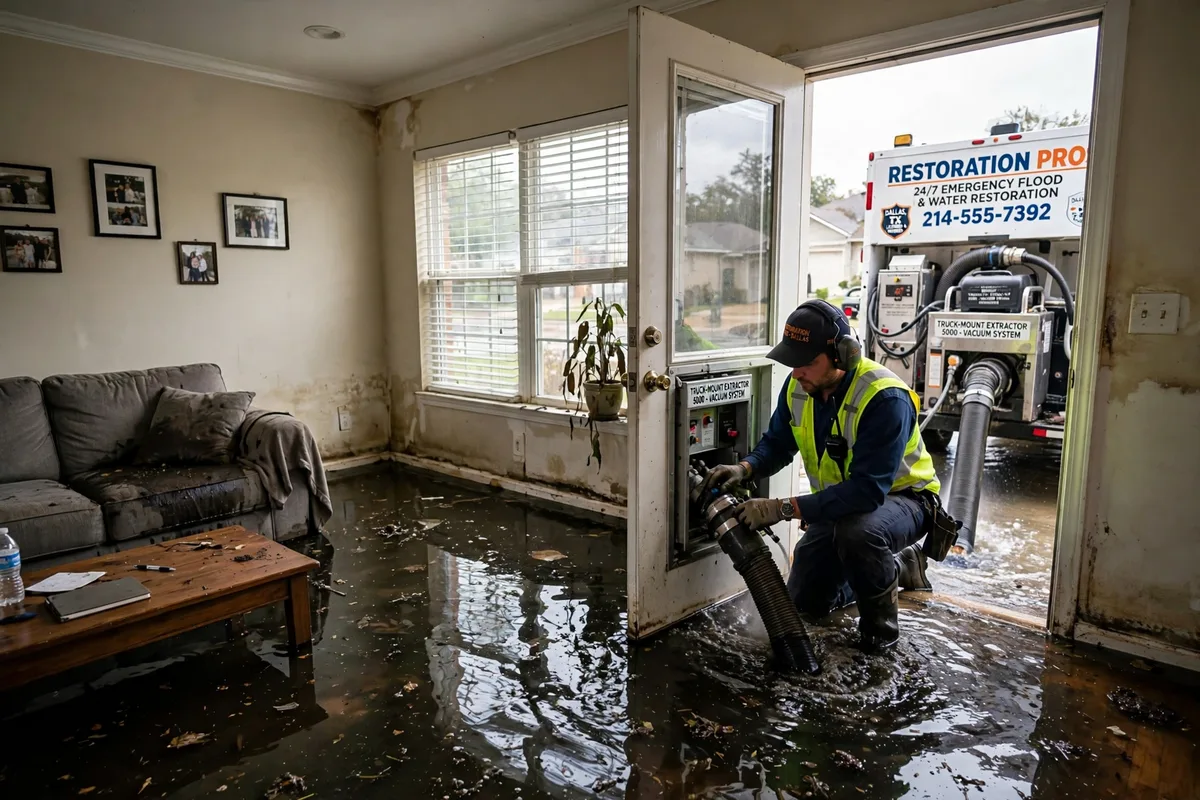
Phase one is emergency extraction — high-volume pumps and truck-mounted vacuums removing standing water, typically within hours of the call. The goal is speed: every hour of standing water multiplies wicking into drywall, subfloor, and framing, and mold begins colonizing in 24–48 hours. Phase two is structural drying: industrial air movers and commercial dehumidifiers placed to create controlled airflow, with technicians taking moisture readings from walls, floors, and cavities daily until they reach documented dry standards. Phase three is remediation: contaminated water means contaminated materials — drywall below the flood line, insulation, and carpeting are removed (the "flood cut"), and remaining surfaces are cleaned and sanitized with HEPA filtration running. Phase four is reconstruction: replacing drywall, flooring, baseboards, and cabinets, finishing, and paint — the return to pre-loss condition. Our first-response flood guide covers what to do before the crew arrives. However, phases overlap more than they sequence — drying equipment runs while demolition happens, and sanitization repeats as new materials are exposed, so treat them as tracks, not steps.
The timeline compresses or stretches with three variables. Water category is the biggest: clean Category 1 water (a supply-line flood) can often be dried in 3–5 days with most materials saved; Category 3 floodwater requires demolition of everything porous below the waterline, adding days of remediation and weeks of rebuild. Material porosity is the second: tile over concrete dries fast, while carpet, pad, drywall, and MDF trim do not survive flood contact and must be removed. The third variable is response time: a crew extracting at hour two works a fundamentally different job than a crew arriving at hour thirty — the first is drying a structure, the second is remediating one. The storm cleanup guide covers the overlapping post-storm scenario. However, do not let a fast extraction fool you into a short drying cycle — pulling the standing water is the easy part, and removing equipment before moisture readings hit dry standards is how secondary damage starts.
How Is Floodwater Different From Storm Damage or a Pipe Burst?
| Water source | Category | What survives | Drying time |
|---|---|---|---|
| Burst supply pipe | Category 1 | Most materials | 3–5 days |
| Storm runoff, roof leak | Category 1–2 | Some materials | 4–7 days |
| Floodwater, rising water | Category 3 | Tile, concrete, metal | 5–10 days + rebuild |
| Sewage backup | Category 3 | Tile, concrete only | 5–10 days + rebuild |
The water category system (IICRC S500) is the industry's contamination ladder, and floodwater sits at the top: Category 3, "black water," carrying soil, sewage, chemicals, and everything the water touched on its way in. That classification is why flood restoration involves more demolition than drying — porous materials that contact Category 3 water cannot be reliably sanitized and must be removed. A burst pipe is the opposite end: clean, potable supply water that a good crew can usually dry in place, saving drywall, cabinets, and flooring with professional equipment. Storm damage sits in the middle and is the most variable — wind-driven rain through a damaged roof can be nearly clean, while ground-level storm runoff behaves like floodwater. The sewage cleanup guide covers the other Category 3 scenario Dallas homes face. However, categories describe the water at the source, not after time — clean water left standing degrades: it warms, stagnates, and can pick up contaminants, so a Category 1 flood left for days is treated more aggressively than the same water extracted in hours.
The practical difference for the homeowner is what gets removed versus what gets dried. In a flood job, expect the flood cut: drywall removed 12–24 inches above the visible waterline (wicking travels higher than it looks), all insulation in affected walls discarded, carpet and pad removed, and MDF trim and lower cabinets removed. Tile, concrete, structural lumber, and metal are cleaned and dried in place. In a clean-water job, much of this survives — drywall can often be dried with injection systems, carpet can sometimes be saved if extraction is fast. This is also the difference that shows up in the invoice: Dallas restoration jobs run $2,500–$7,500, and flood jobs with demolition and rebuild sit at the higher end of that range and beyond, while the Texas average burst-pipe claim is about $15,500 (State Farm). However, the demolition decision is not negotiable on contaminated materials — a contractor who promises to "dry your flood-soaked drywall in place" is promising future mold, and no savings justify it.
📞 24/7 Flood Extraction in Dallas: +1 214-807-4697
What Does Flood Damage Restoration Cost in Dallas?
The Dallas band for a typical restoration job is $2,500–$7,500, covering extraction, drying, and light remediation for a contained event. Flood jobs run higher because demolition and rebuild are labor- and material-intensive: a single-room flood cut and rebuild typically lands in the mid five figures, and multi-room floods with flooring replacement can reach the $15,500 Texas burst-pipe-claim average (State Farm) and beyond. Mold adds its own band — Dallas mold remediation runs $1,200–$3,800 — and any flood left over 48 hours becomes a flood-plus-mold job, stacking the two bands. Insurance changes the math entirely if the right policy is in force, but a standard homeowners policy excludes flood: flood coverage means a separate NFIP policy or private flood insurance, and the average flood claim nationally runs far higher than the homeowner expects. However, cost estimates from the restoration company are not the rebuild quotes — the extraction/drying invoice and the reconstruction invoice are usually separate scopes, and the total project cost is both, so always ask which one a quote covers.
Documentation is what turns a restoration invoice into a paid insurance claim. Photograph everything before the crew touches it — waterlines, damaged contents, serial plates on appliances — and keep a room-by-room inventory with approximate values. The restoration company should provide moisture logs (daily readings proving the structure reached dry standards), an itemized scope of removed materials, and before/after photos; these are the documents the adjuster needs. Save every receipt from emergency spending — hotel, meals, pump rentals — because additional living expenses are often covered under a separate provision. Our flood damage repair services page details the phases we perform and document. However, do not wait for the adjuster to begin emergency work — standard policies and NFIP both require the homeowner to mitigate further damage, and a documented emergency extraction never hurts a claim while a documented delay can.
Important Considerations
The flood-insurance reality is the single most misunderstood piece of flood restoration in Dallas. Standard homeowners policies exclude rising-water flooding — the "flood exclusion" is one of the oldest exclusions in the book — and most Dallas homeowners outside mapped floodplains carry no flood policy at all. NFIP policies have a 30-day waiting period, so buying coverage when the storm is on radar does not work. After a flood without coverage, the restoration cost is out of pocket, and the only recovery path is an SBA disaster loan if a federal disaster is declared. The claim-denied guide covers the sudden-vs-gradual fight that decides most water claims. However, "not in a floodplain" is not "no flood risk" — Dallas flash flooding hits far outside mapped zones, and the homes that flood on a dry creek bed are often the ones with no flood policy.
The rebuild phase is where flood jobs stall, and the stall is usually about sequencing and materials, not money. After demolition and drying, the rebuild competes with normal contractor demand — post-flood periods see every contractor in the metro booked, and material lead times stretch. Living arrangements during rebuild matter: families often stay in the home during a single-room rebuild but need alternate housing for multi-room jobs, and the disruption timeline should be negotiated with the contractor up front. Keep the restoration company's moisture documentation forever — it is the proof that the drying was done to standard, and it protects against future mold disputes and future insurance questions. However, do not rush the rebuild to "get back to normal" — cabinets and flooring installed over walls that have not reached dry standards trap moisture inside the cavity, and that trapped moisture becomes the mold colony that costs $1,200–$3,800 to remediate six months later.
Frequently Asked Questions
What is the difference between water damage restoration and flood damage restoration?
Water damage restoration is the general term for returning any water-damaged property to pre-loss condition; flood damage restoration is the specialized subset for rising-water floods. The difference is contamination: floodwater is Category 3 black water, so flood restoration includes demolition of porous materials, full sanitization, and HEPA air filtration — phases a clean-water burst-pipe job often skips. Flood jobs also involve flood-specific insurance (NFIP or private) rather than standard homeowners coverage. The rebuild phase is typically larger in flood jobs because more material is removed. However, the extraction and drying science is the same — the same air movers, dehumidifiers, and moisture meters apply regardless of the water source.
How long does flood damage restoration take from start to finish?
Extraction takes hours, structural drying takes 5–10 days for a flood job, and the full restoration including rebuild typically runs 2–6 weeks. Clean-water events are faster: extraction in hours, drying in 3–5 days, total project often under two weeks. The long poles are drying verification — equipment stays until moisture readings hit documented dry standards — and rebuild scheduling, since post-flood periods see contractors booked solid. Contaminated jobs add demolition and remediation time before drying even begins. However, the fastest way to shorten the timeline is the fastest call — every day of standing water adds days of drying and demolition, so the clock starts when the water stops, not when the crew arrives.
Can drywall be dried after a flood, or does it have to be removed?
After a Category 3 flood, drywall below the flood line must be removed — it cannot be reliably sanitized once contaminated. The industry practice is the flood cut: remove drywall 12–24 inches above the visible waterline, because wicking carries contamination higher than the stain shows. Insulation behind that drywall is removed and discarded too. Drywall above the cut line that stayed dry can stay. In clean-water events (a burst supply line), drywall can often be dried in place with injection systems if the response is fast. However, the line between "dried" and "must go" is the water category, not the appearance — flood-soaked drywall that looks intact is still contaminated and still has to come out.
Will my homeowners insurance cover flood damage restoration?
Not through a standard homeowners policy — rising-water flooding is excluded, and flood coverage requires a separate NFIP policy or private flood insurance. Inland flash flooding from creeks and poor drainage counts as flood, not as a covered water event. If you carry a flood policy, it covers the building and contents per its terms, and the restoration company's documentation supports the claim. Without a flood policy, the restoration cost is out of pocket unless a federal disaster declaration unlocks SBA disaster loans. The claim-denied guide documents how Texas adjusters draw coverage lines. However, check your policy for "water backup" or "sump discharge" endorsements — those cover a different failure (drains backing up) and are not flood insurance, but they are worth having.
What is a flood cut and why does the crew cut my drywall?
A flood cut is the removal of contaminated drywall (and insulation) from the floor up to 12–24 inches above the visible waterline. The cut is higher than the waterline because wicking draws contaminated water upward through drywall and insulation beyond where the stain stops. Removing the material lets the crew clean and sanitize the wall cavity, dry the framing, and verify moisture readings on the studs — none of which is possible with contaminated drywall in place. It also prevents the hidden mold colony that grows behind intact-looking drywall. However, the cut height is a minimum, not a rule — if moisture readings show contamination higher, the cut goes higher, and a crew that cuts exactly at the stain line is cutting for looks.
Is mold guaranteed after a flood?
Mold is not guaranteed, but the odds are terrible without professional drying: mold colonizes in 24–48 hours on wet organic materials, and a flood soaks everything. Floodwater also deposits organic sediment that feeds mold long after the water is gone. A professional flood job prevents the colony — fast extraction, controlled drying to documented standards, HEPA filtration, and sanitization — which is why the restoration phases exist. A DIY mop-up with a rental dehumidifier is the scenario where mold becomes the second claim: Dallas mold remediation runs $1,200–$3,800, and that stacks on top of the flood work. However, a fast, professional response genuinely prevents mold in most flood jobs — the colony is the price of delay, not the price of flooding.
Can I stay in the house during flood damage restoration?
Usually for part of it, but not always for all of it. During extraction and drying of a single room, families typically stay — the equipment is loud but the rest of the house is habitable. During demolition of multiple rooms, with flood cuts, HEPA scrubbers, and dust, many families relocate temporarily. The deciding factors are the water category (Category 3 contamination makes portions of the home genuinely uninhabitable during remediation), the electrical status, and whether HVAC is running. The stay-or-leave guide covers the decision in detail. However, check your insurance — additional living expenses coverage often pays for the hotel or rental during a covered event, and the restoration company can document the displacement for the adjuster.
Do you handle the rebuild, or just the water cleanup?
Water Damage Restoration Dallas handles the full sequence — extraction, structural drying, remediation, and reconstruction — as one managed project. That matters because the handoffs are where flood jobs fail: the drying contractor who leaves before readings are verified, the builder who rebuilds over damp framing. Our crews document moisture readings, remove contaminated materials, sanitize, and then rebuild what was removed — drywall, flooring, baseboards, cabinets, paint. Serving Dallas 24/7 with typical 60-minute emergency arrival. Call +1 214-807-4697 for the full project or any single phase. However, be clear about scope in the estimate — some companies stop at drying, and you need to know whether the quote in front of you includes reconstruction or just the mitigation.
What documentation do I need for a flood damage claim?
Before the crew arrives: photos and video of everything — waterlines on walls, damaged contents, appliance serial plates, the exterior conditions that caused it. During the job: the restoration company's moisture logs (daily readings proving dry standards were met), the itemized scope of removed materials, and before/after photos. After: all invoices, every receipt for emergency spending (hotel, meals, equipment), and a room-by-room contents inventory with approximate values. For NFIP claims, the adjuster needs proof of loss within 60 days — the documentation habit starts at hour one. However, do not let documentation delay emergency work — photograph first, then let the crew work, because policies require you to mitigate further damage and a documented delay is worse than an undocumented fast response.
How do I know the drying is actually done?
By moisture readings, not by touch or by time. Professional crews take daily readings with pin and pinless meters from walls, floors, and cavities, comparing them to dry standards established from unaffected materials in the same structure. The equipment stays until the readings hit those standards — not until the surface feels dry, not until three days have passed. The final moisture log is your proof: it documents that every affected area reached dry standard, and it is the document that protects against future mold disputes. However, a crew that removes equipment on a schedule rather than on readings has not finished the job — surface-dry is not structure-dry, and trapped cavity moisture is the mold colony of six months from now.
Is Water Damage Restoration Dallas available for flood emergencies?
Yes — 24/7 emergency response across Dallas with typical arrival around 60 minutes, including nights, weekends, and holidays. Flood calls get priority dispatch: extraction equipment rolls first, and the full restoration scope — drying, remediation, rebuild — is scoped on the first visit. We are IICRC-certified for water damage restoration and serve Downtown, Uptown, Lakewood, Frisco, Plano, and the wider metro from 315 North St. Paul Street, Dallas, TX 75201. Free estimates on the restoration scope. Call +1 214-807-4697 — floods do not wait for business hours, and neither do we. However, if water is still rising or streets are impassable, call 911 for the safety emergency first and the restoration company second — we cannot extract what is still flooding in.
What should I not do after a flood before the crew arrives?
Do not walk through standing water without boots — it is Category 3 contaminated water. Do not turn on the HVAC, which spreads contaminated air through the ductwork. Do not run a household vacuum or plug equipment into wet outlets — the electrical safety guide covers the shock and fire risks. Do not throw away damaged items before photographing them — the documentation is your claim. And do not delay the call to "see if it dries on its own" — it will not, and mold starts in 24–48 hours. The first-response flood guide has the full safe-actions checklist. However, do photograph everything and shut off power to affected areas at the breaker if it is safe to reach — those two actions cost nothing and protect everything.
📞 Free Flood Restoration Estimate: +1 214-807-4697
📞 Call Water Damage Restoration Dallas Now: +1 214-807-4697
Related Dallas Water Damage Guides
- What to Do When Your House Floods in Dallas, TX: The Right Steps in the Right Order
- Standing Water in Your House: When DIY Cleanup Is Enough — and When to Call a Pro
- Flooded House Electrical Safety: What to Shut Off, What Never to Touch
- How to Save Your Belongings After Water Damage: A Triage Guide for Dallas Homes