Plano and Frisco New Builds: Water Damage Risks Nobody Mentions
TLDR
- Can a brand-new home in Plano or Frisco have water damage?: Yes — construction defects, grading and drainage errors, rushed plumbing, and appliance-install mistakes cause water losses in new builds every year.
- What are the most common new-build water risks?: Improper grading toward the foundation, missing or misdirected flashing, untested plumbing connections, HVAC condensate issues, and sprinkler/irrigation leaks.
- Does the builder's warranty cover water damage?: Typically the 1-year workmanship warranty covers defects, the 10-year structural warranty covers major structural issues — but consequential water damage claims get disputed.
- What should I check before closing on a new build?: Grading slope away from the foundation, visible flashing, water heater pan and drain, appliance supply lines, and an independent inspection — not just the builder's walkthrough.
- Is new construction safer than an older Dallas home?: Different risks, not fewer — older homes fail from age, new builds fail from defects; both flood.
- Who pays when a new build leaks — builder or insurance?: The builder for defects under warranty; your homeowners policy for sudden failures — with the two often pointing at each other.
- Water issues in your new Plano or Frisco home?: Water Damage Restoration Dallas serves the northern suburbs 24/7: +1 214-807-4697.
The sales office shows you the model home, the granite, the smart thermostat. Nobody shows you the grading plan, the flashing details, or the plumbing pressure-test report — the unglamorous systems that decide whether your new Plano or Frisco home stays dry. New construction carries a comforting myth: everything is new, so nothing can fail. The reality from the restoration side is different — new builds generate a steady share of water damage calls, and the failures have a signature: they are defects, not age. A supply line that was never fully tightened, grading that slopes toward the slab instead of away from it, a water heater pan with no drain line, an AC condensate line that terminates inside a wall. These are installation failures, and they fail early — often in the first year, often right after the warranty conversation gets complicated. Dallas-area water jobs run $2,500–$7,500, and a new-build leak costs the same as an old-house leak to dry out — the only difference is who should have prevented it. However, this guide is not anti-new-construction — it is pro-informed-ownership: the new build is a great asset once its specific risks are checked, and the checks below are the difference.
📞 New Build Leaking in Plano/Frisco? +1 214-807-4697
What Water Risks Are Specific to New Construction?
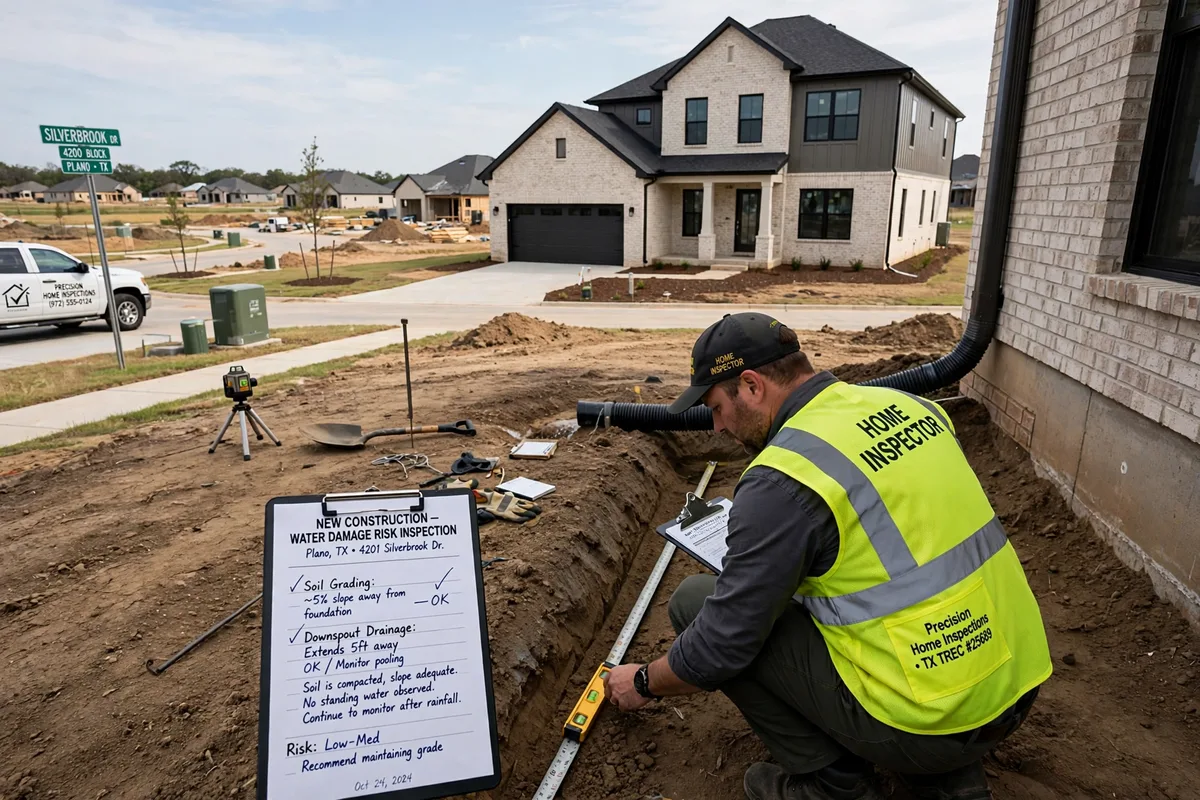
New-build water failures cluster into five defect types. Grading and drainage: the soil around the foundation must slope away from the house (6 inches over the first 10 feet is the standard rule), and in rushed developments the final grading is sometimes flat or — worse — slopes toward the slab, directing every storm straight at the foundation. Flashing and envelope: window, door, and roof flashing keep water out of wall assemblies, and missed or misdirected flashing is invisible until the first driving rain — the stain appears months after closing. Plumbing connections: supply lines, fixture connections, and appliance hookups that were never fully tightened or properly sealed — these fail under normal pressure, sometimes within weeks. HVAC condensate: in North Texas's long cooling season, the AC produces gallons of condensate daily, and a misrouted or un-trapped condensate line (the AC leak guide covers the mechanism) floods from the "new" system. Irrigation and exterior plumbing: sprinkler lines, hose bibs, and pool equipment installed without proper backflow or drainage saturate the soil against the foundation. The Lakewood guide covers the mirror image — what aging does to old pipes; this is what rushing does to new ones. However, not every new build has these defects — the point is not that new construction is bad, it is that new construction needs verification, because the defects are invisible by design.
New Build vs Older Home: How Do the Risks Compare?
| Risk factor | New build (Plano/Frisco) | Older home (Dallas core) |
|---|---|---|
| Plumbing | Install defects, untested joints | Corrosion, age fatigue |
| Foundation water | Grading/drainage errors | Settling, old drainage |
| Envelope leaks | Flashing defects | Worn seals, old flashing |
| Appliances | Install mistakes | Aging hoses, old heaters |
| Detection | Warranty + inspection | Maintenance history |
The table's real message is the last row: the two housing stocks fail differently and get caught differently. Older homes fail from age — corrosion, fatigue, worn seals — and the defense is maintenance history and regular inspection. New builds fail from defects — and the defense is the warranty plus independent verification before and during the warranty period. A 1970s Lakewood home with original galvanized plumbing is a known quantity: it will fail, and the only question is when. A 2024 Frisco build with a rushed plumbing crew is an unknown quantity: it may be perfect, or it may have the loose washing-machine connection that floods the laundry room in month three. The new-build owner's advantage is leverage — the builder is contractually on the hook for defects — but leverage only works with documentation: the independent inspection report, the dated photos, the written warranty claims. However, the comparison should not comfort either owner — both columns end at the same place, which is water where it should not be; the difference is only in who pays and how the failure gets found.
What Should I Check Before Closing on a New Build?
The builder's walkthrough is a sales event; the independent inspection is the real check — hire your own licensed inspector even on new construction, and specifically ask for water-risk focus. The grading check: walk the perimeter after a rain if possible, or run a hose — water should flow away from the foundation everywhere, with no pooling against the slab. The envelope check: look at window and door flashing from outside, check that weep holes (in brick veneer, standard in Plano/Frisco) are present and unobstructed, and confirm the roof flashing details at valleys and penetrations. The plumbing check: run every fixture simultaneously and watch for pressure drops, check under every sink with a flashlight for drips at connections, verify the water heater has a pan with a plumbed drain line (not just a pan), and confirm washing-machine supply lines are braided steel, not rubber. The HVAC check: find where the condensate line terminates — it should drain outside or to a proper drain, not into a wall cavity or onto the slab — and confirm the secondary drain pan under attic air handlers. The irrigation check: run the sprinklers and watch where the water goes relative to the foundation. Document everything with dated photos — this file is your warranty leverage. The freeze checklist adds the winter-specific checks for the first cold season. However, the inspection is not adversarial — good builders welcome it, because it catches their subs' mistakes before they become warranty claims; a builder who resists an independent inspection is telling you something.
📞 Pre-Closing Water Check? Ask Us: +1 214-807-4697
Who Pays When a New Build Leaks — Builder or Insurance?
Both, and they will point at each other — so understand the lanes before you need them. The builder's warranty typically has three tiers: 1-year workmanship (defects in materials and labor — the loose connection, the bad flashing), 2-year systems (plumbing, electrical, HVAC distribution in many Texas warranties), and 10-year structural (major structural defects). A water leak from a construction defect in year one is a workmanship claim — the builder fixes the defect and, in well-written warranties, the resulting damage. Your homeowners insurance covers sudden and accidental water damage regardless of the home's age — the burst supply line is covered whether the house is 2 or 52. The friction point is the overlap: the builder says the damage is an insurance matter, the insurer says the defect is a warranty matter, and the homeowner sits between them with a wet laundry room. The practical sequence: document everything immediately, notify the builder in writing (warranty claims need the paper trail), mitigate the water damage without delay (the claim-denied guide covers why delay kills coverage), and file the insurance claim in parallel — the two processes can run simultaneously, and the subrogation (the insurer recovering from the builder) is the carriers' problem, not yours. However, do not let the builder's "we'll take care of it" delay professional drying — the warranty covers the repair, but the mold clock does not honor warranty timelines; dry first, argue second.
What About Slab Foundations in New Plano/Frisco Builds?
Nearly all new Plano and Frisco construction sits on slab foundations, and slabs have their own water story. The good: no basement to flood, no crawlspace to grow mold. The bad: plumbing runs under or through the slab, and a slab leak in a new build — from a kinked line, a bad joint, or construction damage to the piping — is the defect-version of the older home's corrosion failure. The signs are the same: unexplained water bills, warm spots on the floor, the sound of running water with fixtures off, foundation-adjacent moisture. Detection runs $150–$400 for professional slab leak detection in Dallas, and the repair in a new build is typically a warranty matter — but the water damage from the leak is the immediate problem regardless of who pays for the pipe. The slab leak detection guide covers the full diagnostic process. New-build slabs also face the grading interaction: expansive North Texas clay soils swell and shrink with moisture, and poor drainage against a new slab accelerates the soil movement that stresses both the foundation and the under-slab plumbing. However, the slab is not fragile — properly built and drained, it is the right foundation for the soil; the risk is in the execution details, which is the theme of this entire guide.
Important Considerations
Three new-build specifics deserve emphasis. First, the warranty clock: the 1-year workmanship warranty is short, and defect leaks often appear in months 6–18 — calendar the warranty milestones and run a pre-expiration inspection at month 11, because defects found in month 13 are a negotiation, not a claim. Second, the documentation standard: warranty claims live or die on the paper trail — the independent inspection report, dated photos of every issue, written notices to the builder with timestamps, and the builder's written responses. Verbal promises from the warranty rep are not claims. Third, the insurance interplay: notify your homeowners carrier promptly for any significant water event even when pursuing the builder — the policy's duties (mitigation, prompt notice) apply regardless of the warranty process, and the carrier can subrogate against the builder afterward. Our flood damage repair page covers the structural drying standard. However, the biggest consideration is psychological: the new-build owner who assumes "it's new, it's fine" skips the checks that would have caught the defect — and the defect does not care about the assumption.
Frequently Asked Questions
Can a brand-new home have water damage?
Yes — and it happens regularly. New builds fail from defects, not age: untested plumbing connections, improper grading, missing flashing, misrouted condensate lines, and irrigation mistakes. These are installation failures, and they typically surface in the first year — often right when the homeowner has stopped watching. The "everything is new" comfort is the risk factor: it suppresses the inspection instinct that older-home owners develop. However, defect failures are also the most preventable category — the independent inspection and the checks in this guide catch most of them before they become losses.
What is the most common water problem in new construction?
Grading and drainage errors rank high — soil that slopes toward the foundation instead of away from it, directing stormwater at the slab. Plumbing connection failures run close second: the supply line or fixture connection that was never fully tightened and lets go under normal pressure. HVAC condensate misrouting is the quiet third — gallons of daily condensate in cooling season going somewhere it should not. All three share a trait: invisible until they fail. However, "most common" varies by builder and crew — which is why the pre-closing check covers all five defect types rather than betting on the statistics.
Does the builder's warranty cover water damage?
The 1-year workmanship warranty typically covers defects and the damage they directly cause — the loose connection and the wall it soaked. The 10-year structural warranty covers major structural defects, a narrower category. What warranties often dispute is consequential damage beyond the direct repair, and anything after the workmanship year expires. Read your specific warranty's water and consequential-damage language — Texas builder warranties vary significantly. However, the warranty is a contract claim with procedures and deadlines — follow them in writing, calendar the milestones, and do not rely on verbal assurances from the warranty department.
Should I get an independent inspection on a new build?
Yes — always, even with the builder's walkthrough and the municipal inspections. The municipal inspector checks code compliance, not quality; the builder's walkthrough is a sales process; only your independent inspector works for you. Specify water-risk focus: grading, flashing, plumbing connections, water heater pan and drain, appliance supply lines, condensate routing, and irrigation drainage. The few hundred dollars is the cheapest insurance in the transaction. However, schedule it before closing, not after — leverage is highest before the money moves, and findings become closing conditions rather than warranty fights.
What should the grading around my new home look like?
Soil should slope away from the foundation — 6 inches of drop over the first 10 feet is the standard rule — with no low spots pooling against the slab. Walk the perimeter after rain (or simulate with a hose) and watch where water goes: every drop should travel away from the house. Check that downspouts discharge well away from the foundation, not at its base. In new developments, final grading sometimes settles or was never finished properly — verify it, do not assume it. However, grading is also maintenance — soil settles, mulch beds change the profile, and the slope you verify at closing needs re-checking after the first year.
Who fixes a leak in a new build — the builder or my insurance?
Both lanes exist: the builder fixes defects under warranty, and your homeowners policy covers sudden water damage regardless of the home's age. In practice, run both in parallel — notify the builder in writing for the warranty claim, mitigate and document the water damage immediately, and file the insurance claim for the damage. The builder and the carrier will sort out subrogation between themselves. However, do not let either process delay drying — the mold clock runs on its own schedule, and neither the warranty department nor the adjuster will accept "we were waiting" as mitigation.
Are slab leaks common in new Plano/Frisco homes?
They happen — the new-build version is usually a construction defect (kinked line, bad joint, piping damaged during the pour) rather than the corrosion failure of older homes. The signs are identical: unexplained water bills, warm spots on floors, running-water sounds with fixtures off, moisture at the slab edge. Professional slab leak detection in Dallas runs $150–$400, and in a new build the pipe repair is typically a warranty matter. However, the water damage from the leak is the immediate problem either way — detect, document, dry, and let the warranty and insurance processes handle the pipe.
What is a water heater pan and does my new home have one?
A drain pan sits under the water heater to catch leaks and route them to a drain — and in many installations (attics, upper floors, finished spaces) it is a code requirement, not an option. Check yours: the pan should be present, intact, and connected to a drain line that actually drains somewhere — a pan with no drain is a bathtub. This is a two-minute check that prevents the water-heater-floods-the-house scenario. However, the pan only handles small leaks — a catastrophic tank failure overwhelms it; the pan is the early-warning system, not the flood defense.
How does North Texas clay soil affect my new home's water risk?
Expansive clay swells when wet and shrinks when dry, and that movement stresses foundations and under-slab plumbing. Poor drainage against the foundation accelerates the cycle — which is why the grading check matters structurally, not just cosmetically. Maintain consistent soil moisture around the foundation (soaker hoses in drought, drainage in storms) rather than letting it swing between soaked and parched. However, the soil is a known quantity — engineers design for it, and the failures come from the water management around the house, not from the clay itself.
What if I find a defect after the 1-year warranty expires?
The 2-year systems and 10-year structural tiers may still apply depending on the defect's nature — plumbing and HVAC distribution defects often fall in the 2-year tier. Document the defect, get a professional assessment of its cause and origin (defects often predate discovery by months), and file the warranty claim in writing with the evidence. Texas also has implied warranty and deceptive trade practice avenues for genuine construction defects, though those are attorney territory. However, the month-11 pre-expiration inspection exists precisely to avoid this situation — calendar it, because the defects found in month 13 are always harder than the ones found in month 11.
Do new builds need the same freeze protection as older homes?
Yes — new plumbing freezes just like old plumbing, and new builds have their own freeze vulnerabilities: hose bibs on uninsulated walls, sprinkler systems, and pipes in unconditioned attic spaces of rushed construction. The February 2021 freeze burst pipes in homes of every age across North Texas. Winterize before the first freeze regardless of the build year: insulate exposed pipes, disconnect hoses, know your shutoff locations. However, the new-build advantage is documentation — you know where every shutoff is because you watched the build (or your inspector mapped them); use that knowledge.
Does Water Damage Restoration Dallas serve Plano and Frisco?
Yes — we serve Dallas plus the northern suburbs including Plano and Frisco, 24/7, with the same emergency response: extraction, structural drying with verified moisture readings, and the mold watch. New-build leaks get the full documentation treatment — drying logs, photo sets, moisture readings — which supports both the builder warranty claim and the insurance claim in parallel. From 315 North St. Paul Street, Dallas, TX 75201, with typical 60-minute emergency arrival in the metro and IICRC-certified technicians. Call +1 214-807-4697 any time. However, call us for the water — the warranty fight with the builder is yours, and our documentation is the evidence you bring to it.
📞 Free New-Build Water Assessment: +1 214-807-4697
📞 Call Water Damage Restoration Dallas Now: +1 214-807-4697