Dallas Water Damage Recovery Timeline: What Happens After the Crew Leaves
TLDR
- How long does recovery take after water damage in Dallas?: Mitigation and drying take 3–7 days; full recovery including rebuild usually takes 2–8 weeks for a typical residential loss.
- What happens after the water is extracted?: Structural drying with monitored equipment runs for days, then moisture verification, then repairs and rebuild of damaged materials.
- When is it safe to move back in?: After drying is verified with moisture readings, mold risk is cleared, and the space is clean, dry, and structurally sound — not when it merely looks dry.
- Who handles the rebuild — the same company?: Some restoration companies handle both mitigation and rebuild; others hand off to a general contractor, so ask before the job starts.
- What should I be watching for during recovery?: Musty odors, new stains, buckling floors, and humidity readings — the mold watch window runs through the first two weeks.
- How does insurance fit into the recovery timeline?: Documentation from the mitigation phase supports the claim; the adjuster approves the rebuild scope once the structure is dry and documented.
- Need help with the recovery phase in Dallas?: Water Damage Restoration Dallas, 24/7: +1 214-807-4697 — mitigation through move-back.
The trucks leave, the house is quiet, and most Dallas homeowners realize they never asked the real question: what happens now? The emergency phase — extraction, the first equipment set — is only the first third of the recovery. What follows is a structured sequence: monitored structural drying, moisture verification, the mold watch window, and the rebuild that returns the house to its pre-loss condition. Knowing this timeline matters because the decisions made during it — when to let the equipment run, when to approve demolition, when it is safe to move back — determine whether the recovery ends in two weeks or drags into months. Dallas restoration jobs run $2,500–$7,500 for typical residential losses, and the timeline below reflects that middle of the curve, not the flooded-slab outlier. However, every loss is its own case — the timeline is a map of the normal path, and the professional assessment of your specific home is what sets the actual dates.
📞 Crew Left, Questions Remain? +1 214-807-4697
What Does the First Week After Extraction Look Like?
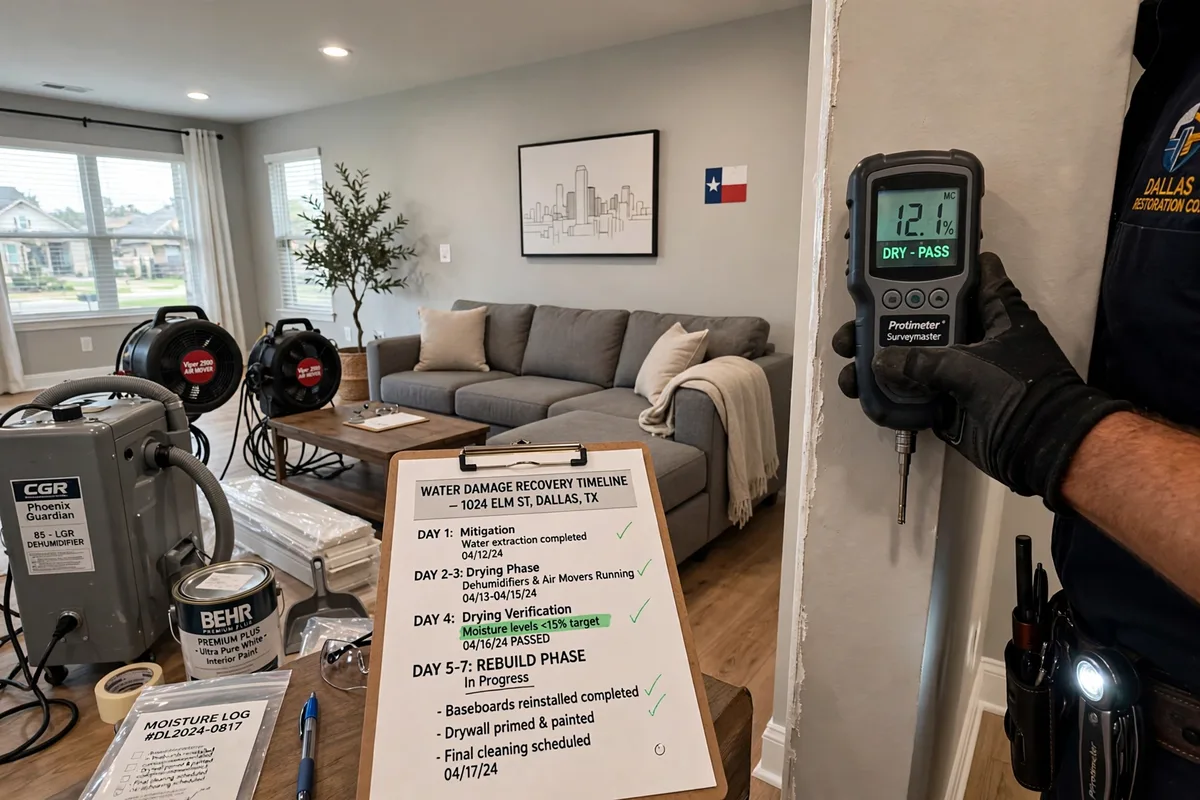
Days 1–3 are the active drying phase. Air movers and dehumidifiers stay in place around the clock, and a technician returns daily to take moisture readings from walls, floors, and framing — these readings, not appearances, decide when equipment comes out. Drying typically takes 3–5 days for most Dallas homes, though hardwood floors, slab foundations, and multi-room losses can push toward a week or more. During this window, homeowners should keep the equipment running without interruption: every unplanned shutoff resets the drying clock and re-opens the mold window. The crew may also remove unsalvageable materials — wet carpet pad, swollen baseboards, saturated drywall below the flood line — because materials that cannot be dried to standard become mold food. The extraction guide covers what happened before this phase began. However, drying is not restoration — a house can be fully dry and still need two more weeks of rebuild, so do not mistake the equipment pickup for the finish line.
Days 4–7 are verification and the first rebuild decisions. The technician compares final moisture readings against the dry standard — the moisture content of unaffected materials in the same house — and only equipment removal happens when readings hold at that baseline. This is also when the scope of the rebuild gets locked: the final drying log documents exactly what was wet, what was removed, and what needs replacement, and that log becomes the foundation of the insurance rebuild estimate. The adjuster typically engages during this window, using the mitigation documentation to approve the rebuild scope. Homeowners should use these days to make material selections if flooring, drywall, or cabinets need replacement — the rebuild cannot start until the materials are ordered. However, do not let impatience compress this phase — approving the rebuild before moisture verification is how hidden moisture gets sealed inside new walls, and that mistake surfaces months later as mold behind fresh paint.
What Is the Mold Watch Window?
The mold watch runs through roughly the first two weeks, and it is the phase homeowners most often skip. Mold can begin developing within 24–48 hours under favorable conditions, and even after professional drying, areas that dried unevenly — inside wall cavities, under flooring, behind cabinets — deserve monitoring. The signs to watch are specific: a musty or earthy odor that was not there before, new discoloration on walls or ceilings, paint bubbling, flooring that cups or buckles, and humidity that feels wrong for the room. A simple practice helps: walk the affected areas daily with a flashlight at a low angle across walls and floors — surface irregularities show up that overhead lighting hides. If anything looks or smells off, the restoration company should re-check with moisture meters and, if needed, thermal imaging before any rebuild covers the area. The 24–48 hour mold guide explains why the clock runs this fast. However, a musty smell is not a mold diagnosis — it is a signal to investigate, and the investigation is a moisture reading, not a panic call for remediation.
How Do Mitigation, Repair, and Restoration Differ?
| Phase | What happens | Typical duration |
|---|---|---|
| Mitigation | Extraction, drying, demolition of unsalvageable material | 3–7 days |
| Repair | Fixing damaged surfaces: drywall, flooring, fixtures | 1–3 weeks |
| Restoration | Returning the property to pre-loss condition | 2–8 weeks total |
| Remediation | Mold/contamination removal if needed | Adds 2–5 days |
These terms get used interchangeably by homeowners and sometimes by contractors, but they describe different scopes with different costs and different insurance treatments. Mitigation is the emergency phase — stop the damage, dry the structure, remove what cannot be saved. Repair is the reconstruction of damaged surfaces — new drywall, new flooring, new paint. Restoration is the whole arc: mitigation plus repair, ending with the property back to its pre-loss condition. Remediation is a separate specialty that enters only if mold or contamination is found. The practical reason this matters: a quote that says "restoration" should itemize all three, and an insurance estimate that covers only mitigation is not the full recovery. The repair-vs-restoration guide breaks down the cost and quote differences. However, do not let terminology stall the work — the important question for any contractor is not what they call the phase but what scope is included, documented, and priced.
📞 Drying Done? Plan Your Rebuild: +1 214-807-4697
When Is It Safe to Move Back In?
The move-back decision has three gates, and all three must be cleared. Gate one is verified dry: moisture readings at or below the dry standard in every affected area, documented, not eyeballed. Gate two is mold clearance: no active growth found, any remediation complete, and clearance readings where remediation occurred — the safe-to-stay guide covers the health side of this call. Gate three is basic habitability: functioning plumbing and electrical in the affected areas, safe flooring, no open wall cavities, and air quality that does not trigger symptoms. A house that clears all three is ready even if cosmetic work continues — living around fresh paint is fine; living around open drywall with active drying equipment is not. For families with infants, elderly members, or anyone with respiratory conditions, the bar for gate two runs higher, and a professional clearance gives more confidence than a sniff test. However, the rebuild finishing is not the same as the recovery finishing — keep the documentation file (drying logs, photos, invoices) for at least the life of the insurance claim plus one year, because latent issues surface on that timescale.
How Does the Insurance Claim Run Alongside Recovery?
The claim and the recovery run in parallel, and the mitigation documentation is what connects them. The drying logs, moisture readings, photo sets, and equipment records from the first week are the evidence the adjuster uses to approve both the mitigation invoice and the rebuild scope — this is why a restoration company that documents to IICRC S500 standards protects the claim. The typical sequence: emergency mitigation proceeds immediately (insurers expect this; delaying mitigation to wait for the adjuster can be treated as failure to mitigate), the adjuster inspects during or after drying, the rebuild scope gets agreed, and repairs proceed with supplement documentation if hidden damage appears. Deductibles come out of pocket first; the rest follows the policy. The first-24-hours guide covers the documentation to start at the very beginning. However, do not sign an assignment of benefits or any document you have not read — some contractors ask homeowners to assign the insurance claim to them, which transfers control of the claim and is a decision that deserves its own careful review.
Important Considerations
The biggest recovery mistake is treating "looks dry" as "is dry." Wall cavities, subflooring, and the back sides of cabinets dry slower than visible surfaces, and the standard failure mode is new flooring or fresh paint trapping moisture that then grows mold for months. The second mistake is pausing between mitigation and rebuild — a house that sits with open wall cavities through a humid Dallas week invites dust, pests, and moisture re-absorption; schedule the rebuild to start as soon as the dry standard is verified. The third is the contents question: belongings moved out during mitigation need their own drying and cleaning plan — the belongings guide covers what is salvageable and how. However, the recovery is also a finite process with a real end — most Dallas residential losses fully resolve in 2–8 weeks, and a recovery stretching past that usually means a scope problem, a documentation problem, or an insurance problem, any of which a direct conversation with the restoration company and the adjuster can usually unstick.
Frequently Asked Questions
How long does water damage recovery take in Dallas?
Mitigation and structural drying take 3–7 days for a typical residential loss; full recovery including rebuild usually runs 2–8 weeks. Hardwood floors, slab foundations, and multi-room losses push toward the longer end, and custom materials add ordering time. The drying phase is the least flexible — equipment runs until moisture readings hit the dry standard, and rushing it risks hidden mold. The rebuild phase is where scheduling, material choices, and insurance approvals set the pace. However, these are middle-of-the-curve numbers — a single-room clean-water loss can resolve in under two weeks, while a whole-house flood with rebuild can run longer; the on-site assessment sets the real timeline.
Can I live in my house during water damage recovery?
Usually yes for Category 1 (clean water) losses once the water is extracted — the drying equipment is loud and runs around the clock, but the space is safe. Category 3 (sewage) losses or active mold may require temporary relocation until remediation clears. The decision turns on three gates: verified dry readings, mold clearance, and basic habitability of plumbing, electrical, and flooring. Families with infants, elderly members, or respiratory conditions should hold a higher bar for the mold gate. However, "can" and "should" differ — if the drying phase means sleeping next to industrial dehumidifiers for five nights, a short hotel stay is a comfort decision, and additional living expenses may be part of the insurance claim.
Who rebuilds after water damage — the restoration company or a contractor?
Both models exist. Full-service restoration companies handle mitigation through rebuild with one team and one scope; mitigation-only companies hand off to a general contractor or the homeowner's chosen builder once drying is verified. Neither is inherently better — what matters is a clean handoff: complete drying documentation, a locked scope, and a rebuild start date that does not leave the house open for weeks. Ask before the job starts which model the company uses, because discovering the handoff at equipment pickup is how recoveries stall. Water Damage Restoration Dallas manages the recovery arc from emergency response through rebuild planning, 24/7 at +1 214-807-4697. However, you are not locked to one vendor for both phases — the mitigation documentation belongs to you and works with any qualified rebuild contractor.
What if my insurance adjuster hasn't visited yet?
Do not delay mitigation waiting for the adjuster. Insurers expect emergency mitigation to proceed immediately — extraction, drying, and reasonable demolition of unsalvageable material — and delaying it can be treated as failure to mitigate, which weakens the claim. Document everything: photos, the drying log, moisture readings, invoices. The adjuster typically inspects during or after drying and works from the mitigation documentation to approve the rebuild scope. However, keep the adjuster informed in parallel — a quick call to the carrier at the start creates the claim record, and the restoration company's documentation does the rest of the talking.
How do I know the drying is actually complete?
Moisture readings, not appearances. The technician measures affected materials and compares them to the dry standard — the moisture content of unaffected materials in the same house — and equipment comes out only when readings hold at that baseline. Ask to see the drying log: it should show daily readings trending down to the standard across walls, floors, and framing. If readings plateau above the standard, something is still feeding the moisture — a hidden leak, trapped water, or inadequate equipment — and the cause gets found before rebuild. However, do not accept "it feels dry" as verification — the entire point of the instrumentation is that touch and sight cannot measure what is inside a wall cavity.
What should I do with my belongings during recovery?
Move affected belongings out of the drying area and give them their own triage: dry and clean what is salvageable, discard what is contaminated or unsalvageable, and document everything for the contents portion of the claim. Porous items that sat in Category 2 or 3 water — upholstery, mattresses, cardboard-stored items — are usually losses. Electronics need professional evaluation before power-on. Photograph every item before disposal; insurers need the evidence even for discarded property. The belongings guide details the salvage decision item by item. However, do not store wet belongings in a sealed garage "for later" — the mold clock runs on contents too, and a sealed, damp storage space is an incubator.
Will my walls need to be cut open during recovery?
Only where materials cannot be dried to standard or contamination requires removal. Clean-water losses in walls with no insulation often dry in place through the drywall; saturated insulation, Category 2/3 water, or readings that will not come down mean controlled removal — typically a flood cut a foot or two above the water line. The removal is surgical and documented, and the rebuild replaces exactly what was removed. However, flood cuts are a drying decision, not a demolition habit — a company that cuts first and measures later is working backward; readings should drive the saw.
What happens if mold is found during recovery?
The recovery pauses for remediation: containment goes up, the affected materials are removed or treated under IICRC S520 protocols, HEPA filtration and air scrubbers run, and clearance verification confirms the space is clean before rebuild resumes. This typically adds 2–5 days to the timeline. Dallas mold remediation runs $1,200–$3,800 depending on scope. The important part is sequencing — remediation happens after drying verification and before rebuild, so no new material covers an unaddressed problem. However, finding some mold during a water recovery is common and not a catastrophe — it is a known, solvable step with a standard protocol, not a sign the whole job failed.
How much does full water damage recovery cost in Dallas?
Typical Dallas residential jobs run $2,500–$7,500 for mitigation through rebuild of a standard loss. The mitigation portion (extraction, drying, minor demolition) is usually the smaller share; the rebuild (drywall, flooring, paint, fixtures) is where scope drives cost. Mold remediation, if needed, adds $1,200–$3,800. Deductibles come out of pocket; the rest follows the policy for covered losses. However, the estimate is only as good as the scope — a quote that skips the moisture verification or lumps the rebuild into one line deserves a second look before it becomes a contract.
Can recovery be sped up?
The drying phase cannot be meaningfully rushed — physics sets the pace, and equipment runs until readings verify. The rebuild phase can be accelerated: pre-select materials during the drying week, approve the scope promptly, and keep the insurance documentation flowing so approvals do not idle the job. Choosing a full-service company that does both phases removes the handoff gap. However, speed has a failure mode — compressing verification or starting rebuild on unverified-dry materials trades a week now for a mold remediation later, which is the most expensive kind of fast.
What paperwork should I keep after recovery?
Keep the full file: the drying log with moisture readings, before/during/after photos, all invoices, the insurance claim correspondence, the rebuild scope and warranties, and any mold clearance reports. Keep it for at least the life of the claim plus one year — latent issues like slow-developing mold or settling repairs surface on that timescale. Store copies outside the house (cloud storage) so a future event does not take the records with it. However, the file is not just for disputes — it is also the maintenance history that adds confidence (and value) when the house is eventually sold.
Does Water Damage Restoration Dallas handle the whole recovery?
Yes — from the emergency call through verified drying, the mold watch, and rebuild planning, with adjuster-ready documentation at every step. Serving Dallas 24/7 from 315 North St. Paul Street, Dallas, TX 75201, with typical 60-minute emergency arrival, IICRC-certified technicians, and free estimates. Call +1 214-807-4697 any time — including the week after the crew leaves, when the questions get specific. However, we will also hand you a clean, complete documentation file if you choose a different rebuild contractor — the recovery belongs to you, not to us.
📞 Free Recovery Assessment: +1 214-807-4697
📞 Call Water Damage Restoration Dallas Now: +1 214-807-4697