Water Damage Repair vs Restoration in Dallas: What's the Difference?
TLDR
- What is water damage repair?: Fixing the damaged materials — replacing drywall, flooring, fixtures, and paint. It is the rebuild phase, not the cleanup.
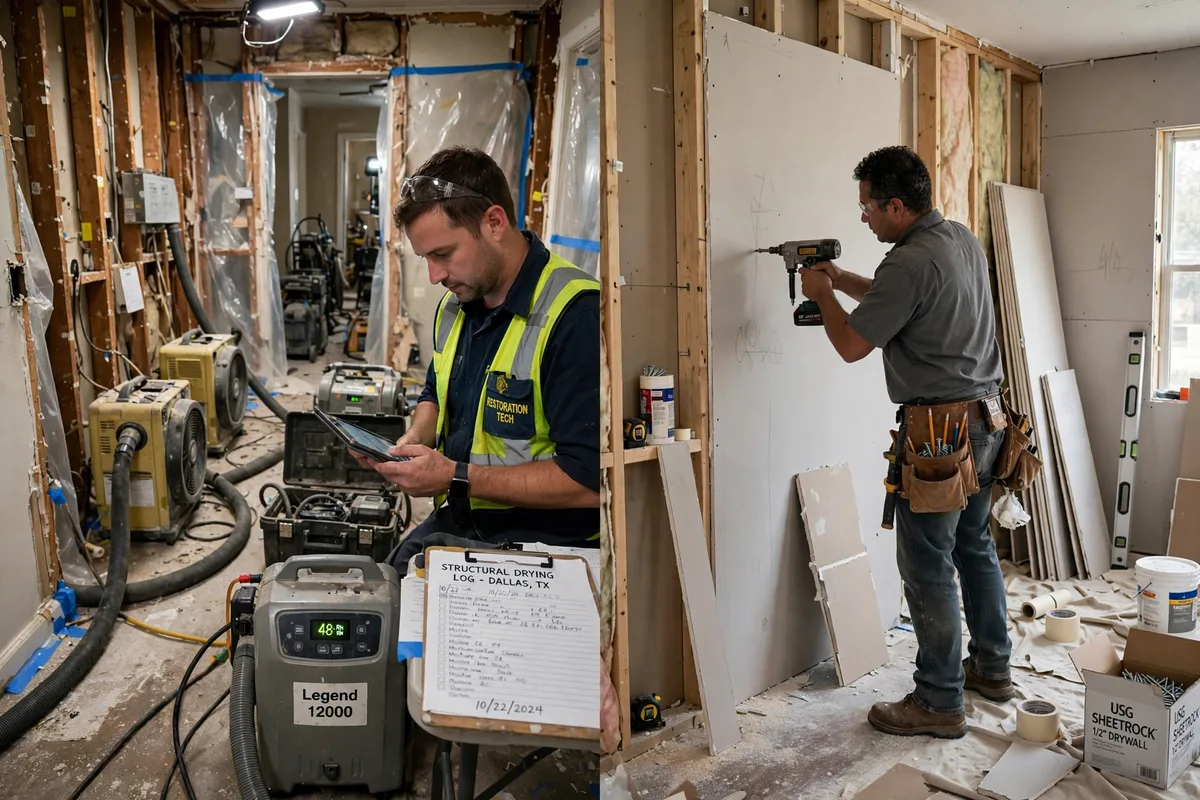
- What is water damage restoration?: The full return to pre-loss condition — water extraction, structural drying, sanitization, remediation, then the repair work.
- What is remediation?: Removing contamination — mold, sewage, floodwater residue — to safe levels. A job becomes remediation when contamination is present.
- Which one do I need?: Extraction and drying (restoration) first in almost every case; repair-only works only when everything is already dry and verified.
- How much do they cost in Dallas?: Dallas jobs run $2,500–$7,500; the Texas average burst-pipe claim is about $15,500 (State Farm). Repair-only quotes are lower because they skip the drying scope.
- Who does both in Dallas?: Water Damage Restoration Dallas, 24/7: +1 214-807-4697 — extraction, drying, remediation, and rebuild under one roof.
Three terms — repair, restoration, remediation — get used interchangeably by homeowners and, unfortunately, by some contractors, and the confusion costs real money. Repair means fixing what the water broke. Restoration means returning the property to its pre-loss condition, which includes the extraction, drying, and sanitization that must happen before any repair. Remediation means removing contamination — mold, sewage, flood residue — to safe levels. A Dallas homeowner who hires "repair" when the job needs "restoration" gets new drywall over wet framing and a mold colony in six months. This guide separates the three terms, shows what each one should include on a quote, and explains why "water damage repair" searches in Dallas tend to surface underpriced quotes that skip the critical middle. However, the terminology is not the product — a good company does all three phases regardless of which word the ad used.
📞 Not Sure What You Need? Call +1 214-807-4697
What Does Water Damage Repair Actually Include?
Repair is the rebuild phase: replacing the drywall, flooring, baseboards, cabinets, and fixtures that the water damaged or that the restoration crew removed. A repair scope reads like a remodeling invoice — materials, labor, finishing, paint — and it assumes the structure underneath is dry, sanitized, and ready. Repair is what happens after the moisture meters confirm dry standards and after remediation is complete. In Dallas, repair-only projects make sense when the water event is already fully resolved: a small supply-line leak caught in minutes, dried thoroughly, with moisture readings to prove it, leaving only a section of ruined drywall. The Dallas cost guide breaks down what the repair phase typically costs. However, repair without verified drying is the most expensive mistake in water damage — new materials installed over wet cavities trap moisture, and the trapped moisture becomes the mold job that costs $1,200–$3,800 to remediate on top of everything else.
The quote discipline for repair is about scope boundaries. A repair quote should itemize exactly what gets replaced, what materials are used (match or better), and what is explicitly excluded — especially the drying and sanitization work it assumes is already done. Dallas homeowners should ask the repair contractor one question: "Who verifies the structure is dry before you close the walls?" If the answer is vague, the scope is incomplete. Repair quotes are also where the "too good to be true" number appears: a handyman quoting drywall replacement for a fraction of the restoration bid is not beating the market — he is skipping the extraction, the dehumidifiers, the moisture monitoring, and the sanitization, and you will pay for those phases later as mold or structural repair. However, not every low repair quote is a scam — a genuinely small, fully-dried event really does need only repair, which is why the moisture readings, not the price, decide.
What Does Full Water Damage Restoration Include?
| Phase | What happens | Typical duration | Typical cost band |
|---|---|---|---|
| Extraction | Pumps, truck vacuums remove water | Hours | $2,500–$7,500 job |
| Structural drying | Air movers, dehumidifiers, readings | 3–5 days | Same scope |
| Remediation | Remove contamination, sanitize | 1–3 days | $1,200–$3,800 mold |
| Repair/rebuild | Replace drywall, floors, fixtures | 1–3 weeks | Scope-dependent |
Restoration is the complete return to pre-loss condition, and it always starts with extraction and drying — the phases repair skips. The restoration crew removes standing water with pumps and truck-mounted extraction, then places industrial air movers and commercial dehumidifiers to dry the structure, taking daily moisture readings until documented dry standards are met. If the water was contaminated — sewage, floodwater, or standing water old enough to breed mold (24–48 hours) — the remediation phase removes contaminated materials and sanitizes what remains. Only then does the repair phase begin: the rebuild. The extraction guide walks the first phase hour by hour. However, the phases are not always performed by one company — the critical question is not who does each phase but whether each phase is done, because a restoration project with a skipped phase is a repair project with hidden damage.
Remediation deserves its own definition because it is where the three terms collide. Remediation means reducing contamination to safe levels: mold remediation (IICRC S520) uses containment, negative air pressure, HEPA filtration, and removal of colonized materials; sewage remediation removes Category 3 contamination and sanitizes; flood remediation does both. A water job becomes a remediation job the moment contamination is present — visible mold, sewage odor, floodwater residue, or water that has stood long enough for bacterial growth. Dallas jobs run $2,500–$7,500 for the restoration scope, and mold remediation specifically runs $1,200–$3,800 when it stacks on top. The mold-timeline guide explains why the 24–48 hour window decides whether remediation joins the scope. However, do not let the term "remediation" scare you into thinking it is a separate contractor — in water damage, remediation is usually a phase of the restoration, performed by the same crew with the same equipment standards.
📞 24/7 Restoration + Repair in Dallas: +1 214-807-4697
Why Do "Water Damage Repair" Quotes Come In So Low?
Because they are quoting a smaller scope. A "repair" quote covers materials and labor for the visible damage — the stained drywall, the buckled flooring — without the extraction equipment, the dehumidifiers, the days of moisture monitoring, or the sanitization. Compared line-by-line against a restoration quote, the repair bid looks like a bargain; compared scope-by-scope, it is a different (and incomplete) project. Dallas homeowners searching "water damage repair dallas" see these numbers first because repair contractors advertise to the repair keyword — and the top result for a repair search is structurally biased toward the cheapest, least complete quote. The real comparison is total project cost: the cheap repair plus the mold remediation six months later, when Dallas mold work adds $1,200–$3,800 and the repair has to be redone. The Texas average burst-pipe claim of about $15,500 (State Farm) reflects the full restoration cost, not the repair-only price. However, an honest repair quote is not the enemy — it is exactly right for a fully-dried, verified-dry event, and the discipline is matching the quote to the job, not assuming every low number is a trap.
The insurance angle is where the terminology actually bites. Standard homeowners policies cover the damage from sudden water events — the ruined drywall, the buckled floors — but they pay for restoration (return to pre-loss condition), not upgrades, and they require the mitigation to be done to standard. A repair-only invoice without drying documentation can complicate a claim: the adjuster needs the moisture logs and the scope to justify the payout. Worse, if the homeowner does repair-only and mold appears later, the second claim hits the gradual-damage exclusion — the insurer treats the mold as a consequence of inadequate mitigation, not as a new event. Our water damage cleanup services page details the full restoration scope that supports a claim. However, do not confuse the insurance payment with the project budget — the insurer pays to restore pre-loss condition, and any upgrades beyond that are out of pocket regardless of which term the contractor used.
Important Considerations
The three-phase discipline is the practical takeaway: dry first (verified by readings), remediate contamination if present, then repair. Skipping to repair is the single most common and most expensive mistake Dallas homeowners make after water damage — it converts a $2,500–$7,500 restoration into a restoration plus a $1,200–$3,800 mold job plus a second repair. The sequencing also matters for living arrangements: extraction and drying are loud but usually compatible with staying in the home, demolition and rebuild are dustier and more disruptive. Ask every contractor the same two questions: "What are the moisture readings, and when does the equipment come out?" and "What exactly is included in this quote's scope?" The answers separate the restoration companies from the repair-only shops. However, the phases can be split across companies legitimately — a restoration company that stops at drying and a separate contractor for the rebuild is fine, as long as the handoff includes the moisture documentation and the rebuild does not start before dry standards are verified.
Do-it-yourself boundaries follow the same phase logic. A homeowner can handle the documentation, the initial water shutoff, and the call for help — but extraction, structural drying, and remediation are equipment and standards work, not mop work. Household dehumidifiers and fans cannot reach cavity moisture, and without moisture meters there is no way to know when drying is done. The repair phase is where DIY is legitimate: once a professional has verified dry standards in writing, a skilled homeowner can patch drywall and paint with confidence. The DIY-vs-pro guide draws the boundary in detail. However, the DIY repair after professional drying is a real savings opportunity — the expensive part is the equipment and verification, and the drywall patch is the cheap part, so do not let a contractor bundle them inseparably without asking.
Frequently Asked Questions
Is water damage repair the same as water damage restoration?
No. Repair is fixing the damaged materials — replacing drywall, flooring, and fixtures. Restoration is the full return to pre-loss condition, which includes the extraction, structural drying, and sanitization that must happen before repair. Think of restoration as the complete project and repair as its final phase. A company advertising "repair" may do only the rebuild; a company advertising "restoration" should do the whole sequence. However, the word in the ad is less important than the scope in the quote — ask what phases are included, and the terminology question answers itself.
What is the difference between remediation and restoration?
Remediation removes contamination to safe levels; restoration returns the property to pre-loss condition. Mold remediation uses containment, negative air, and HEPA filtration to remove colonized materials; sewage and flood remediation removes Category 3 contamination and sanitizes. In practice, remediation is usually a phase within the restoration project — the job becomes a "remediation job" when contamination is present, but the same crew performs it. Dallas mold remediation runs $1,200–$3,800 when it stacks onto a restoration. However, standalone remediation companies exist for pure mold jobs with no water event — and for those, no extraction or drying phases are needed at all.
Which should I hire first — a repair contractor or a restoration company?
A restoration company first, in almost every case. The restoration company extracts the water, dries the structure to verified standards, remediates any contamination, and then performs or hands off the repair. Hiring the repair contractor first reverses the sequence: new materials go in before the structure is dry, trapping moisture and guaranteeing future mold. The only exception is the fully resolved micro-event — caught in minutes, dried thoroughly, moisture readings in hand — where repair-only is genuinely enough. However, even then, the readings are what make it enough — without documented dry standards, the "small job" assumption is a guess, and guesses are how mold colonies start.
Why is the restoration quote so much higher than the repair quote?
Because the restoration quote includes phases the repair quote omits: extraction equipment, industrial dehumidifiers, days of moisture monitoring, sanitization, and possibly remediation. The repair quote covers materials and rebuild labor only. The honest comparison is total project cost over time: the cheap repair plus the mold remediation ($1,200–$3,800 in Dallas) plus the second repair, when moisture trapped under new materials grows a colony. The Texas average burst-pipe claim of about $15,500 (State Farm) is the full restoration cost — the repair-only price is a down payment on a larger bill. However, for a genuinely small, verified-dry event, the repair quote is the right and cheaper answer — the discipline is matching scope to the actual job.
Does insurance pay for repair, restoration, or both?
Standard homeowners policies pay to restore the property to pre-loss condition after a covered sudden event — which means the covered claim includes both the restoration phases (extraction, drying) and the repair phase (rebuild). What insurance does not pay for is betterment: upgrades beyond pre-loss condition are out of pocket. The claim needs the restoration documentation — moisture logs, itemized scopes, before/after photos — to be paid cleanly. If the homeowner does repair-only without drying documentation and mold appears later, the second claim can hit the gradual-damage exclusion. However, the deductible and the claim-vs-pay math still apply — the claim-vs-pay guide runs the break-even analysis for Dallas homeowners.
Can I do the repair myself after a professional dries the structure?
Yes — and it is a legitimate way to save money. Once a professional has extracted, dried to documented dry standards, and (if needed) remediated, the remaining work is ordinary remodeling: drywall patches, baseboards, paint, flooring. A skilled homeowner can handle the cosmetic phases confidently because the expensive and technical part — the equipment, the moisture verification, the sanitization — is done and documented. Keep the moisture log with your records: it is the proof the drying was done to standard. However, do not DIY the drying itself — household fans and dehumidifiers cannot reach cavity moisture, and without meters there is no way to know when "dry" is actually dry.
How do I know if my water damage needs remediation too?
It needs remediation if contamination is present: visible mold growth, musty odors from cavities, sewage or floodwater contact, or water that has stood for 24–48+ hours (the mold colonization window). Clean supply-line water extracted within hours usually needs extraction and drying only. Gray-area cases — a leak that ran for days but looks clean, water of unknown origin — get treated more aggressively, because the cost of unnecessary sanitization is far lower than the cost of a missed colony. Dallas mold remediation runs $1,200–$3,800. However, the crew's assessment during the first visit settles it — moisture meters, visual inspection, and (for mold) air or surface sampling are the diagnostic tools, and a reputable company will show you the evidence rather than just billing the phase.
What should a restoration quote itemize that a repair quote won't?
Extraction (equipment type, hours), structural drying (dehumidifier and air mover count, monitoring days), moisture documentation (daily readings to dry standard), sanitization/antimicrobial treatment, remediation scope if contamination is present (containment, HEPA, removal quantities), and then the rebuild line items the repair quote also has. The restoration quote should also state the dry standard it targets and who signs off on equipment removal. A repair quote typically itemizes only materials, labor, and finishing. However, itemization is not the same as completeness — a long repair quote is still a repair quote, and the missing phases are the ones that matter most.
How long does the full restoration take compared to repair-only?
Extraction takes hours and structural drying takes 3–5 days for clean water (longer for contamination); the repair/rebuild phase adds 1–3 weeks depending on materials and scope. Repair-only on a verified-dry event can be days. The drying phase is the long pole that repair quotes skip — and it is the phase that cannot be rushed, because equipment comes out on moisture readings, not on schedules. A "two-day full restoration" promise is a red flag: the drying science does not compress. However, the rebuild can overlap with the tail of drying for unaffected areas, so a well-managed project does not always stack the phases end to end.
Does Water Damage Restoration Dallas do both restoration and repair?
Yes — extraction, structural drying, remediation, and the full rebuild under one roof, so there is no handoff gap between the drying crew and the repair crew. The project is managed as one scope: moisture readings documented, contamination remediated to standard, then drywall, flooring, baseboards, cabinets, and paint restored to pre-loss condition. Serving Dallas 24/7 from 315 North St. Paul Street, Dallas, TX 75201, with typical 60-minute emergency arrival and IICRC-certified technicians. Free estimates on the full scope. Call +1 214-807-4697 — one company, one scope, one accountable project. However, if you already have a contractor for part of the work, we can scope just the phases you need — the moisture documentation travels with the project either way.
What happens if I skip the drying phase and go straight to repair?
The moisture trapped in walls, subfloor, and cavities stays there — sealed in by new drywall, flooring, and paint. Within weeks to months, it becomes mold: the musty smell, the staining, the health complaints. The repair has to be torn out and redone, the mold remediated ($1,200–$3,800 in Dallas), and the drying done properly the second time. The "savings" of skipping drying become a project that costs more than doing it right the first time — and the second round of work is rarely covered by the original insurance claim. However, this is entirely preventable: moisture meters and documented dry standards exist precisely to answer the question "is it dry enough," and any contractor who resists that verification is telling you everything you need to know.
Is a handyman enough for water damage repair?
For the repair phase of a verified-dry event, a good handyman or remodeler is fine — patching drywall and painting after professional drying is ordinary work. For anything involving extraction, drying, or remediation, no: those phases need IICRC-standard equipment, moisture meters, and contamination protocols that handyman work does not include. The risk is the handyman who does not know the phases exist — who patches the drywall without asking whether the cavity is dry. Ask the direct question: "How do you verify the structure is dry before you close it up?" The answer separates the safe hire from the dangerous one. However, do not overpay either — for a verified-dry cosmetic repair, the restoration company's rebuild crew and a good handyman produce the same drywall patch, and the price should reflect that.
📞 Free Restoration Scope Review: +1 214-807-4697
📞 Call Water Damage Restoration Dallas Now: +1 214-807-4697