How Do I Know If There's Hidden Mold After Water Damage?
TLDR
- What are the signs of hidden mold?: Persistent musty odor, new stains or discoloration, bubbling paint, warping floors, and allergy-like symptoms that improve away from home.
- Where does mold hide after water damage?: Inside wall cavities, under flooring, behind cabinets and baseboards, in HVAC-adjacent spaces, and above ceilings.
- Can I test for hidden mold myself?: Surface moisture meters and careful visual inspection help, but only professional moisture mapping and inspection confirm what is inside assemblies.
- How soon after water damage should I check?: Start watching immediately — mold can begin developing within 24–48 hours — and monitor through the first two weeks.
- Does a musty smell always mean mold?: No — it means investigate. Musty odor signals microbial activity or damp materials, and the investigation is a moisture reading, not a conclusion.
- When does hidden mold need professional remediation?: When it covers more than about 10 square feet, sits inside wall cavities or HVAC, or involves anyone with health vulnerabilities.
- Suspect hidden mold in your Dallas home?: Water Damage Restoration Dallas inspects with moisture meters and thermal imaging, 24/7: +1 214-807-4697.
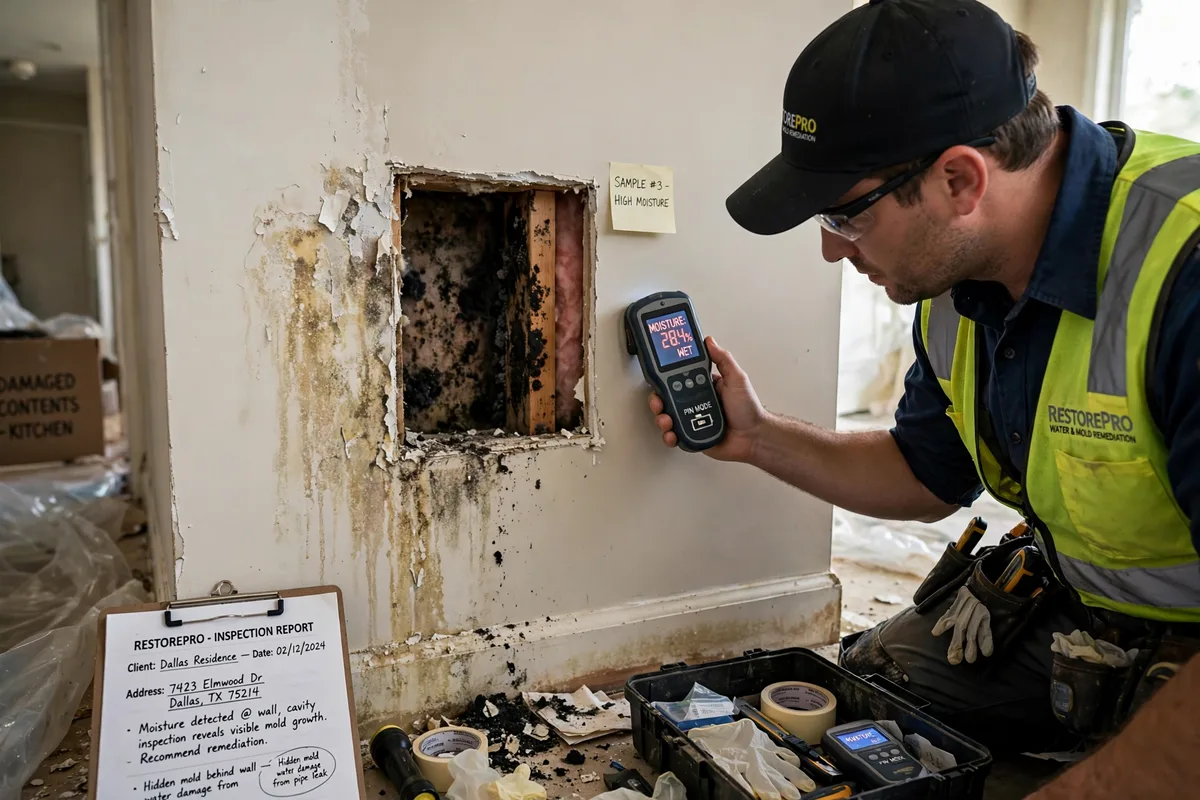
The wall looks dry. The floor feels fine. And somewhere inside the assembly — behind the drywall, under the baseboard, in the dark space where the water went and the air does not — mold may be doing what mold does. This is the anxiety that follows every water event, and it is not irrational: water travels along framing, wicks up drywall, and pools in places no homeowner ever sees, and mold follows water on a 24–48 hour clock. The good news is that hidden mold leaves traces — odors, stains, moisture, symptoms — and that a systematic check finds most of it before it becomes a remediation project. The other good news is that "hidden" does not mean "unknow-able": moisture meters, thermal cameras, and inspection openings turn the invisible into the measurable. Dallas mold remediation runs $1,200–$3,800 when it is needed — and the entire point of the detection work below is to find out whether it is needed before the colony decides for you. However, this guide is about detection, not treatment — finding mold and removing mold are different jobs, and the bleach bottle is not the answer (the bleach myth guide explains why).
📞 Suspect Hidden Mold? Get It Checked: +1 214-807-4697
What Are the Warning Signs of Hidden Mold?
The signs fall into four groups, and any one of them justifies investigation. Smell: a persistent musty, earthy, or damp odor in a room that had water exposure — especially an odor that intensifies when the HVAC runs or when the room has been closed up. Sight: new stains, discoloration, or yellowing on walls and ceilings; paint that bubbles, peels, or feels soft; caulk or grout that darkens; flooring that cups, buckles, or gaps. Touch and behavior: drywall that feels cool, damp, or soft when pressed; baseboards that have pulled slightly from the wall; doors in the affected area that suddenly stick (swollen framing). Health: allergy-like symptoms — sneezing, congestion, itchy eyes, headaches — that appear or worsen at home and improve away from it; anyone with asthma or allergies reacting more than usual. No single sign is diagnostic, but the pattern is: water history plus one or more of these signs equals investigate. The 24–48 hour guide explains the growth timeline driving the urgency. However, symptoms are the weakest signal alone — allergies have many causes, and the mold hypothesis needs the physical evidence (moisture, odor source, visible growth) before it becomes a conclusion.
Where Does Mold Hide After Water Damage?
| Hiding place | Why water gets there | How to check |
|---|---|---|
| Inside wall cavities | Wicking up drywall, pipe leaks | Moisture meter, inspection opening |
| Under flooring | Seepage at edges, slab wicking | Meter readings, lift a threshold |
| Behind cabinets/baseboards | Trapped, slow to dry | Remove baseboard, meter behind |
| Above ceilings | Leaks from above, attic moisture | Attic inspection, ceiling meter |
| HVAC-adjacent spaces | Condensation, duct leaks | Visual + pro inspection |
Each hiding place has a water path and a check method. Wall cavities collect water through wicking — drywall can pull water upward well above the visible flood line — and through leaks inside the wall from plumbing or the exterior. The check is a pin or pinless moisture meter on the wall surface at multiple heights, plus, where readings are elevated, a small inspection opening (a 2-inch hole behind furniture) to see and smell inside. Under flooring, water travels at edges and seams and wicks from slabs — the check is meter readings across the floor and, where suspect, lifting a threshold or transition strip to look underneath. Behind cabinets and baseboards, water gets trapped in the zero-airflow gap — the check is removing a section of baseboard (it is cheap to replace) and metering the drywall behind it. Above ceilings, the check is the attic or the floor above: look for staining on the top side of the drywall and meter from below. HVAC-adjacent spaces — the closet with the air handler, the return plenum area — collect condensation and duct-leak moisture; these deserve a visual check plus professional inspection because the air system distributes whatever grows there. However, the table is a map, not a DIY demolition plan — inspection openings are small and targeted, and the professional's moisture mapping finds the right spots before any drywall is opened.
What Can I Check Myself vs What Needs a Pro?
The homeowner's toolkit covers the first pass: eyes, nose, and a $30–$50 pin-type moisture meter from the hardware store. Walk every room with water history, meter the walls at baseboard height and at 12 and 24 inches up, meter around windows and plumbing walls, and note every elevated reading with painter's tape and a photo. Run the HVAC-off smell test: close the room for a few hours, walk in, and note any musty odor — then run the HVAC and check whether the odor spreads, which suggests duct or air-handler involvement. Check the attic and crawlspace if accessible: staining, damp insulation, and musty air are all reportable findings. This first pass finds the obvious and maps the suspect — and it costs almost nothing. The slab leak signs guide covers the foundation-side version of this detective work. However, the homeowner pass has hard limits: it cannot see inside closed cavities, it cannot distinguish active moisture from old staining, and it cannot assess HVAC interiors — which is where the professional inspection begins.
The professional inspection adds three capabilities the homeowner cannot replicate. Moisture mapping: pinless meters and thermal imaging cameras scan whole assemblies for temperature and moisture anomalies, finding the wet spot behind the intact paint. Controlled inspection openings: small, targeted openings at the mapped locations to visually confirm growth and collect the evidence for the remediation scope. And the assessment judgment: distinguishing active growth from old staining, sizing the affected area, and determining whether the job is a contained remediation or a whole-assembly replacement. Thermal imaging deserves a specific note — it does not "see mold"; it sees temperature differences caused by moisture, which then get verified with meters and visual confirmation. Any company that diagnoses mold from a thermal image alone is skipping steps. However, the professional inspection is not automatically a remediation sale — a competent inspector reports "no active growth, monitor these two areas" when that is the finding, and the drying verification may be all the house needs.
📞 Pro Moisture Inspection in Dallas: +1 214-807-4697
When Does Hidden Mold Become a Remediation Job?
Three thresholds turn detection into remediation. Size: growth covering more than about 10 square feet — or spread across multiple cavities — exceeds sensible DIY scope and calls for containment, HEPA filtration, and professional removal under IICRC S520 protocols. Location: growth inside wall cavities, under flooring assemblies, or in HVAC-adjacent spaces needs professional handling regardless of size, because the containment and the hidden extent make DIY removal incomplete by nature. Vulnerability: households with infants, elderly members, or anyone with asthma, allergies, or immune compromise should professionalize the response earlier — the health margin is thinner, so the caution margin runs thicker. Dallas mold remediation runs $1,200–$3,800 depending on scope, and the inspection that determines the scope is the money well spent. The remediation guide details the professional process step by step. However, the remediation decision is about the growth, not the fear — a musty smell with dry readings and no visible growth is a monitoring situation, not a $3,000 invoice; the readings decide.
How Do I Keep This From Happening Again?
Prevention is moisture control, and moisture control is a short list. Fix the source completely — the detection work is wasted if the leak that fed the mold is still active; verify the repair with a follow-up moisture check, not just a dry day. Dry to the standard, not to the eye — after any future water event, structural drying runs until meter readings verify, because the hidden mold of next year is the unverified drying of this year. Control indoor humidity — Dallas summers push indoor humidity high, and a $200 dehumidifier in a chronically damp area (the bathroom without a fan, the laundry room, the closed-up guest room) removes the ambient moisture that lets small leaks become colonies. Maintain the envelope — caulk, flashing, grading, and the roof details that keep water out of walls in the first place. And keep the inspection habit — the seasonal walk-through with the moisture meter takes twenty minutes and catches the slow failures before they become hidden ones. However, prevention reduces risk, it does not eliminate it — plumbing fails, storms happen, and the realistic goal is early detection, not a mold-proof house.
Important Considerations
Three misconceptions waste the most homeowner effort. The first is the air-test misconception: a mold air sample (spore trap) without a moisture investigation is nearly useless for hidden mold — it tells you spores are in the air (they always are, everywhere) without telling you where the growth is or whether it is active. Spend the money on moisture mapping first; air testing has a role in clearance verification, not in detection. The second is the "mold-proof paint" misconception: encapsulant paints have legitimate uses after professional remediation, but painting over active growth without addressing the moisture is concealment, not treatment — the colony continues behind the paint. The third is the timeline misconception: finding hidden mold six months after a water event does not mean the original drying failed — it may mean a new, slow leak started since; investigate the current moisture before assigning blame to the past. Our mold remediation page covers the professional standard. However, the single most important consideration is also the simplest: moisture is the cause, mold is the symptom — every detection effort that does not find and fix the moisture source is a temporary victory.
Frequently Asked Questions
What does hidden mold smell like?
Musty, earthy, or damp — like a basement, old books, or wet cardboard — and it persists rather than airing out. The smell often intensifies in a closed-up room or when the HVAC kicks on, because the air system moves air across the growth. A smell that appears after a water event in a previously odor-free room is the single most common first sign of hidden mold. However, smell is a signal to investigate, not a diagnosis — damp building materials can smell musty without active growth, and the investigation is a moisture reading at the odor's source.
Can mold grow inside walls without any visible signs?
Yes — this is the defining feature of hidden mold. Water wicks up inside the wall cavity or leaks from plumbing within the wall, and the paper facing of drywall plus the dark, still cavity is an ideal growth environment — all while the room-side paint looks fine. The first external signs are usually secondary: a musty odor, paint bubbling at the base of the wall, or baseboards pulling away. This is why moisture meters matter more than eyes for wall assemblies. However, "can" does not mean "always" — many wall cavities dry out uneventfully after minor events; the risk tracks with the amount of water, the duration, and whether drying was verified.
How can I check for mold behind drywall without tearing it open?
Start non-destructive: a pin or pinless moisture meter on the wall surface at multiple heights, the closed-room smell test, and a flashlight at a low angle to catch surface irregularities. A professional adds thermal imaging to map moisture anomalies across the whole wall. If readings are elevated, the next step is a small inspection opening — a 2-inch hole in an inconspicuous spot — to visually confirm, which is easily patched. However, do not cut exploratory holes at random — moisture mapping first, targeted opening second; random demolition finds mold by luck and creates repair work regardless.
Is a home mold test kit from the store reliable?
For hidden mold, no. Settle-plate kits grow whatever spores land on them — and spores are everywhere, indoors and out — so a positive result proves nothing about hidden growth, and a negative result misses the colony inside the wall. Tape-lift kits only test visible surfaces. Neither replaces a moisture investigation. The kits have one legitimate use: documenting visible growth for a landlord or insurer dispute. However, if you have already bought one, do not let its result drive decisions — let the moisture readings drive them, and treat the kit as the curiosity it is.
How long after water damage should I worry about hidden mold?
Start watching immediately and monitor through the first two weeks — mold can begin developing within 24–48 hours, and the watch window covers the uneven-drying period. After professional drying with verified readings, the acute risk drops sharply — but keep the seasonal habit: a quick moisture-meter walk-through every few months catches the slow failures (the supply-line seep, the flashing failure) that become next year's hidden mold. However, worry is not the goal — the goal is a routine: check after every water event, verify after every drying, and the timeline takes care of itself.
Can hidden mold make me sick?
Mold exposure can trigger allergy-like symptoms — sneezing, congestion, itchy or watery eyes, headaches — and can aggravate asthma; people with allergies, asthma, or compromised immune systems react more strongly. The symptom pattern that suggests a home source is symptoms that appear or worsen at home and improve away from it. That said, most healthy adults tolerate background-level exposure without issues, and not every symptom cluster is mold — dust, pollen, and HVAC issues mimic the pattern. However, do not use symptoms as the detection method — by the time symptoms are the signal, the colony is established; use moisture and odor as the early signals instead, and treat health concerns with a clinician, not a search engine.
Will my homeowners insurance cover hidden mold remediation?
Often yes, when the mold results from a covered sudden water event — the burst pipe, the appliance failure — and the remediation is part of the water damage claim. Coverage gets harder when the mold traces to a long-term leak (the gradual-damage exclusion) or when the policy has a mold sublimit. Document the water event, the detection findings, and the professional assessment — the claim is argued on the moisture timeline. However, check your policy's mold language before you need it — some Texas policies cap mold coverage or require endorsements, and the time to discover the cap is before the colony, not after.
Should I open up the wall myself if I suspect mold?
A small inspection opening (2 inches, in an inconspicuous spot, with a dust mask on) is reasonable for a look — but stop at looking. Disturbing a colony without containment spreads spores through the room and the HVAC, turning a contained problem into a distributed one. If you see growth, close it back up and call a professional: containment, HEPA filtration, and proper removal are the job from that point. However, the better sequence is professional moisture mapping first — the targeted opening at the mapped location beats three exploratory holes every time.
Does bleach kill hidden mold?
No — and this is the most persistent myth in the category. Bleach whitens the surface color of mold on non-porous materials, creating the appearance of removal, while the roots (hyphae) survive inside porous materials like drywall and wood — and the water in the bleach solution can actually feed the remaining growth. On porous building materials, bleach is concealment, not remediation. Professional remediation removes the affected material under containment; it does not paint over it chemically. However, bleach has legitimate household uses — mold remediation is not one of them.
How much does hidden mold remediation cost in Dallas?
Dallas mold remediation typically runs $1,200–$3,800 depending on scope — a contained single-cavity job sits at the lower end, while multi-room or HVAC-involved remediation runs higher. The inspection and moisture mapping that sizes the job is a separate, smaller cost and the money well spent — it prevents both the under-scoped job (growth left behind) and the over-scoped one (paying for demolition you did not need). Insurance often covers remediation tied to a covered water event, subject to the policy's mold terms. However, get the scope in writing before work starts — "remediation" without a defined area, protocol, and clearance standard is a blank check.
Can a thermal imaging camera find hidden mold?
It finds moisture, not mold — and that distinction matters. The camera detects temperature differences caused by evaporative cooling at wet spots, which the inspector then verifies with moisture meters and visual confirmation. It is an excellent mapping tool: it scans whole walls and ceilings quickly and finds the anomaly behind intact paint. But a thermal image alone is not a mold diagnosis — any company that quotes remediation from the image without meter verification is skipping the step that separates professionals from salespeople. However, as part of the full inspection (thermal + meters + targeted openings), it is genuinely useful — which is why it is in the professional toolkit.
Does Water Damage Restoration Dallas inspect for hidden mold?
Yes — moisture mapping with pin and pinless meters plus thermal imaging, targeted inspection openings where readings warrant, and a written assessment of findings: what is wet, what shows growth, what needs remediation, and what needs monitoring. If remediation is warranted, we perform it under IICRC S520 protocols with containment and HEPA filtration, and we verify clearance before rebuild. Serving Dallas 24/7 from 315 North St. Paul Street, Dallas, TX 75201, with typical 60-minute emergency arrival, IICRC-certified technicians, and free estimates. Call +1 214-807-4697. However, if the inspection finds no active growth, we will tell you that — the monitoring plan and the dry readings are the deliverable, not an invoice.
📞 Free Hidden Mold Inspection: +1 214-807-4697
📞 Call Water Damage Restoration Dallas Now: +1 214-807-4697