Mold Remediation After Water Damage in Dallas: When Cleaning Isn't Enough
TLDR
- When does a water job need mold remediation?: When mold is visible, musty odors come from cavities, or water stood 48+ hours — the colonization window for mold is 24–48 hours.
- What is professional mold remediation?: Containment, negative air pressure, HEPA filtration, removal of colonized materials, and sanitization — the IICRC S520 process.
- Why doesn't bleach work?: Bleach bleaches the color but leaves the roots in porous materials; the mold returns. The bleach-myth guide documents why.
- How much does it cost in Dallas?: Dallas mold remediation runs $1,200–$3,800, depending on the affected area and whether it is part of a larger restoration.
- Can I stay home during remediation?: Usually yes for contained single-room work; multi-room or HVAC-involved jobs often need relocation. See the stay-or-leave guide.
- Who does it in Dallas 24/7?: Water Damage Restoration Dallas: +1 214-807-4697 — IICRC-certified remediation with documented clearance.
A water damage job becomes a mold remediation job at a specific threshold: when contamination is present that ordinary cleaning cannot safely remove. Mold colonizes wet organic materials in 24–48 hours — drywall, wood, insulation, carpet backing — and once it is established inside a wall cavity or under flooring, no spray bottle and no surface wipe reaches it. Professional remediation is not "deep cleaning." It is a containment-and-removal process governed by the IICRC S520 standard: isolate the work area, filter the air, remove the colonized materials, sanitize what remains, and verify the job with documented clearance. This guide covers when water damage crosses into remediation, what the professional process actually involves, what it costs in Dallas, and why the DIY attempts fail. However, not every water job needs remediation — fast extraction and verified drying prevent the colony, and the remediation phase is the price of delay, not the price of getting wet.
📞 Suspect Mold After Water Damage? +1 214-807-4697
When Does Water Damage Become a Mold Remediation Job?
The threshold is contamination, and contamination has three triggers. The first is time: any water event that went undried for 48 hours or more is treated as a mold job until proven otherwise, because the 24–48 hour colonization window has closed. The second is evidence: visible mold growth, musty or earthy odors from walls or floors, or staining that returns after cleaning all indicate an established colony. The third is water type: sewage backups and floodwater are remediation jobs from the start — Category 3 water carries contamination that requires professional protocols regardless of timing. A clean supply-line burst extracted within hours usually needs only extraction and drying; the same burst discovered after a week needs remediation. The mold-timeline guide maps the colonization window in detail. However, the absence of visible mold is not the absence of a colony — mold grows inside wall cavities, under carpet, and behind baseboards, and the musty smell is often the first and only surface sign.
The Dallas-specific risk factors compress the timeline. North Texas heat and humidity accelerate colonization — a wet wall cavity in a Dallas August is a mold incubator, and the window skews toward the 24-hour end of the range. Dallas's expansive clay soil keeps crawlspaces and slab-adjacent framing damp longer than the drying math assumes. And the region's freeze-thaw cycle produces the classic delayed-discovery pattern: a pipe bursts during a freeze, thaws, seeps inside a wall for weeks, and the homeowner discovers the colony when the musty smell or the staining surfaces in spring. Insurance draws the same line the professionals do: remediation for sudden-event mold is typically covered; remediation for long-term seepage hits the gradual-damage exclusion. The claim-denied guide documents how Texas adjusters apply that line. However, do not let the insurance question delay the response — the colony grows whether or not the claim is filed, and every week of delay expands the affected area and the invoice.
What Does Professional Mold Remediation Actually Involve?
| Step | What the crew does | Why it matters |
|---|---|---|
| Assessment | Moisture readings, visual, sampling | Maps the colony |
| Containment | Poly barriers, negative air | Stops spore spread |
| Filtration | HEPA air scrubbers run | Cleans the air |
| Removal | Colonized materials out | Eliminates the source |
| Sanitization | Antimicrobial, HEPA vacuum | Kills remaining spores |
| Clearance | Post-remediation verification | Proves it worked |
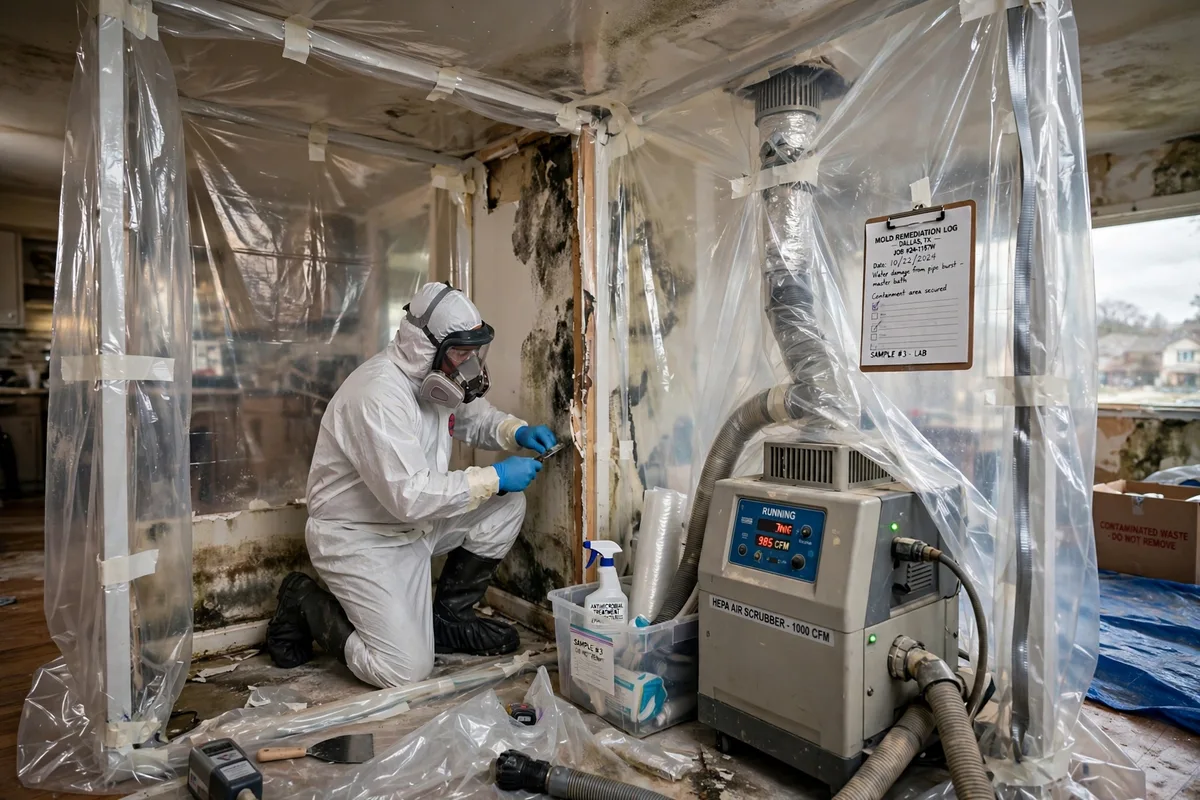
The IICRC S520 process starts with assessment: moisture meters map the wet areas, the crew inspects cavities and hidden spaces, and air or surface sampling may establish the contamination level — the sampling is the diagnostic, not the decision. Then containment: the work area is sealed with polyethylene sheeting, and negative-air machines maintain pressure so spores flow inward, not into the rest of the house. HEPA air scrubbers run continuously, filtering the work-area air. Then removal: colonized drywall, insulation, carpet, and pad come out — porous materials with established colonies are not cleaned, they are discarded, because the hyphae (the mold's root structure) penetrate deeper than any surface treatment reaches. Then sanitization: remaining structural surfaces get antimicrobial treatment and HEPA vacuuming. Then clearance: post-remediation verification — visual inspection, moisture readings at dry standard, and sometimes air sampling — documents that the job is done. Our mold remediation services page details the process we follow. However, the step homeowners never see — containment — is the one that protects the rest of the house; a "remediation" without containment is just demolition that spreads the colony.
The DIY failures follow a predictable pattern, and bleach is the star. Bleach changes the mold's color — it bleaches the pigment — which looks like success but leaves the hyphae alive in porous materials; on drywall and wood, the mold returns within weeks, often worse, because the bleach's water component feeds it. The bleach-myth guide documents the chemistry. The second failure is no containment: scrubbing a mold patch without sealing the area aerosolizes spores and seeds new colonies in previously clean rooms. The third is partial removal: cutting out the visibly moldy drywall while leaving the colonized insulation behind it, or cleaning the surface while the cavity stays wet. Dallas mold remediation runs $1,200–$3,800 professionally — the DIY attempt that fails costs that band plus the larger colony it created. However, small surface mold on non-porous materials (tile grout, a metal fixture) is genuinely DIY-able with proper cleaning — the remediation line is porous materials and hidden colonies, not every spot of mildew.
📞 24/7 Mold Remediation in Dallas: +1 214-807-4697
How Much Does Mold Remediation Cost in Dallas?
The Dallas band is $1,200–$3,800 for mold remediation, with the position in the band set by the affected area and the contamination depth. A contained single-room job — a bathroom wall cavity, a section of drywall behind a failed supply line — sits at the lower end. Multi-room colonization, HVAC involvement (mold in ductwork or the air handler spreads it house-wide), or remediation stacked onto a full water restoration sits at the higher end. The band assumes professional S520 work: containment, HEPA filtration, removal, sanitization, and clearance documentation. What is not in the band: the water damage restoration that usually precedes it (Dallas jobs run $2,500–$7,500 for the restoration scope) and the rebuild that follows it. A flood that becomes a mold job is three invoices — restoration, remediation, rebuild — which is why the fast response that prevents the colony is the cheapest mold strategy that exists. However, get the scope in writing before work starts — the estimate should state the affected areas, the containment plan, the removal quantities, and the clearance standard, because "mold remediation" without those specifics is a price, not a plan.
Insurance covers remediation for sudden events and denies it for gradual ones — the same sudden-vs-gradual line that decides every water claim. A burst pipe's mold is typically covered as part of the restoration claim; a slow seep's mold is typically excluded as long-term deterioration. The documentation that supports the claim is the remediation company's own work product: moisture logs proving the timeline, photos of the contamination, the itemized scope, and the clearance verification. Some policies cap mold coverage with a sublimit — read the endorsements, because a $10,000 mold sublimit on a $25,000 colony is a nasty surprise. The claim-vs-pay guide runs the math on when filing makes sense. However, the remediation should never wait for the coverage decision — the colony does not pause for the adjuster, and the additional damage from delay is never covered.
Important Considerations
Health effects are the reason remediation has a standard and a containment protocol. Mold exposure triggers allergic reactions, asthma attacks, and respiratory irritation in sensitive individuals — children, the elderly, and the immunocompromised most of all — and some molds produce mycotoxins that make prolonged exposure genuinely hazardous. This is not a reason to panic about a spot of shower mildew; it is a reason to treat an established colony in living space as a health project, not a cleaning project. During remediation, the stay-or-leave decision hinges on containment quality and the affected area: a sealed single-room job with the HVAC isolated is usually compatible with staying, while whole-house or HVAC-involved remediation usually means relocating until clearance. The stay-or-leave guide covers the decision in detail. However, do not diagnose health effects yourself or wait for symptoms to act — the colony's size and location decide the response, and a professional assessment is the fast path to that answer.
The clearance standard is what separates professional remediation from expensive demolition. A reputable company verifies its own work: post-remediation visual inspection (no visible mold, no dust and debris), moisture readings at dry standard on all affected materials, and — for larger or sensitive jobs — third-party air sampling showing spore counts at or below outdoor/baseline levels. Get the clearance documentation in writing and keep it with the property records: it is the proof the job was done to standard, the defense against future insurance disputes, and a disclosure asset if the home is ever sold. A company that resists clearance verification is resisting accountability. However, do not demand laboratory perfection — the standard is "returned to a normal fungal ecology," not "zero spores," because spores exist in all indoor air; the goal is removing the colony, not sterilizing the house.
Frequently Asked Questions
How do I know if I need mold remediation or just cleaning?
You need remediation when the mold is in porous materials (drywall, wood, insulation, carpet), hidden inside cavities, or covering a large area — anywhere surface cleaning cannot reach the colony's roots. Surface mold on non-porous materials like tile, glass, or metal can be cleaned with proper products and technique. The decision triggers: visible growth larger than about 10 square feet, musty odors from walls or floors, water that stood 48+ hours, or any sewage/floodwater contact. A professional assessment with moisture meters settles borderline cases. However, when in doubt, treat it as remediation — the cost of an unnecessary assessment is trivial next to the cost of a colony that was "cleaned" and came back.
Why doesn't bleach kill mold on drywall?
Bleach bleaches the mold's pigment — the color disappears, which looks like success — but the chlorine does not penetrate porous materials, so the hyphae (the root structure) survive inside the drywall and regrow. Worse, bleach is mostly water, and that water feeds the surviving colony. On non-porous surfaces bleach works fine; on drywall, wood, and other porous materials it is a cosmetic treatment that makes the problem invisible while it grows. The bleach-myth guide documents the chemistry and the regrowth pattern. However, do not conclude that all DIY products fail — the issue is specific to bleach on porous materials; the real fix is removing the colonized material, which no spray accomplishes.
How long does mold remediation take?
A contained single-room remediation typically takes 1–3 days: assessment and containment on day one, removal and sanitization, then clearance verification. Multi-room or HVAC-involved jobs run 3–7 days. The timeline assumes the water source is already fixed and the structure is drying or dry — remediation cannot finish while the area is still getting wet. Drying to verified standards runs in parallel with the remediation in most projects. However, the clearance step is not compressible — post-remediation verification happens after the work area is clean and the air has settled, and a company that skips it to finish a day early has not finished.
Is mold remediation covered by homeowners insurance in Texas?
Usually yes when the mold results from a covered sudden event — a burst pipe, an appliance failure — and usually no when it results from long-term seepage, neglect, or flooding (which needs separate flood coverage). The claim needs the remediation documentation: moisture logs establishing the timeline, photos of the contamination, and the itemized scope. Watch for mold sublimits in the policy endorsements — some Texas policies cap mold payouts regardless of the total claim. The claim-denied guide documents how adjusters draw the sudden-vs-gradual line. However, never delay remediation for the coverage decision — the colony grows during the wait, and the additional damage is the homeowner's cost.
Can I stay in the house during mold remediation?
For a properly contained single-room job, usually yes — the containment keeps spores out of the living space, and the HVAC serving that zone is isolated. For multi-room remediation, HVAC contamination, or large colonies, relocation until clearance is the standard recommendation. Sensitive occupants — children, elderly, immunocompromised, asthmatics — should relocate for any significant remediation regardless. The stay-or-leave guide walks the decision in detail. However, the decision belongs to the containment quality, not the homeowner's comfort — ask the crew to show you the containment and explain the negative-air setup before deciding to stay.
What is the IICRC S520 standard?
The S520 is the industry's Standard for Professional Mold Remediation: it defines the assessment, containment, filtration, removal, sanitization, and clearance procedures that constitute professional work. It specifies when materials must be removed versus cleaned, how containment and negative air pressure are established, and what post-remediation verification looks like. A company that follows S520 produces documented, verifiable work; a company that does not is improvising. Ask any remediation bidder whether they work to S520 — the answer is a fast quality filter. However, the standard is a process specification, not a magic credential — verify the company actually follows it on your job, because the certificate on the wall and the containment in your hallway are different things.
Do I need mold testing before remediation?
Not always. When mold is visible and the moisture source is known, the professional assessment — moisture readings plus visual inspection — is usually sufficient to scope the work, and pre-testing adds cost without changing the plan. Testing earns its place in ambiguous cases: hidden musty odors with no visible growth, health symptoms with no visible source, post-remediation clearance verification, or disputes (insurance, real estate transactions). Air sampling compares indoor spore counts to outdoor baselines; surface sampling identifies what is growing where. However, do not let a testing company sell you testing as a substitute for remediation — the test identifies the problem, and the colony still has to be removed by the same process whether or not you paid for the lab report.
Will the mold come back after professional remediation?
Not if the moisture source is fixed and the structure is dried to verified standards — mold needs moisture, and remediation that ends with dry materials and a resolved leak has removed the conditions for regrowth. Recurrence means one of three failures: the water source was not actually fixed, the drying was not verified to standard, or a new water event occurred. This is why the clearance documentation matters: moisture readings at dry standard are the proof that the conditions are gone. Dallas's humidity means the "dry" in "dry standard" is doing real work — the readings are compared to unaffected materials in the same structure, not to an absolute number. However, no remediation warranties against future leaks — a new burst pipe in the same wall is a new event, and the warranty covers the workmanship, not the plumbing.
How is mold remediation different from water damage restoration?
Remediation removes contamination to safe levels; restoration returns the property to pre-loss condition. In practice, remediation is usually a phase within the restoration project: extraction and drying first, then remediation of the mold, then the rebuild. Standalone remediation exists for pure mold jobs with no active water event — an old colony discovered during a renovation, for example — where no extraction or drying phases are needed. Dallas mold remediation runs $1,200–$3,800; the restoration scope it often stacks onto runs $2,500–$7,500. However, the sequencing is non-negotiable — remediating while the area is still wet is futile, and any company that proposes it is selling motion, not results.
Does Water Damage Restoration Dallas handle mold remediation?
Yes — IICRC-certified mold remediation as part of water damage restoration or as a standalone service: assessment, containment, negative air, HEPA filtration, removal of colonized materials, sanitization, and documented clearance verification. Serving Dallas 24/7 from 315 North St. Paul Street, Dallas, TX 75201, with typical 60-minute emergency arrival. Free estimates, and we document everything the insurance claim needs. Call +1 214-807-4697 — mold does not wait, and the 24–48 hour colonization window means the call you make today prevents the colony you would remediate next month. However, if you are buying or selling and need an independent pre-purchase mold assessment, say so upfront — we will scope the assessment separately from any remediation bid.
What should I do right now if I see mold after water damage?
Do not disturb it — scrubbing or tearing into it without containment spreads spores through the house. Do not run the HVAC if the mold is near vents or the air handler. Photograph the growth and the water source for the record. Fix the water source if it is still active (shut the valve, stop the leak). Then call for a professional assessment — the moisture readings and the containment plan are the next two things the job needs. The mold-timeline guide explains what the colony is doing while you decide. However, do not seal the room and forget it — sealing without remediation just gives the colony privacy, and the musty smell spreading under the door is the sign it is expanding.
Is black mold more dangerous than other mold?
"Black mold" usually means Stachybotrys chartarum, which can produce mycotoxins — but color is a poor identifier, and many harmless molds are black while some concerning ones are not. The health risk depends on the species, the exposure level, and the individual's sensitivity, not the color. What matters for the remediation decision is not the species but the colony: any established mold colony in living space, in porous materials, or in the HVAC system needs professional remediation regardless of its color. Lab identification is available when it matters — health investigations, legal disputes — but it does not change the removal process. However, do not let the "is it black mold" question delay the response — the colony's growth does not wait for the lab result, and the remediation is the same either way.
📞 Free Mold Assessment in Dallas: +1 214-807-4697
📞 Call Water Damage Restoration Dallas Now: +1 214-807-4697