Roof Leak or Plumbing Leak? How to Tell the Difference in a Dallas Home
TLDR
- How do I tell a roof leak from a plumbing leak?: Roof leaks appear during or right after rain; plumbing leaks run on their own schedule — check whether the stain grows when it is dry outside.
- Where do roof leaks show up?: Top-floor ceilings, near chimneys, vents, and valleys; plumbing leaks appear anywhere below bathrooms, kitchens, or water lines.
- What is the fastest test?: Shut off the main water valve and watch the meter — if the stain keeps growing with the water off, it is the roof.
- Which is more urgent?: An active plumbing leak — it is pressurized and runs 24/7; a roof leak is serious but usually slower and weather-dependent.
- What does the water damage cost in Dallas?: Dallas restoration jobs run $2,500–$7,500; the Texas average burst-pipe claim is about $15,500 (State Farm).
- Who finds and fixes the damage in Dallas?: Water Damage Restoration Dallas, 24/7: +1 214-807-4697 — we handle the water damage from either source.
A brown stain spreading across the ceiling presents a Dallas homeowner with exactly two suspects: the roof above or the plumbing within. The distinction matters because the two leaks demand different contractors, different urgency, and different insurance treatment — a roofer for the roof, a plumber for the pipe, and a restoration company for the water damage either way. Fortunately, the leaks leave different fingerprints: timing, location, water behavior, and a simple shutoff test separate them in most cases. This guide is the diagnostic walkthrough — the clues, the test, the traps — so you call the right professional first and stop the damage fast. However, some leaks refuse the simple answer — condensation, AC drains, and slab moisture all mimic the two suspects, and the guide covers those impostors too.
📞 Ceiling Stain Spreading? Call +1 214-807-4697
What Are the Timing Clues That Separate Roof and Plumbing Leaks?
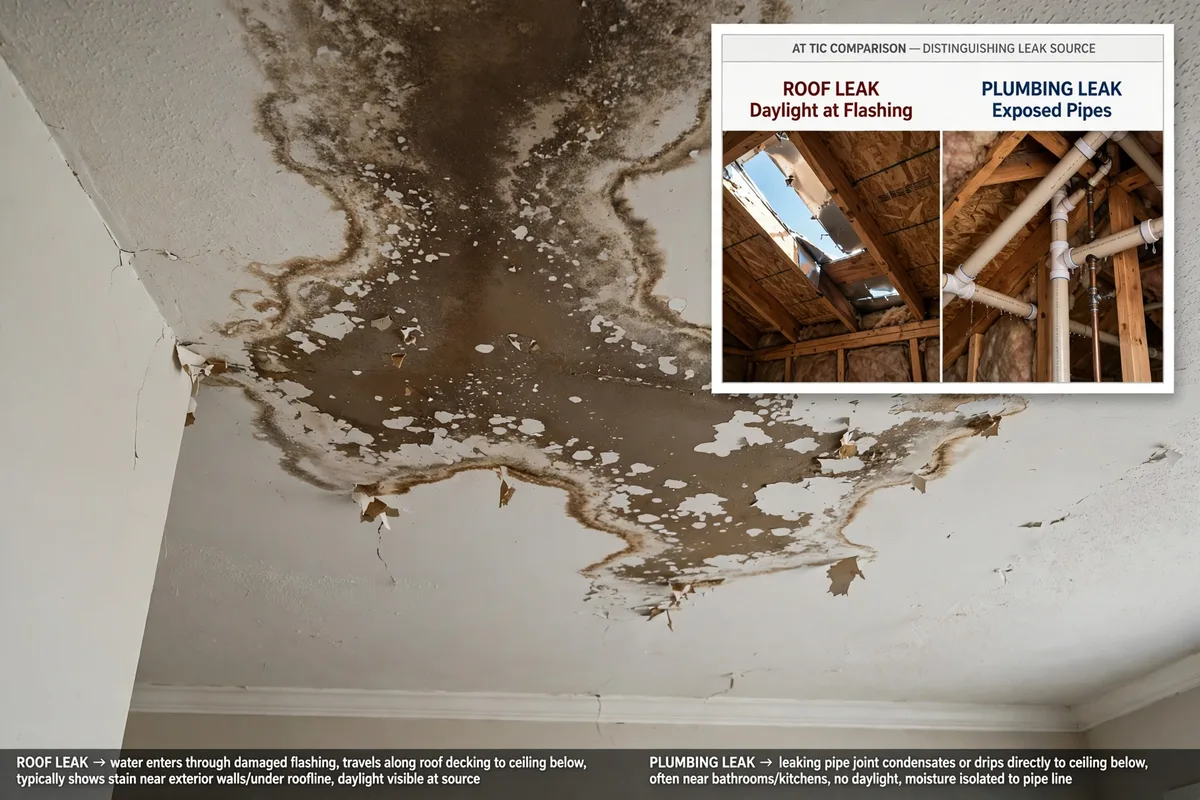
Timing is the single most reliable diagnostic. A roof leak is weather-dependent: the stain appears during rain, grows during storms, and goes dormant in dry weather. A plumbing leak is schedule-independent: it drips, seeps, or sprays whether it is raining or not, because the water comes from pressurized pipes, not from the sky. The homeowner's log is the diagnostic tool — note when the stain appeared, whether it grows on dry days, and whether it worsens after heavy rain. A stain that appeared the morning after a Dallas thunderstorm and has not changed since is a roof suspect; a stain that grows steadily through a dry week is a plumbing suspect. The heavy-rain flooding guide covers the storm-driven side. However, timing can deceive in one common case — a roof leak that soaks the attic insulation, which then releases water slowly for days after the rain stops, mimicking a plumbing leak's steady drip; the attic inspection below resolves it.
The meter test is the definitive answer when timing is ambiguous. Shut off the main water valve at the house (the shutoff guide shows where Dallas homes hide it), then watch the water meter: if the meter's leak indicator is still moving with everything off, water is escaping somewhere in the plumbing. More practically, mark the stain's edge with a pencil and check it over 24 dry hours with the water on, then 24 hours with the water off — a plumbing leak pauses when the pressure is off, a roof leak does not care about your valve. This test costs nothing, takes minutes to set up, and eliminates the most expensive diagnostic mistake: paying a roofer to chase a plumbing leak, or a plumber to chase a roof leak. However, the meter test only catches supply-side leaks — a drain-line leak (a shower drain, a toilet seal) does not move the meter, because drains are not pressurized; those need the usage test, where the stain grows only after the fixture above is used.
Where Does Each Type of Leak Show Up?
| Clue | Roof leak | Plumbing leak |
|---|---|---|
| Location | Top floor, near penetrations | Below wet rooms |
| Timing | During/after rain | Any time |
| Water pattern | Streaks from a point | Round spreading stain |
| Attic signs | Wet rafters, daylight | Dry roof deck |
Location narrows the suspect list fast. Roof leaks appear on the top floor — ceilings directly under the roof, walls near the roofline, around chimneys, skylights, vents, and valleys where flashing fails. The water enters at a penetration and travels along rafters and decking before it finds a ceiling to stain, which is why the stain is often feet away from the actual breach. Plumbing leaks appear anywhere below a water source: ceilings under upstairs bathrooms, walls behind kitchens and laundry rooms, floors above slab lines. A first-floor ceiling stain under a second-floor bathroom is plumbing until proven otherwise — there is no roof above it. The AC condensate guide covers the third suspect that lives in the attic and mimics both. However, water travels — along pipes, along framing, along the top of drywall — so the stain marks where the water exited, not where it entered; the attic or the wall cavity above the stain is where the actual source reveals itself.
The attic inspection is the tiebreaker, and it is safe when done right. Go up during or just after rain with a flashlight (never step on drywall — walk the joists or lay a board). A roof leak shows wet rafters, damp decking, water stains on the wood, and sometimes daylight visible through a failed flashing or a lifted shingle area. Follow the wet wood uphill — water runs down the rafter, so the entry point is above the wettest spot. A plumbing leak in the attic (a supply line to an upstairs bath, a water heater in the attic — common in Dallas) shows a dry roof deck with wet insulation or a dripping pipe below the deck. If the attic is dry and the stain is on a lower ceiling, the source is in the wall or floor cavity — a plumber's territory. However, do not go into the attic during an active storm with lightning, and do not disturb wet insulation barehanded — the inspection is diagnostic, not a repair, and the repair belongs to the roofer or the plumber, not the homeowner with a flashlight.
📞 Water Damage From Any Leak: +1 214-807-4697
What Are the Impostor Leaks That Mimic Both?
Three impostors deserve their spot in the lineup. The AC condensate drain — the most common attic "leak" in Dallas — overflows when the drain line clogs with algae, dripping onto the ceiling below exactly like a roof leak, but on the hottest dry days of summer when no rain has fallen for weeks. The tell is the season and the location: under the air handler, in cooling season, growing steadily in dry weather. The condensate guide covers it fully. The second impostor is condensation: in humid Dallas summers, cold water lines and poorly insulated ducts sweat inside walls and ceilings, producing stains that mimic slow plumbing leaks but stop when the humidity drops or the insulation is fixed. The third is the slab leak's upstairs cousin — no, slab leaks are downstairs, but their symptom pattern (the unexplained water bill, the warm floor) gets misattributed to everything; the slab-leak guide covers the real thing. However, the impostors do not change the response — whatever the source, the water damage needs extraction, drying, and verified dry standards, and the source needs its own tradesperson.
Insurance treats the two suspects differently, and the difference is worth knowing before the adjuster arrives. Roof leaks from a covered peril — wind, hail, a fallen limb — are typically covered, including the resulting interior water damage; roof leaks from wear, age, or neglected maintenance are typically excluded as deterioration. Plumbing leaks from sudden bursts are typically covered; slow seepage over weeks is typically excluded as gradual damage. Either way, the resulting water damage (the stained ceiling, the wet insulation) is usually covered when the source event is covered — the exclusion targets the source repair (the roof itself, the pipe itself), not the damage it caused. Document everything before repairs: photos of the stain, the attic conditions, the weather that day, and the plumber's or roofer's written diagnosis of the source. The claim-denied guide documents how Texas adjusters draw these lines. However, do not wait for the coverage decision to mitigate — shut off the water, contain the spread, call the restoration company, and let the documentation support the claim that follows.
Important Considerations
Urgency differs between the suspects, and the difference should drive the call order. An active plumbing leak is pressurized — a burst supply line releases gallons per minute, and a failed toilet supply or water-heater line can flood a home in hours. That is a shut-the-valve-now emergency, and the restoration call follows immediately. A roof leak is usually slower — drips and seepage rather than flow — but it is not benign: every storm re-wets the cavity, mold colonizes in 24–48 hours, and the saturated insulation and decking deteriorate with each cycle. The Dallas hail season adds a wrinkle: hail-damaged roofs leak intermittently for months before the homeowner connects the stains to the storm, and the insurance claim deadline does not wait for the connection. Our burst pipe repair services page covers the plumbing emergency side. However, do not rank the roof leak as "can wait until the dry season" — the cavity does not dry between storms on its own, and the mold timeline runs on moisture, not on your schedule.
The contractor sequence is the practical payoff of the diagnosis. Roof leak: roofer first to stop the water (emergency tarping if the storm is ongoing), restoration company in parallel for the interior damage. Plumbing leak: plumber first to fix the pipe (or the homeowner shuts the valve and the plumber follows), restoration company in parallel for the water damage. Either way, the restoration company handles the extraction, the structural drying with moisture readings, the remediation if mold is present, and the rebuild — the phases neither the roofer nor the plumber performs. Calling the restoration company does not replace the roofer or the plumber; it covers the damage they do not. However, resist the one-contractor-does-all pitch from the wrong trade — the roofer who offers to "handle the interior too" and the plumber who offers to "dry it out" are both selling outside their expertise, and the water damage phases need the IICRC-standard crew.
Frequently Asked Questions
How can I tell if a ceiling stain is from the roof or plumbing?
Check the timing first: if the stain appeared during or right after rain and stays stable in dry weather, suspect the roof; if it grows steadily regardless of weather, suspect plumbing. Check the location: top-floor ceilings near chimneys, vents, or valleys point to the roof; ceilings below bathrooms or kitchens point to plumbing. Then run the meter test — shut off the main valve and watch for meter movement or stain growth. An attic inspection during rain settles most remaining cases. However, water travels along framing before it stains, so the stain's location is the exit point, not the entry — always verify in the attic or the cavity above before calling the contractor.
Will a roof leak stop when it stops raining?
The dripping stops, but the damage does not. The soaked insulation, decking, and drywall stay wet, and mold colonizes in 24–48 hours on wet organic materials. The next storm re-wets everything, and each cycle deepens the damage — the stain grows, the decking softens, the insulation compresses and loses its R-value. A roof leak is a chronic condition between storms, not an acute one during them. The interior water damage needs extraction and verified drying regardless of the weather forecast. However, emergency tarping between storms is legitimate mitigation — it stops the re-wetting while the permanent roof repair is scheduled, and insurers expect to see it.
Can a plumbing leak happen without the water bill going up?
Yes — drain-line leaks do not move the meter at all, because drains are not pressurized. A leaking shower drain, a failed toilet wax ring, or a cracked drain pipe releases water only when the fixture is used, and the volume is small enough to hide in the water bill's normal variation. Supply-line leaks do raise the bill, often dramatically — the unexplained spike is the classic slab-leak tell. For a suspected drain leak, run the usage test: mark the stain, use the fixture above normally for a day, and watch for growth. However, do not rule out plumbing just because the bill is flat — the drain side is the silent half of the plumbing system, and it fails just as often.
Who do I call first — a roofer, a plumber, or a restoration company?
Call the tradesperson for the source and the restoration company for the damage — in parallel, not in sequence. If the timing and location point to the roof, call a roofer (emergency tarping if it is still raining) and the restoration company together. If they point to plumbing, shut off the valve, call a plumber, and call the restoration company together. The restoration company handles extraction, structural drying, remediation, and rebuild — phases neither the roofer nor the plumber performs. Water Damage Restoration Dallas is available 24/7 at +1 214-807-4697 for the water damage from either source. However, do not let the source contractor talk you out of the restoration phases — the roofer's patch and the plumber's repair stop the water, but neither dries the structure.
Does homeowners insurance cover roof leaks in Texas?
When the roof leak comes from a covered peril — wind, hail, falling objects — yes, including the resulting interior water damage. When it comes from wear, age, or neglected maintenance, typically no — that is deterioration, and the exclusion applies. Dallas hail claims are the common case: the hail damages the shingles, the roof leaks months later, and the claim needs the storm documentation to connect the two. The resulting interior damage (stained ceilings, wet insulation) is usually covered when the source event is covered. However, the roof repair itself is the grayest area — some policies cover it, some depreciate it, some exclude it — so read the roof provisions before the adjuster arrives, not after.
Does homeowners insurance cover plumbing leaks?
Sudden plumbing failures — burst pipes, failed supply lines, ruptured water heaters — are typically covered, including the resulting water damage. Slow seepage over weeks or months is typically excluded as gradual damage and deterioration. The pipe repair itself is usually not covered (wear and tear), but the damage the water caused usually is — the same source-vs-damage split as roof leaks. Document the suddenness: photos, the plumber's report, the timeline of discovery. The claim-denied guide documents how Texas adjusters apply the sudden-vs-gradual test. However, the mitigation duty applies immediately — shut off the water and call for help first, because the policy requires you to prevent further damage and the claim follows the mitigation, not the reverse.
What does an AC condensate leak look like compared to a roof leak?
An AC condensate leak appears in cooling season — the hottest, driest Dallas months — under or near the air handler, growing steadily with no rain in sight. A roof leak appears during or after rain. The condensate tell is the season plus the location: if the stain is spreading in August under the attic air handler and it has not rained in three weeks, it is not the roof. The drain line clogs with algae and the overflow pan either overflows or was never installed. The condensate guide covers the fix and the prevention. However, a condensate leak left running does the same damage as any other leak — the source is mundane, but the water does not care, and the drying and remediation phases are identical.
How much does it cost to fix the water damage from a leak?
Dallas restoration jobs run $2,500–$7,500 for typical events — extraction, structural drying, and light remediation. The source repair is separate: a plumber's pipe fix or a roofer's flashing repair is its own invoice, usually in the hundreds to low thousands depending on access. The Texas average burst-pipe claim is about $15,500 (State Farm), reflecting the full restoration cost. If mold has established (the 24–48 hour window closed), Dallas mold remediation adds $1,200–$3,800. However, the diagnostic phase is nearly free — the timing log, the meter test, and the attic inspection cost nothing — so there is no reason to pay a contractor to tell you which suspect it is before you have run the tests.
Can I just paint over a water stain on the ceiling?
Only after the source is fixed and the area is verified dry — otherwise the paint is a cover-up, not a repair. Painting over a wet or actively leaking stain traps moisture, and the stain bleeds through ordinary paint within weeks. The correct sequence: fix the source, dry the structure to verified moisture standards, remediate if mold is present, seal the stain with a stain-blocking primer, then paint. A stain that returns after painting is the building telling you the source is still active. However, do not skip the primer step — water stains bleed through regular paint even on fully dried drywall, and the stain-blocker is what makes the cosmetic repair actually cosmetic.
What if the leak is between the floors and I can't see the source?
Hidden-cavity leaks are the plumber's diagnostic territory: acoustic listening equipment, thermal imaging, and strategic access cuts locate the source without demolishing the ceiling. The homeowner's contribution is the timing log and the usage test — which fixtures make it grow, whether the meter moves, whether rain matters. Do not start cutting exploratory holes yourself — the professional locates first and cuts once. Once the source is fixed, the restoration company opens the cavity properly, dries it to verified standards, remediates if needed, and rebuilds. However, a hidden leak that has run for weeks is a mold suspect by definition — the 24–48 hour window closed long ago, so scope the remediation assessment into the project from the start.
Does Water Damage Restoration Dallas find the leak source?
We locate and document water intrusion as part of the restoration scope — moisture mapping, thermal imaging, and cavity inspection to define the affected area — and we handle the full water damage: extraction, structural drying, remediation, and rebuild. For the source repair itself (the roof or the pipe), we coordinate with and refer to licensed roofers and plumbers, because the source is their trade and the damage is ours. Serving Dallas 24/7 from 315 North St. Paul Street, Dallas, TX 75201, with typical 60-minute emergency arrival. Call +1 214-807-4697 — we will tell you honestly which tradesperson you need and handle everything the water touched. However, if the water is actively flowing, shut the main valve first and call us second — the two-minute valve shutoff saves more than any crew can.
How fast should I act on a ceiling stain?
Immediately for an active plumbing leak — shut the valve and call for help, because pressurized water does the most damage the fastest. Within days for a roof leak — tarp if rain is coming, schedule the roofer, and get the interior drying started, because mold colonizes in 24–48 hours. The stain is never "just cosmetic" until the source is fixed and the cavity is verified dry — it is the visible edge of a wet cavity you cannot see. Dallas restoration jobs run $2,500–$7,500, and the fast call keeps the job at the lower end of that band. However, do not panic about a small, stable, explained stain — a documented, fixed, dried, and sealed stain is a completed project, not an emergency; the urgency belongs to the active and the unknown.
📞 Free Leak-Damage Assessment: +1 214-807-4697
📞 Call Water Damage Restoration Dallas Now: +1 214-807-4697
Related Dallas Water Damage Guides
- How to Find Your Main Water Shutoff Valve in a Dallas Home (Before You Need It)
- Slab Leak Detection in Dallas: Signs, Methods, Costs, and Repair Options
- Burst Pipe Water Damage Repair in Dallas, TX: The Full Process From Flood to Fixed
- Can a Leaking AC Drain Line Really Cause Water Damage in My Dallas Home?