Home › Service Areas › Grand Prairie
Grand Prairie Water Damage Restoration — 24/7 Flood Cleanup
Grand Prairie sits between two rivers' worth of trouble. The West Fork Trinity River runs along the city's north edge, Johnson Creek cuts straight through town, and Joe Pool Lake anchors the south — so when a DFW storm stalls overhead, the water has somewhere to go, and too often that somewhere is a living room. The city's own flood warning system, with stream and rain gauges across its creeks, exists because the risk is real: most DFW storms move west to east, the same direction the streams flow, so creeks here react very fast. Add an older 1950s–70s housing core around Dalworth with copper lines under clay-soil slabs, newer subdivisions like Lake Ridge and Mira Lagos, and the warehouses of the Great Southwest Industrial District — and Grand Prairie's water damage comes in more shapes than almost any suburb we serve.
Water Damage Restoration Dallas answers Grand Prairie calls live around the clock from our downtown Dallas dispatch, about 25 minutes east on I-30. The first visit covers extraction, moisture mapping and a free written estimate — and because Grand Prairie losses so often involve creek flooding, our crews document everything an insurance adjuster needs from hour one, including the flood-versus-plumbing distinction that decides which policy pays.
Water in the house — or a creek rising toward it? Same-day Grand Prairie response, free estimates.
📞 Call +1 214-807-4697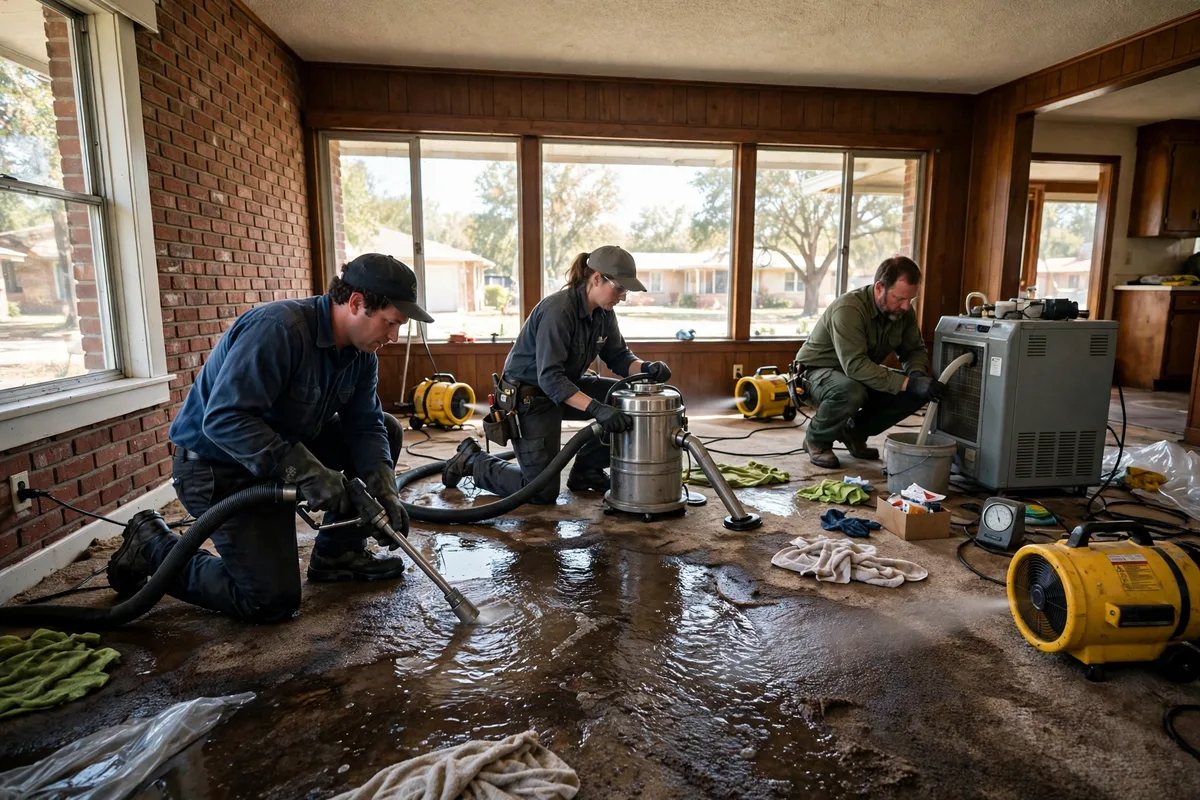
What Water Damage Looks Like in Grand Prairie
River and creek flooding. The West Fork Trinity and Johnson Creek are Grand Prairie's main flood sources, with Fish Creek adding risk in the east. Homes in FEMA Zones AE and AO near those waterways flood first, and the city's flat terrain also sees sheet-flow flooding — shallow water spreading across broad ground rather than channelling through a creek. Dallas County has recorded 3,455 NFIP flood insurance claims since 1978, totalling $69.2 million in payouts, and 316 flood events since 1996 causing $1.4 billion in damage county-wide.
Flash flooding and stormwater backup. Because Grand Prairie's streams flow west to east — the same direction most storms travel — water levels rise fast, sometimes before the rain has even stopped. Street flooding and overwhelmed storm drains push water under doors and into garages well outside the mapped floodplain, and the city runs a flood warning system with gauges and inundation maps precisely because the response window is so short.
Slab leaks in the 1950s–70s core. The Dalworth area and the post-war neighborhoods around it were built with copper supply lines under concrete slabs on expansive clay. Decades of soil movement flex those lines until pinhole leaks form — a slow, hidden loss that wastes thousands of gallons a month and saturates the soil supporting the foundation before anyone sees a wet spot.
Warehouse and commercial losses. The Great Southwest Industrial District and the logistics corridors along I-20, I-30 and SH-360 put thousands of warehouse square feet in the flood and leak path. A roof leak over racking, a sprinkler failure, or dock flooding can wet inventory across a whole bay before the Monday crew arrives — and the job is as much about protecting stock and documenting the loss as it is about drying the building.
Our Grand Prairie Restoration Services
Emergency Water Extraction
Standing water removed on the first visit, day or night, before it migrates into wall cavities, subflooring and stored goods.
Flood & Creek Cleanup
Contaminated-water extraction, sanitation and material removal after West Fork Trinity, Johnson Creek and Fish Creek flooding.
Slab Leak Water Damage
Moisture mapping to find the spread, controlled drying around the repair, and documentation for the access work insurers cover.
Commercial & Warehouse Drying
Large-scale dehumidification for the Great Southwest Industrial District — inventory protection, racking access and landlord-ready documentation.
Structural Drying
Commercial dehumidification and air movement, monitored daily against moisture targets until the structure verifies dry.
Mold Remediation
Containment and removal when a slow Grand Prairie leak has been feeding mold inside walls — growth can start within 24–48 hours of a wetting event.
How Much Does Water Damage Restoration Cost in Grand Prairie?
| Job type | Typical range |
|---|---|
| Most residential water damage jobs | $2,500 – $7,500 |
| Slab leak detection (locating the leak) | $150 – $400 |
| Mold remediation, when a leak went undetected | $1,200 – $3,800 |
| Emergency estimate on site | Free |
However, the pipe repair itself and the water damage it caused are two different scopes — and usually two different pockets. Homeowners insurance typically covers the resulting damage and the access to reach the leak, while the pipe fix is often the homeowner's cost. Floodwater from outside is a separate matter — it needs flood insurance, not a standard policy. We scope both clearly in writing so there are no surprises; our flood damage restoration guide and our storm damage cleanup steps explain what to watch for before a small leak becomes a restoration job.
Suspect a hidden slab leak? Moisture mapping finds it before the floor has to come up.
📞 Call +1 214-807-4697Grand Prairie Areas We Cover
All of Grand Prairie — ZIP codes 75050, 75051, 75052 and 75054 — including Dalworth, Lake Ridge, Mira Lagos, Grand Peninsula, Westchester, the Carrier Parkway area, the Great Southwest Industrial District, and the Joe Pool Lake and Lynn Creek area. Crews also cover the neighbouring pages in this cluster: Irving, Duncanville and Cedar Hill. See the full list of communities we serve on our service-area hub — and if the loss involves fire as well as water, our fire damage restoration page covers the combined cleanup.
Grand Prairie Water Damage FAQs
How much does water damage restoration cost in Grand Prairie?
Most residential water damage jobs in Grand Prairie land between $2,500 and $7,500, the same range as Dallas overall. A contained supply-line leak dried early sits at the low end; a creek flood or a slab leak that has soaked several rooms costs more. We give a free written estimate on site before paid work begins — call +1 214-807-4697.
Which parts of Grand Prairie flood most often?
The West Fork Trinity River along the city's north edge and Johnson Creek cutting through town are the main flood sources, with Fish Creek adding risk in the east. Homes in FEMA Zones AE and AO near those waterways flood first, and the city's flat terrain also sees sheet-flow flooding — shallow water spreading across broad ground — well outside the mapped floodplain. Dallas County has recorded 3,455 NFIP flood claims since 1978, totalling $69.2 million in payouts.
Does flood insurance cost less in Grand Prairie?
Yes — Grand Prairie holds a CRS Class 4 rating, one of the strongest floodplain management ratings in the region, which earns policyholders a 30% discount on NFIP flood insurance premiums. The rating reflects the city's levee systems, flood warning network and floodplain rules. A standard homeowners policy still does not cover flooding; the discount applies to a separate flood policy.
Does homeowners insurance cover flood damage from the Trinity River or Johnson Creek?
No. Standard Texas homeowners policies exclude flooding from outside water — river and creek flooding, storm surge and rising water all need a separate flood insurance policy. The same policy does cover sudden and accidental water damage from inside the home, such as a burst pipe or a failed appliance line. We document the loss with photos and moisture readings from the first visit so your adjuster has what the claim needs.
Why do so many older Grand Prairie homes get slab leaks?
Grand Prairie's older core — the Dalworth area and the 1950s to 1970s neighborhoods — was built with copper supply lines under concrete slabs, on expansive clay soil that swells when wet and shrinks in drought. Decades of that movement flex the lines until pinhole leaks form. A warm spot on the floor, a sudden water-bill spike, or the sound of running water with everything off are the classic signs.
How long does water damage restoration take in Grand Prairie?
Extraction happens on the first visit. Structural drying typically runs 3 to 5 days with daily moisture monitoring, and repairs follow once readings confirm the structure is dry. Creek-flood jobs take longer because floodwater is contaminated and affected materials usually need removal, and warehouse losses run longer still when inventory and racking are involved.
How fast can you reach a Grand Prairie address?
Our dispatch is in downtown Dallas, roughly 25 minutes from Grand Prairie via I-30. Crews typically arrive within about an hour across ZIP codes 75050, 75051, 75052 and 75054, and the call is answered live 24/7 — call +1 214-807-4697.
Grand Prairie water damage? The first hour decides the size of the job.
📞 Call +1 214-807-4697 — 24/7