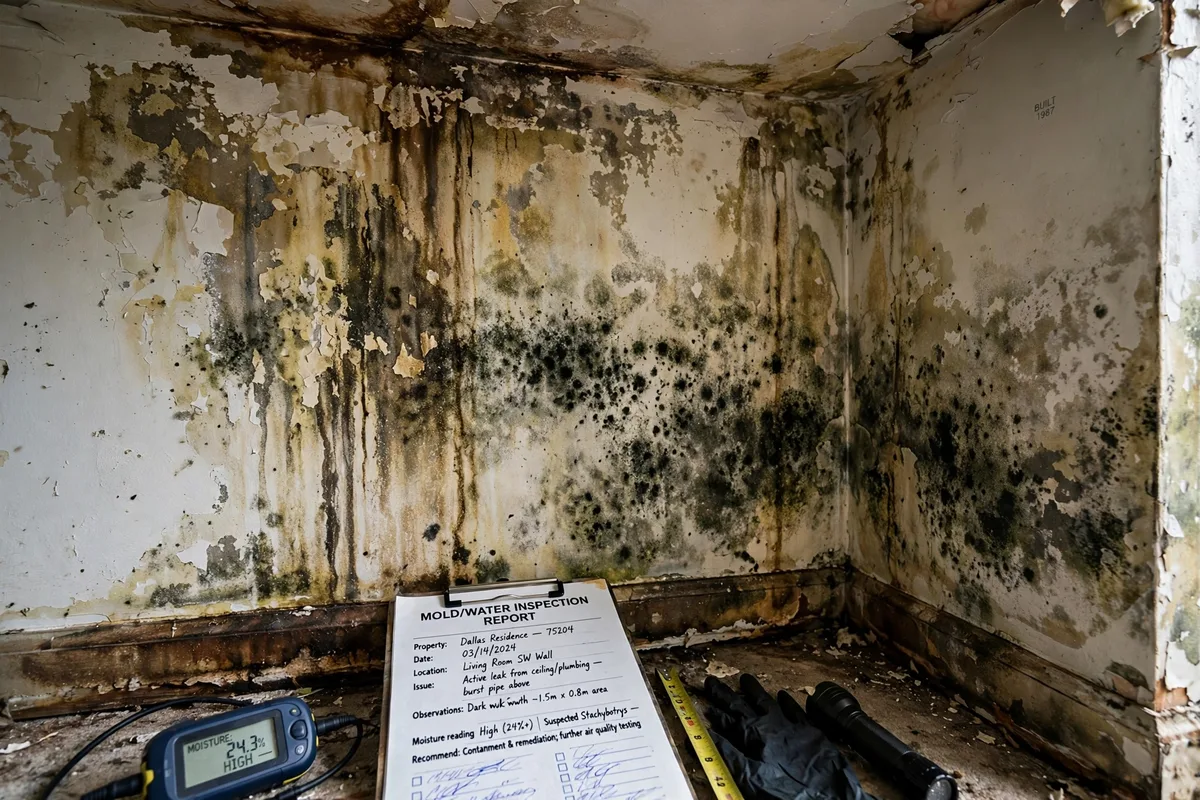
Black Mold After Water Damage: What Actually Matters
TLDR
- What is black mold?: "Black mold" usually means Stachybotrys chartarum, a dark mold that grows on very wet, cellulose-rich materials like drywall and wood — but many harmless molds are also black.
- Is black mold more dangerous than other mold?: Not automatically — health risk depends on the species, the concentration, the exposure, and the person, not on the color; only lab testing identifies the species.
- How fast does black mold grow after water damage?: Mold of any color starts in 24–48 hours on wet materials, and Stachybotrys typically needs a week or more of sustained wetness to establish.
- Can I clean black mold myself?: Small surface patches (under 10 square feet, on hard non-porous surfaces) can be cleaned with proper protection; larger growth, HVAC contamination, or sewage-related mold needs professionals.
- Does bleach kill black mold?: Bleach kills surface mold on hard surfaces but does not remove mold roots from porous materials like drywall — which is why it often appears to "come back."
- When is professional remediation required?: When growth exceeds 10 square feet, when it is inside walls or HVAC, when sewage water was involved, or when anyone in the home has respiratory illness.
- Black mold in your Dallas home?: Water Damage Restoration Dallas inspects, contains, and remediates 24/7: +1 214-807-4697.
The photo goes to the group chat, the internet says "toxic black mold," and suddenly a damp patch behind the washing machine feels like an emergency evacuation. The fear is understandable — and mostly misdirected. "Black mold" is a color description, not a diagnosis: the species most people mean, Stachybotrys chartarum, is indeed dark, but so are many common, low-risk molds, and color alone tells a professional nothing about toxicity. What actually matters after water damage is not the color of the growth but its extent, its location, what water fed it, and whether the moisture that grew it is still there. A small black patch on a bathroom tile is a cleaning job; black growth across the drywall of a room that flooded a week ago is a remediation job with containment, air filtration, and material removal. Dallas mold remediation typically runs $1,200–$3,800, and the difference between the two scenarios is measured in square feet, moisture readings, and days since the water arrived — not in how scary the photo looks. However, the fear does serve one useful purpose: it gets people to act fast, and speed is the one thing that actually controls mold after water damage.
📞 Black Mold Worries? Call Now: +1 214-807-4697
What Is "Black Mold," Really?
Stachybotrys chartarum is a dark greenish-black mold that grows on cellulose-rich materials — drywall paper, wood, ceiling tiles, cardboard — that have stayed very wet for an extended period. It is the species behind most "toxic black mold" headlines, because it can produce mycotoxins (compounds that are toxic in laboratory conditions) under certain conditions. The critical qualifier is "can" — mycotoxin production depends on the strain, the material, the moisture level, and the growth stage, and the presence of dark mold does not prove mycotoxins are present or airborne at harmful levels. Meanwhile, several common molds are also black or dark: Aspergillus niger is black and ubiquitous, Cladosporium is dark olive-to-black and one of the most common indoor molds, and Alternaria is dark as well. A homeowner looking at a dark patch cannot distinguish Stachybotrys from Aspergillus niger by eye, and neither can most contractors — only laboratory analysis of a sample identifies the species. The mold-clock guide covers the growth timeline that applies to all of them. However, the species question, while interesting, is rarely the decision that matters — the remediation decision is driven by extent, location, and moisture, and those are knowable without a lab report.
Is Black Mold More Dangerous Than Other Mold?
| Mold type | Typical color | Health relevance |
|---|---|---|
| Stachybotrys | Dark green-black | Possible mycotoxins |
| Aspergillus niger | Black | Allergenic, common |
| Cladosporium | Dark olive-black | Allergenic, common |
| Penicillium | Blue-green | Allergenic, spreads fast |
| Alternaria | Dark brown-black | Asthma trigger |
| Chaetomium | Dark, cottony | Wet-material indicator |
The table's point is that color and danger do not track together: the most common allergenic molds include several black ones, and the headline species is only one row among six. Health effects from indoor mold exposure generally fall into three categories: allergic reactions (sneezing, itchy eyes, skin irritation), asthma aggravation (wheezing, attacks in asthmatics), and, for immunocompromised people, infection risk from certain species. The people at highest risk are not "everyone in the house" — they are asthmatics, allergy sufferers, infants, the elderly, and the immunocompromised, and the risk scales with exposure concentration and duration. A small, contained patch cleaned promptly is a low-risk event; a large, hidden colony behind walls, releasing spores into the HVAC system for weeks, is a high-exposure event regardless of species. The stay-or-go guide covers the occupancy decision during remediation. However, the health conversation should never be settled by a blog post — anyone with respiratory symptoms, asthma, or immune concerns should talk to a clinician, and anyone unsure about the extent of growth should get a professional assessment rather than guessing from a photo.
How Fast Does Black Mold Grow After Water Damage?
Mold in general starts in 24–48 hours on wet porous materials — that is the universal clock, and it applies to every species on the table above. Stachybotrys specifically is a slow colonizer: it typically needs a week or more of sustained, heavy wetness to establish, because it competes poorly against faster molds like Penicillium and Aspergillus in the early days. That timing fact reframes the fear: a home dried within 3–5 days (the standard structural drying window) rarely develops Stachybotrys at all, because the moisture is gone before the slow species can establish. The black mold scenarios that make headlines are almost always homes where water sat for weeks — a slow leak behind a wall, a flooded room left to "air out," a vacation home with a burst pipe discovered on return. The growth sequence runs: spores (always present in indoor air) land on wet material, germinate within 24–48 hours, form visible colonies within days for fast species, and reach the heavy, established growth of slow species after a week-plus of continuous wetness. The hidden-mold guide covers how to detect growth you cannot see. However, the timeline also means the response window is generous in the first days and unforgiving after the first week — the difference between a drying job and a remediation job is often just the number of days between the water event and the call.
Can I Clean Black Mold Myself?
For small, surface-level growth — under 10 square feet, on hard non-porous surfaces like tile, glass, or metal — yes, with proper protection: an N95 respirator, gloves, eye protection, and ventilation that exhausts outside rather than recirculating through the house. Clean with detergent and water, dry the surface completely, and fix the moisture source — cleaning without fixing the moisture guarantees regrowth. The DIY line is drawn at three boundaries: size (over 10 square feet is a professional job under EPA guidance), material (porous materials like drywall, carpet, and insulation cannot be cleaned — the mold's roots penetrate the material, and the material must be removed), and location (growth inside walls, under flooring, or in the HVAC system needs containment and air filtration that DIY cannot provide). Sewage-related mold is always professional — the contamination category outranks the size rule. The bleach-myth guide explains why the most common DIY chemical fails on porous materials. However, the most common DIY mistake is not the cleaning method — it is disturbing a large colony without containment, which releases a cloud of spores into the home and turns a contained problem into a whole-house problem.
Why Does Bleach Seem to Work and Then Fail?
Bleach kills mold on the surface it touches — which is why the patch disappears and the homeowner believes the job is done. On hard, non-porous surfaces, that is actually true: bleach plus scrubbing removes surface mold effectively. On porous materials — drywall, wood, grout, ceiling tiles — bleach's chlorine stays on the surface while its water component soaks into the material, feeding the mold roots below. The surface looks clean for days or weeks, then the growth returns from the roots, often worse, because the material is now wet again. The correct approach for porous materials is removal: cut out the affected drywall (with containment), discard the insulation behind it, and dry the framing before rebuilding. For hard surfaces, detergent and water plus thorough drying outperforms bleach, and antimicrobial products designed for mold (concrobium-type solutions) address the roots better than chlorine. The chemistry is simple: mold is a moisture problem wearing a color, and any treatment that adds moisture without removing the material is a delay, not a cure. However, the bleach mistake is forgivable — it is the most marketed mold product in every hardware aisle, and the failure mode (surface clean, roots alive) is invisible until the regrowth appears.
📞 Mold Assessment Needed? +1 214-807-4697
When Is Professional Remediation Required?
Professional remediation is required when any of four triggers is present: growth over 10 square feet; growth inside wall cavities, under flooring, or in the HVAC system; growth fed by sewage or category 3 water; or anyone in the home with asthma, allergies, immune compromise, or respiratory symptoms. The professional process follows the IICRC S520 standard: containment (plastic barriers and negative air pressure so spores do not spread), HEPA air filtration (air scrubbers running during and after removal), removal of affected porous materials (cut, bagged, and sealed inside containment), HEPA vacuuming and cleaning of remaining surfaces, and clearance verification (visual inspection plus, when specified, air or surface testing against outdoor baselines). The remediation process guide walks the full sequence. Dallas mold remediation typically runs $1,200–$3,800, with the range driven by area size, containment complexity, and whether HVAC cleaning is included. However, the cost of remediation should never be the reason to delay it — mold that is left growing while the homeowner shops for quotes keeps growing, and the colony that was 12 square feet in October is a larger, more expensive job in November.
Important Considerations
Three cautions matter more than the color debate. First, testing: air sampling can identify species and concentration, but a test result does not replace the remediation decision — a large visible colony needs removal whether the lab names it Stachybotrys or Aspergillus, and a clean test result does not prove a hidden colony does not exist. Test when the health question is specific (a clinician wants species data) or when clearance verification is required — not as a substitute for looking. Second, insurance: mold coverage in Texas is limited — policies typically cover mold resulting from a covered water loss, with sublimits below the typical job cost unless a mold endorsement exists, and mold from an uncovered cause (long-term leak, flood without flood insurance) is generally uncovered. Third, the moisture source: remediation without moisture repair is a rental, not a fix — the leak, the drainage failure, or the humidity source must be corrected or the mold returns on the same schedule. Our mold remediation page covers the service standard. However, the biggest consideration is psychological: the fear of "toxic black mold" should drive fast action, not paralysis or panic — call, assess, contain, and fix the moisture, in that order.
Frequently Asked Questions
What is black mold?
"Black mold" is a color description, not a species — the species most people mean is Stachybotrys chartarum, a dark greenish-black mold that grows on very wet cellulose materials like drywall and wood. Several common molds are also black, including Aspergillus niger and Cladosporium, and color alone cannot identify the species — only lab testing can. Health risk depends on species, concentration, exposure, and the person, not on color. However, the practical response does not depend on the species name: extent, location, and moisture decide whether the job is cleaning or remediation.
Is black mold toxic?
Stachybotrys can produce mycotoxins under certain conditions, but presence of dark mold does not prove mycotoxins are present or airborne at harmful levels. The documented health effects of indoor mold exposure are primarily allergic reactions and asthma aggravation, with infection risk concentrated in immunocompromised people. The risk scales with exposure concentration and duration — a small contained patch is low-risk, a large hidden colony feeding the HVAC system is high-exposure. However, anyone with respiratory symptoms, asthma, or immune concerns should talk to a clinician rather than relying on general guidance.
How fast does black mold grow after a flood?
Mold of any color starts in 24–48 hours on wet materials. Stachybotrys specifically is a slow colonizer that typically needs a week or more of sustained wetness to establish, which is why homes dried within the standard 3–5-day structural drying window rarely develop it. The headline black-mold cases are almost always homes where water sat for weeks — a slow leak, a flooded room left to air out, a burst pipe discovered on return. However, the fast species colonize within days, so the 24–48-hour clock is the one that matters for the first response — dry fast, and the slow species never gets its chance.
Can I use bleach on black mold?
On hard, non-porous surfaces, bleach kills surface mold — but on porous materials like drywall and wood, bleach's chlorine stays on the surface while its water soaks in and feeds the mold roots below. The patch looks clean for days, then regrows from the roots. Porous materials with mold growth must be removed, not bleached. For hard surfaces, detergent and water plus thorough drying works better than bleach, and the moisture source must be fixed or regrowth is guaranteed. However, the bleach mistake is common and forgivable — it is the most marketed mold product available, and its failure mode is invisible until regrowth appears.
How much area of mold can I clean myself?
Under 10 square feet, on hard non-porous surfaces, with an N95 respirator, gloves, and eye protection — that is the EPA's DIY boundary. Over 10 square feet, inside walls or HVAC, fed by sewage water, or in a home with respiratory illness in residence, the job is professional. The boundary is about containment as much as size: disturbing a large colony without barriers and negative air pressure releases spores throughout the home. However, the DIY rule assumes the moisture source is fixed — cleaning without fixing the leak is a delay, not a cure, regardless of size.
Does black mold mean I have to move out?
Not automatically — the stay-or-go decision depends on the extent, the location, and who lives in the home, and it is covered in the stay-or-go guide. Small, contained growth with professional remediation underway is usually compatible with staying, with containment barriers and HEPA filtration in place. Whole-home contamination, HVAC involvement, or respiratory illness in the household can justify temporary relocation. However, the decision should be made with the remediation crew and, for health questions, a clinician — not from the color of the mold in a photo.
Will mold come back after remediation?
Only if the moisture returns — remediation removes the colony, but the leak, drainage failure, or humidity source that fed it must also be corrected, or the same materials will support new growth on the same schedule. Proper remediation includes drying the structure to verified readings before rebuilding, so the rebuilt materials start dry. Post-remediation, watch the area for musty odor or discoloration, and fix any new water intrusion immediately. However, "mold-proof" is not a real promise — every home has airborne spores, and the defense is dry materials, not sterile ones.
Should I get mold testing before remediation?
Testing is useful when the question is specific — a clinician wants species data, or clearance verification is required after remediation — but it does not replace the remediation decision for visible growth. A large visible colony needs removal whether the lab names it Stachybotrys or Aspergillus, and a clean air test does not prove a hidden colony does not exist. Testing also costs money that is often better spent on the remediation itself. However, test when the health stakes are high or when a hidden colony is suspected but not visible — the hidden-mold guide covers the detection methods.
Does insurance cover black mold remediation?
Partially: Texas policies typically cover mold resulting from a covered water loss, but with sublimits below the typical $1,200–$3,800 job cost unless a mold endorsement exists. Mold from an uncovered cause — a long-term leak, flood water without flood insurance — is generally uncovered. Document the water event, the moisture readings, and the remediation scope for the claim. However, the coverage question should never delay the health question — mold grows on its own schedule, and the remediation decision should not wait for the adjuster's verdict.
What does professional black mold remediation involve?
Containment (plastic barriers, negative air pressure), HEPA air filtration, removal of affected porous materials (bagged and sealed inside containment), HEPA vacuuming and cleaning of remaining surfaces, drying to verified readings, and clearance verification. The process follows the IICRC S520 standard, and the full sequence is in the remediation process guide. Dallas jobs typically run $1,200–$3,800 depending on area, containment complexity, and HVAC involvement. However, the process is only as good as its last step — rebuilding over materials that have not been verified dry traps the moisture that started the problem.
Can black mold grow in my HVAC system?
Yes — HVAC systems spread spores through ductwork when mold grows on coils, drain pans, or duct lining, and HVAC involvement is one of the triggers for professional remediation regardless of the visible area. Signs include musty odor when the system runs, visible growth on vents or coils, and symptoms that worsen when the HVAC operates. HVAC mold requires specialized cleaning and sometimes duct component replacement — it is never a DIY filter change. However, the HVAC is also the distribution system for the whole home, which is why HVAC involvement changes the containment plan for the entire job.
Does Water Damage Restoration Dallas handle black mold?
Yes — inspection with moisture mapping, containment, HEPA filtration, removal of affected materials, drying to verified readings, and clearance support, all under the IICRC S520 approach. From 315 North St. Paul Street, Dallas, TX 75201, 24/7, with typical 60-minute emergency arrival and IICRC-certified technicians. Call +1 214-807-4697 any time. However, we are the remediation crew, not a medical authority — for health questions about exposure, talk to a clinician, and we will handle the building.
📞 Free Mold Inspection: +1 214-807-4697
📞 Call Water Damage Restoration Dallas Now: +1 214-807-4697