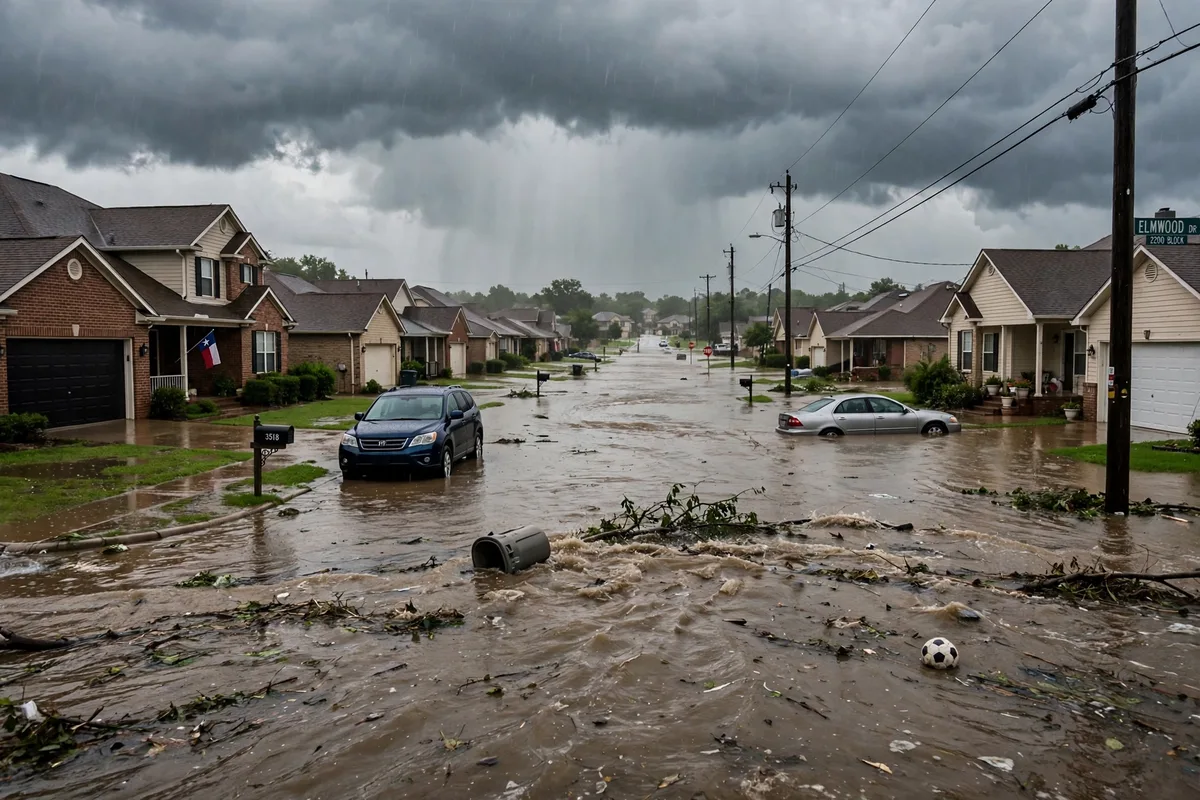
Dallas Is in Flash Flood Alley: What That Means for Your Home
TLDR
- What is Flash Flood Alley?: A corridor across Central Texas — including Dallas — where intense rainfall, steep terrain, and clay soils combine to produce dangerous flash flooding with little warning.
- Why does Dallas flood so fast?: Heavy rain falls faster than drainage can carry it away, and North Texas clay soils absorb little water, so runoff sheets across streets and into homes within minutes.
- Which Dallas areas flood first?: Low-lying areas near creeks and the Trinity River floodplain, streets with poor drainage, and homes at the bottom of slopes — not only mapped flood zones.
- Does my home need flood insurance if it is not in a flood zone?: Yes, consider it — a large share of flood claims come from outside mapped high-risk zones, and Dallas drainage flooding hits homes the map calls safe.
- What should I do before a flash flood warning?: Move valuables upstairs, clear drains and gutters, know your shutoffs, and never drive through flooded streets.
- What do I do when water enters my home?: Stay out of the water (electrical and contamination risk), call for extraction immediately, and document the water's path for the claim.
- Flash flooding in your Dallas neighborhood?: Water Damage Restoration Dallas responds 24/7 with extraction and drying: +1 214-807-4697.
Dallas rain does not always arrive as a gentle soaking — it arrives as inches in an hour, streets turning to rivers, and water finding the lowest point in the neighborhood, which is sometimes your living room. The reason is geography, not bad luck: Dallas sits in Flash Flood Alley, the corridor across Central Texas where intense rainfall, urban development, and clay soils combine to produce flash flooding faster and more often than almost anywhere else in the country. The flooding that results is not the slow river rise of a hurricane week — it is the fast, local, drainage-driven flood that overwhelms a street in twenty minutes and is gone in two hours, leaving a soaked house behind. Dallas-area water jobs run $2,500–$7,500, and flash-flood losses are among the most expensive because the water is contaminated, the damage is widespread, and the cleanup cannot wait. However, Flash Flood Alley is not a curse — it is a known risk with known defenses, and the homeowners who fare best are the ones who understand the mechanism before the warning sounds.
📞 Flash Flood Water in Your Home? +1 214-807-4697
What Is Flash Flood Alley?
Flash Flood Alley is the corridor running from San Antonio through Austin to Dallas–Fort Worth, named for its exceptional flash flood frequency. The ingredients are specific: moist Gulf air collides with weather systems over the Balcones Escarpment, producing intense, slow-moving thunderstorms that drop inches of rain in an hour; the terrain rises from coastal plain to Hill Country, concentrating runoff; and the soils — particularly the expansive clays of North Texas — absorb little water once saturated, so rainfall becomes runoff almost immediately. Urban development amplifies it: pavement, rooftops, and compacted soil shed water instead of absorbing it, and storm drains sized for ordinary rain are overwhelmed by alley-rate downpours. The result is flooding that arrives with minimal warning — a creek that was ankle-deep at noon is over its banks at 12:30, and a street that drains normally in a typical storm becomes a river in an alley storm. The National Weather Service's flash flood warnings for the Dallas area are among the most frequent in the country, and the alley's reputation is earned in lives as well as property — most flash flood deaths involve vehicles in flooded streets. However, the alley label is also a planning tool: it tells Dallas homeowners that flooding is not a rare disaster but a recurring local hazard, and recurring hazards reward preparation rather than surprise.
Why Does Dallas Flood So Fast?
Speed is the alley's signature, and it comes from three compounding factors. Rainfall intensity: Dallas thunderstorms routinely deliver 2–4 inches in an hour, a rate that exceeds the design capacity of most neighborhood drainage. Soil behavior: North Texas clay absorbs water slowly and, once saturated, sheds nearly all additional rainfall as surface runoff — the ground stops helping within the first hour of a heavy storm. Urban surface: Dallas's pavement, parking lots, and rooftops convert rainfall to runoff instantly, and the runoff concentrates in streets, culverts, and low spots faster than the drainage network can move it. The combination means a Dallas home can go from dry to flooded in the time it takes to watch a storm build — and the water does not need a river to arrive. Street runoff, overwhelmed culverts, and sheet flow across yards are the usual delivery mechanisms, which is why homes far from any creek still flood. The basement flooding guide covers the specific paths water takes into Dallas homes. However, the speed also means the warning window is short — the time to prepare is before the storm season, not during the warning, because the warning itself may give only minutes.
Which Dallas Areas Flood First?
| Area type | Flood mechanism | Warning sign |
|---|---|---|
| Creek-adjacent homes | Creek overbank flow | Water at creek banks |
| Trinity floodplain | River rise, backwater | Levee-area alerts |
| Low street sections | Drainage overwhelm | Ponding at curbs |
| Bottom-of-slope homes | Sheet flow, yard runoff | Water pooling uphill |
| Older drainage areas | Undersized culverts | Chronic street ponding |
| New developments | Grading, unfinished drainage | Bare-soil runoff |
The table's message is that flood risk in Dallas is local, not just mapped — the FEMA floodplain covers the creek and river corridors, but the street-drainage and slope-driven flooding that fills most Dallas claims happens outside those lines. Creek-adjacent homes in Lakewood, along White Rock Creek and its tributaries, face overbank flow during alley storms. Homes at the bottom of slopes collect every yard's runoff. Older neighborhoods with undersized culverts pond at every heavy rain, and new developments with unfinished grading shed bare-soil runoff at their neighbors. The flood restoration guide covers the cleanup process for any of these mechanisms. However, the map is still worth checking — not as a guarantee but as a starting point — and the real risk assessment is a walk around the property: where does water go in a heavy rain, where does it pond, and where is the lowest entry point into the house.
What Should Dallas Homeowners Do Before Flash Flood Season?
Preparation is a short list with high returns. Know your property's water paths: walk the yard during a heavy rain (safely, from inside or from high ground) and note where water flows, ponds, and enters. Clear gutters, downspouts, and street drains near the property — a clogged drain turns a manageable storm into a flooded street. Extend downspouts away from the foundation and verify grading slopes away from the house — the storm cleanup guide covers the post-storm sequence. Move valuables, documents, and electronics to upper floors or high shelves before storm season, not when the warning sounds. Know the shutoffs — main water valve, electrical panel, gas — because floodwater and electricity are a lethal combination, covered in the electrical safety guide. Review flood insurance: standard homeowners excludes rising water, and NFIP policies carry a 30-day waiting period, so the time to buy is before the forecast, not during it. The flood-versus-water insurance guide explains the coverage distinction in detail. However, the single highest-value preparation is the simplest: a household flood plan — where everyone goes, what gets moved, and who to call — written down before the season, because the warning itself leaves no time for planning.
What Do I Do When Water Is Entering My Home?
First, do not enter the water — floodwater carries sewage, chemicals, and debris, and it conducts electricity from submerged outlets, appliances, and damaged wiring. If the electrical panel is safely accessible and dry, shut off power to affected areas; if it is not, stay out and wait for professionals. Move to high ground within the home, move valuables upstairs if it can be done without entering the water, and call for extraction immediately — the house-floods guide covers the first-hour sequence. Document the water's path with photos and video from a safe position: the entry points, the water level, the exterior street conditions — this documentation decides whether the claim is a flood claim or a homeowners claim. Do not drive through flooded streets, ever: most flash flood deaths involve vehicles, and six inches of moving water can knock a person down while twelve inches can carry a car. However, the most important action is also the simplest — call early, because extraction and drying that start the same day prevent the mold, structural, and contamination damage that turns a flood into a rebuild.
📞 Flood Emergency? Call Now: +1 214-807-4697
What Happens After the Water Recedes?
The cleanup sequence for flash flood water is longer than for a clean-water loss, because floodwater is category 3 (contaminated) by definition. Porous materials that contacted floodwater — drywall, carpet, insulation, upholstered furniture — are removed, not dried, because contamination cannot be reliably cleaned from porous material. Hard surfaces are cleaned and disinfected, the structure is dried to verified moisture readings, and the rebuild follows only after verification. The timeline runs longer than a burst-pipe job: demolition and sanitation add days, and the drying phase still runs its 3–5-day course after the contaminated materials are out. Dallas-area water jobs run $2,500–$7,500 for clean-water losses, and flood losses often exceed that range because of the removal and sanitation scope. The flood restoration guide details the full process. However, the post-flood phase also carries a health caution: floodwater residue, mold growth (starting in 24–48 hours on wet materials), and damaged electrical systems all persist after the visible water is gone, and the house is not safe to reoccupy until the crew verifies it — not when it merely looks dry.
Important Considerations
Three cautions complete the picture. First, the map is not the risk: FEMA flood zones describe river and creek flooding, while much of Dallas's flash flood damage comes from street drainage and slope runoff outside any mapped zone — check the map, then walk the property. Second, flood insurance timing: the 30-day NFIP waiting period means coverage bought during a forecast does not cover that storm, and private carriers vary — buy before the season. Third, the vehicle rule: never drive through flooded streets, and never let children play in floodwater — the water carries sewage and debris, and its depth and current are invisible from the surface. Our flood damage repair page covers the restoration standard. However, the biggest consideration is mindset: Dallas flash flooding is not a once-in-a-lifetime event but a seasonal, recurring hazard, and the homeowners who treat it that way — prepared, insured, and ready to call early — recover faster and cheaper than the ones who treat each flood as a surprise.
Frequently Asked Questions
What is Flash Flood Alley?
A corridor across Central Texas — San Antonio through Austin to Dallas–Fort Worth — where intense rainfall, terrain, and clay soils produce flash flooding more frequently than almost anywhere else in the country. Moist Gulf air meets weather systems over the Balcones Escarpment, dropping inches of rain in an hour; clay soils shed the rain as runoff; and urban pavement concentrates it faster than drainage can carry it. Dallas's flash flood warnings are among the most frequent in the nation. However, the alley label is a planning tool, not a curse — it tells homeowners that flooding is a recurring local hazard that rewards preparation.
Why does my street flood even though I am not near a creek?
Because Dallas flash flooding is usually drainage flooding, not river flooding: intense rain overwhelms street drains and culverts, and runoff sheets across pavement and yards into low spots. Clay soils absorb little water once saturated, so nearly all heavy rainfall becomes surface runoff. A home at the bottom of a slope, on a low street section, or downstream of a large paved area can flood with no creek in sight. However, the mechanism is diagnosable — walk the property during a heavy rain and watch where water flows, ponds, and enters, and the fix usually involves drainage, grading, or both.
Do I need flood insurance if my home is not in a flood zone?
Consider it seriously — a large share of flood claims come from outside mapped high-risk zones, because the maps describe river and creek flooding while Dallas's street-drainage flooding happens everywhere. Standard homeowners insurance excludes rising water entirely, so without flood insurance a drainage flood is fully out of pocket. NFIP policies carry a 30-day waiting period, so coverage must be bought before storm season. However, compare NFIP and private carriers — private flood insurance sometimes offers shorter waits and higher limits for Dallas homes.
How fast can flash flooding happen in Dallas?
In minutes: a creek can go from ankle-deep to over its banks in half an hour, and a street can pond and flood within twenty minutes of an intense downpour. The warning window is short, which is why preparation must happen before the season — the household flood plan, the moved valuables, the cleared drains, and the insurance must all be in place before the warning sounds. However, the speed also means the water often recedes fast — the damage is done in the hours the water stands, which is why same-day extraction matters even for a flood that "only lasted a few hours."
Is it safe to walk through floodwater in my house?
No — floodwater carries sewage, chemicals, fuel, and debris, and it conducts electricity from submerged outlets and damaged wiring. Stay out of the water, and if the electrical panel is safely accessible and dry, shut off power to affected areas; otherwise wait for professionals. Children should never play in floodwater, and pets should be kept out of it as well. However, documentation does not require entering the water — photograph entry points, water levels, and exterior conditions from safe, dry positions.
Can I drive through a flooded street if the water looks shallow?
Never — six inches of moving water can knock a person down, twelve inches can carry a car, and the road surface beneath the water may be washed out entirely. Most flash flood deaths involve vehicles in flooded streets, and the water's depth and current are invisible from the surface. Turn around, do not drown is the National Weather Service's rule, and it is literal. However, the rule also applies to the driveway and the neighborhood exit — if the only exit is flooded, shelter in place on high ground rather than driving through it.
What is the difference between a flash flood watch and warning?
A watch means conditions are favorable for flash flooding — prepare, monitor, and be ready to move. A warning means flash flooding is happening or imminent — move to high ground immediately and do not drive through flooded areas. Dallas warnings often arrive with little lead time, which is why the household plan must exist before the watch. However, the distinction matters less than the response: a watch is the time to move valuables and check drains, and a warning is the time to move people.
How long does flood cleanup take?
Longer than a clean-water loss: contaminated porous materials must be removed, hard surfaces disinfected, and the structure dried to verified readings before rebuilding — typically two to four weeks door to door for a single-room flood, longer for multi-room losses. The drying phase alone runs 3–5 days after demolition and sanitation. Dallas-area water jobs run $2,500–$7,500 for clean-water losses, and flood losses often exceed that range. However, the timeline starts when extraction starts — every day of delay adds mold growth (starting in 24–48 hours) and structural damage to the bill.
Will my homeowners insurance cover flash flood damage?
No, if the water rose from outside — rising water is flood damage, excluded from standard homeowners policies, and requires separate flood insurance. Rain that entered through a wind-damaged roof is a homeowners claim, but street runoff and creek overflow entering at ground level are flood claims. The flood-versus-water insurance guide explains the distinction and the documentation that separates the two. However, the claim classification is decided by the water's path, not by the storm — which is why entry-point photos taken before cleanup are the most valuable claim evidence.
What should I move before flash flood season?
Valuables, documents, photos, electronics, and medications to upper floors or high shelves; chemicals, paint, and fuel to high, sealed storage so they do not contaminate floodwater; and vehicles to high ground when a warning is issued. Keep a go-bag with documents, medications, and chargers. The preparation list is short, but it must be done before the season — the warning itself leaves minutes, not hours. However, moving belongings is secondary to moving people — no possession is worth entering floodwater or driving through a flooded street.
How do I know if my Dallas home is at risk?
Check the FEMA flood map as a starting point, then walk the property: where does water flow in a heavy rain, where does it pond, and where is the lowest entry point into the house? Ask neighbors about past flooding, check whether the street ponds regularly, and look for water stains on foundation walls and in low rooms. Homes near creeks, at slope bottoms, and on low street sections carry the highest risk, but drainage flooding can reach any Dallas property. However, the most reliable risk indicator is history — if the street or the house has flooded before, it will flood again without drainage or grading changes.
Does Water Damage Restoration Dallas handle flash flood cleanup?
Yes — 24/7 extraction, contaminated-material removal, disinfection, structural drying to verified readings, and full documentation for the flood insurance claim. From 315 North St. Paul Street, Dallas, TX 75201, with typical 60-minute emergency arrival and IICRC-certified technicians. Call +1 214-807-4697 any time. However, we are the cleanup crew, not the rescue service — if water is rising and people are at risk, call 911 first, and call us the moment the scene is safe.
📞 Free Flood Risk Assessment: +1 214-807-4697
📞 Call Water Damage Restoration Dallas Now: +1 214-807-4697
Related Dallas Water Damage Guides
- What to Do When Your House Floods in Dallas, TX: The Right Steps in the Right Order
- Standing Water in Your House: When DIY Cleanup Is Enough — and When to Call a Pro
- Flooded House Electrical Safety: What to Shut Off, What Never to Touch
- How to Save Your Belongings After Water Damage: A Triage Guide for Dallas Homes