Flood Damage vs Water Damage Insurance in Texas: The Difference That Costs Thousands
TLDR
- What is the difference between flood damage and water damage for insurance?: Flood damage is water rising from outside — ground water, overflowing creeks, storm surge — while water damage is water from inside sources like burst pipes, appliance failures, and roof leaks.
- Does homeowners insurance cover flood damage in Texas?: No — standard Texas homeowners policies exclude flood damage; rising outside water requires a separate flood insurance policy (NFIP or private).
- Does homeowners insurance cover water damage?: Yes, when it is sudden and accidental — a burst pipe, a failed water heater, an appliance overflow — but not gradual leaks or maintenance failures.
- What about rain that enters through a storm-damaged roof?: Usually covered — rain entering through a wind-created opening (torn shingles, broken window) is a homeowners claim, not a flood claim.
- Why do so many Texas claims get denied as "flood"?: Insurers classify by how the water entered, not by what caused the storm — rising ground water is flood even when the rain that caused it was ordinary.
- What should I do the day water enters my home?: Document the water's source and path with photos and video, mitigate immediately, and notify the right carrier — the wrong policy means a denied claim.
- Flood or water damage in your Dallas home?: Water Damage Restoration Dallas documents the source and the damage for your claim, 24/7: +1 214-807-4697.
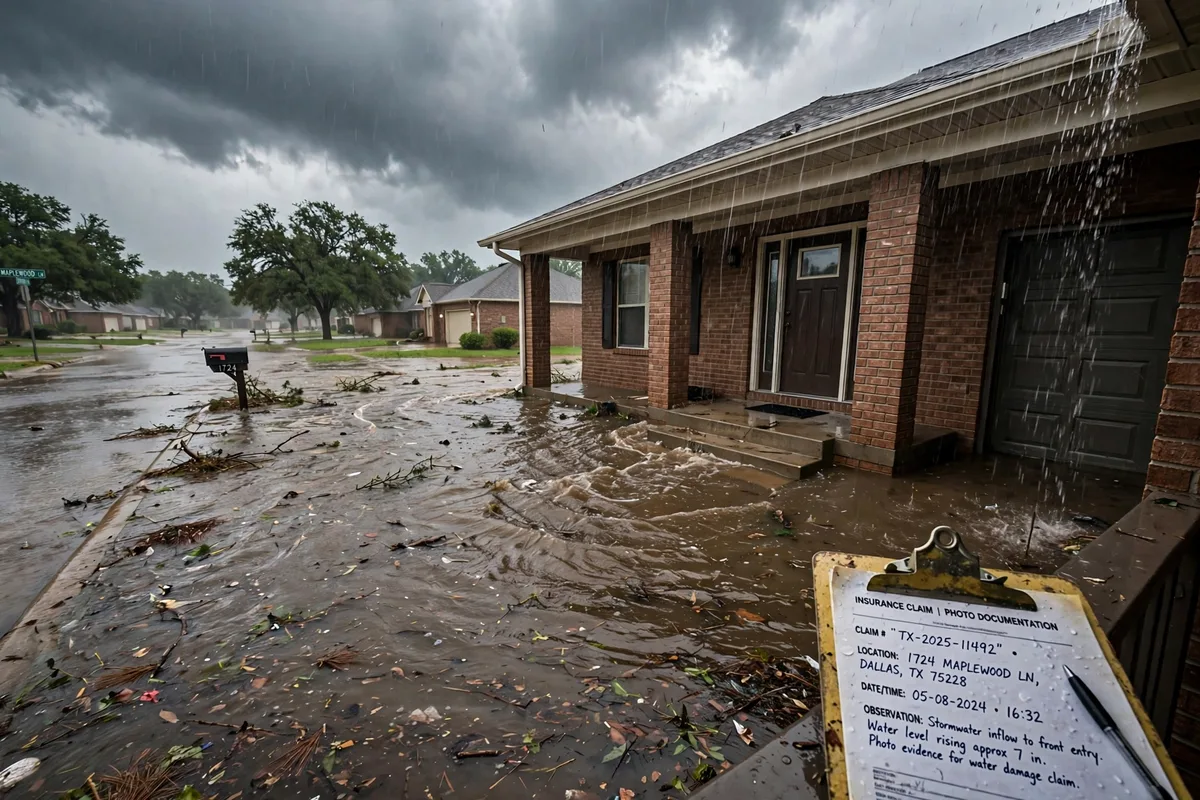
A Dallas homeowner watches stormwater rise across the yard, come under the back door, and soak the living room — then learns the claim is denied because the policy covers "water damage" but not "flood damage." The distinction feels like wordplay, but to an insurer it is the entire claim: it is not the storm that decides coverage, it is where the water came from and how it entered. Water from inside the house — a burst pipe, a failed appliance, a roof leak through a wind-torn opening — is generally a homeowners claim. Water that rises from outside — ground water, an overflowing creek, street runoff that enters at ground level — is flood damage, and standard Texas homeowners policies exclude it outright. The difference costs Texas families thousands every storm season, and it is decided in the first hours, when the evidence of how the water entered is still visible. Dallas-area water jobs run $2,500–$7,500, so getting the classification right is not paperwork — it is the difference between a covered loss and a bill you pay alone. However, the line is not always obvious, and the gray cases (rain through a damaged roof, water that entered two ways at once) are exactly where claims get fought — which is why documentation from hour one matters more than any argument later.
📞 Flood or Water Damage? Call Now: +1 214-807-4697
What Is the Difference Between Flood Damage and Water Damage?
Insurers draw the line at the water's origin and path, not at the weather event. Flood damage is water that comes from outside the structure at ground level — rising water from heavy rain, an overflowing river or creek, storm surge, or street runoff that accumulates and enters the home. The Texas Department of Insurance defines flood damage as water from a rainstorm or a body of water that suddenly rises over dry land and into the house. Water damage, in the homeowners-policy sense, is water from inside the home or from a covered event acting on the structure — pipes, water heaters, washing machines, dishwashers, and other devices that hold water, plus rain that enters through a storm-created opening in the roof or walls. The same storm can produce both: wind tears shingles off the roof (water damage, covered) while the yard floods and water rises through the back door (flood damage, excluded). The adjuster's first question is never "how bad was the storm" — it is "where did the water come from, and which way did it travel." However, the distinction is a policy definition, not a physics one — water does not care which category it falls in, and a home hit by both kinds of water in one storm needs two claims, two carriers, and documentation that separates them.
Which Policy Covers Which Kind of Water?
| Water source | Policy that responds | Typical outcome |
|---|---|---|
| Burst pipe, appliance failure | Homeowners | Covered if sudden |
| Rain through wind-damaged roof | Homeowners | Covered, wind peril |
| Rising ground / street water | Flood insurance | Excluded otherwise |
| Overflowing creek or river | Flood insurance | Excluded otherwise |
| Sewage backup, sump overflow | Endorsement only | Needs added rider |
| Slow leak, seepage, neglect | Neither | Excluded, gradual |
The table is the whole claim in one view, and the two rows that surprise homeowners most are the second and the fifth. Rain through a wind-damaged roof is a homeowners claim because the covered peril is the wind — the rain is just the consequence of the opening the wind created. Sewage backup is the trap: it is neither "water damage" nor "flood" in the standard policy — it needs a water backup endorsement added to the homeowners policy, and without it, a sewage loss is uncovered even though it happened entirely inside the house. The sewage backup guide covers why that category is never a DIY job. Gradual damage is the other exclusion that surprises people: a slow leak behind a wall that runs for months is excluded as maintenance failure, which is the same "sudden and accidental" test the claim-denied guide explains in detail. However, the table is a starting point, not a verdict — every policy has its own endorsements, limits, and wording, and the actual language in your declarations page outranks any general guide.
What Counts as a "Flood" Under Insurance Rules?
Flood is defined by the water's behavior, not by the scale of the disaster. Under National Flood Insurance Program rules, a flood is a general condition of partial or complete inundation of normally dry land — typically affecting two or more properties or two acres — from overflow of inland or tidal waters, unusual and rapid accumulation of surface water, or mudflow. The "two properties" element is why a single home's flooded yard can still be a flood: if the street and the neighbors' yards are under the same water, the event is general, not private. What matters for the homeowner is the direction: water that rises from the ground and enters at ground level is flood, even if the rain that caused it was an ordinary thunderstorm, even if no river is involved, and even if the home is nowhere near a mapped floodplain. FEMA's own data shows a large share of flood claims come from outside high-risk zones — the map is a risk rating tool, not a guarantee. The flood restoration guide covers the cleanup process once the water is inside. However, the flood definition also creates the most contested gray zone in Texas claims: rain that ponds against the foundation and seeps in is often labeled flood by the carrier and labeled seepage or drainage failure by the homeowner — and that argument is won with photos of the water's path, taken before cleanup changes the scene.
Does Homeowners Insurance Cover Rain That Comes Through a Damaged Roof?
Yes, in the standard case — and this is the single most valuable distinction in the whole topic. When wind, hail, or a falling tree damages the roof, walls, or windows, and rain then enters through that opening, the resulting interior water damage is a homeowners claim under the windstorm peril. The carrier covers the interior damage because the covered event (wind) created the opening; the rain is not classified as flood because it came from above through a structure failure, not from rising ground water. The same logic covers rain through a window broken by wind-blown debris. The claim fails only when there was no storm-created opening — a roof that simply leaked because it was old, or flashing that had deteriorated over years, is a maintenance exclusion, not a wind claim. Documentation is the difference: photos of the damaged roof section, the debris, and the interior entry point, taken before emergency tarping covers the evidence. The roof-versus-plumbing guide helps separate the source before the adjuster arrives. However, do not wait for the adjuster's verdict to tarp the roof — emergency mitigation is a policy duty, and delaying it to preserve evidence is exactly the kind of delay that gets claims reduced.
What About Sewage Backup and Sump Pump Overflow?
Neither standard homeowners nor flood insurance automatically covers sewage backup — it lives in its own category, and it is the most commonly missed gap in Texas policies. A sewage backup (wastewater entering through drains and toilets) or a sump pump overflow typically requires a water backup endorsement added to the homeowners policy, usually with its own sublimit (often $5,000–$10,000, far below a full remediation bill). Without the endorsement, the loss is uncovered even though it happened inside the home and had nothing to do with weather. The endorsement is cheap — often tens of dollars a year — which makes it the highest-value gap to close in a Texas policy. The same logic applies to sump pump failure: the pump itself is maintenance, and the resulting water damage needs the endorsement. Mold remediation after a water loss is similarly limited — the remediation guide covers the process, and Texas policies typically cap mold remediation well below the $1,200–$3,800 typical job cost unless a separate endorsement exists. However, the endorsement must be in place before the loss — no carrier sells it retroactively, and the day the sewage backs up is the day every homeowner wishes they had checked.
How Do I Prove Which Kind of Water Hit My Home?
Proof is the claim, and it is built in the first hours before cleanup erases it. Photograph and video the water's entry points before moving anything: the door threshold with water flowing under it (rising water, flood), the ceiling stain under the wind-torn roof section (water damage, homeowners), the drain with sewage coming up (backup, endorsement). Capture the exterior too — the street water level, the neighbors' yards, the creek level — because the "general condition" test for flood depends on what the neighborhood looked like, not just your house. Keep a timestamped log: when the water arrived, when it peaked, when you called for help, and who you called. Save every receipt for mitigation — extraction, drying, emergency tarping — because mitigation costs are recoverable under the responding policy, and the carrier that pays them is the carrier whose category you prove. The file-or-pay guide covers the math of whether to claim at all. However, the most important proof step is also the simplest: call a professional mitigation crew immediately, because their moisture mapping, photos, and drying logs become the independent record that backs your version of the water's path when the adjuster arrives days later.
📞 Need Claim Documentation? +1 214-807-4697
What Happens When Both Kinds of Water Hit at Once?
Both claims run in parallel, and the homeowner's job is to keep them separate. A single Texas storm can tear the roof (homeowners), flood the yard (flood policy), and back up the sewer (endorsement) — three losses, three coverages, one wet house. File each loss with the right carrier, and do not let either carrier reclassify the other's damage: the classic denial pattern is the homeowners carrier calling interior damage "flood" because the yard also flooded, and the flood carrier calling it "wind" because the roof was also damaged. The defense is the documentation from the previous section — entry-point photos that show which water went where. Mitigation crews dry the whole house regardless of category, and the drying logs and invoices get allocated between carriers afterward; the homeowner should not delay drying while carriers argue about allocation. The cost guide gives the Dallas price bands that frame the stakes. However, the parallel-claims situation is also where a public adjuster earns a fee — when two carriers are each pointing at the other, a licensed adjuster who works for the homeowner (not either carrier) is often the fastest route to both checks.
Important Considerations
Three cautions frame everything above. First, policy language outranks general guidance: Texas homeowners forms vary (HO-3, HO-5, and the Texas-specific TWIA and FAIR Plan forms for coastal and high-risk areas), and the endorsements on your specific policy — water backup, mold, replacement cost — decide your actual coverage. Read the exclusions section of your own policy, not a blog post, before storm season. Second, flood insurance has a 30-day waiting period under NFIP (private carriers vary) — it cannot be bought the week a storm is forecast, and the Dallas homeowner who waits for the forecast is uninsured for that storm. Third, the claim clock matters twice: most policies require prompt notice, and the "sudden and accidental" test punishes delay — a leak discovered weeks late is a harder claim than the same leak reported the day it was found. However, the biggest consideration is not legal at all — it is behavioral: the homeowners who recover fastest are the ones who documented the water's path in hour one, mitigated in hour two, and filed with the right carrier on day one, while the slow claims are the ones still arguing about which kind of water it was months later.
Frequently Asked Questions
Is flood damage covered by homeowners insurance in Texas?
No — standard Texas homeowners policies exclude flood damage, which is water rising from outside at ground level: overflowing creeks, storm surge, street runoff entering at ground level. Rising outside water requires a separate flood insurance policy, either through the National Flood Insurance Program or a private carrier. This is the single most common coverage surprise in Texas storm claims, because homeowners assume "water damage" in their policy covers all water. However, the exclusion is about the water's origin and path, not the storm — rain through a wind-damaged roof is still a homeowners claim, while the same storm's rising yard water is a flood claim.
What is the difference between water damage and flood damage?
Water damage is water from inside the home or from a covered event acting on the structure — burst pipes, appliance failures, water heater ruptures, and rain entering through a storm-created opening. Flood damage is water from outside at ground level — rising water, overflowing rivers and creeks, storm surge, and surface water accumulating and entering the home. The Texas Department of Insurance draws the same line: flood is water from a rainstorm or body of water that rises over dry land and into the house; water damage is water from pipes, appliances, and devices that hold water. However, one storm can produce both kinds, and each kind goes to a different carrier with its own claim.
Does homeowners insurance cover a burst pipe in Texas?
Yes, when the burst is sudden and accidental — a pipe that freezes and bursts overnight, or a supply line that fails under normal pressure, is the classic covered water loss. Dallas-area water jobs run $2,500–$7,500, and the burst-pipe category is the one Texas carriers handle most routinely. The Texas burst-pipe average claim runs around $15,500 according to State Farm figures, which is why carriers take mitigation speed seriously. However, the same pipe that leaked slowly for months before bursting is a different claim — gradual damage is excluded, and the carrier will look for evidence of how long the leak ran.
Is rain damage from a storm covered if my roof was damaged?
Yes, when wind, hail, or a falling tree created the opening the rain came through — the covered peril is the wind, and the interior water damage follows it. Photograph the damaged roof section and the interior entry point before emergency tarping, because the opening is the evidence that separates a homeowners claim from a flood exclusion. A roof that leaked because it was old or poorly maintained is a maintenance exclusion, not a wind claim. However, tarp the roof immediately regardless — emergency mitigation is a policy duty, and delaying it to preserve evidence can reduce the claim.
What is a water backup endorsement and do I need one?
It is an add-on to a homeowners policy that covers sewage backup and sump pump overflow — losses that neither standard homeowners nor flood insurance covers by default. The endorsement usually carries its own sublimit, often $5,000–$10,000, and costs relatively little per year. Without it, a sewage loss is entirely out of pocket even though it happened inside the home. However, it must be in place before the loss — no carrier adds it retroactively, and the day the drains back up is the wrong day to discover the gap.
Can I buy flood insurance if I am not in a flood zone?
Yes — any homeowner can buy flood insurance, and a large share of flood claims come from outside mapped high-risk zones. Flood risk in Dallas is driven by local drainage, creeks, and street grading as much as by the FEMA map, and the map is a rating tool, not a guarantee of safety. NFIP policies carry a 30-day waiting period, so coverage must be bought before storm season, not when a storm is forecast. However, private flood carriers sometimes offer shorter waits and higher limits — compare both, and do not assume the map's "low risk" label means no risk.
What should I photograph after water enters my home?
The water's entry points before anything is moved: the door threshold with water flowing under it, the ceiling stain under the damaged roof section, the drain with sewage coming up, and the exterior — street water level, neighbors' yards, creek level. Add a timestamped log of when the water arrived, when it peaked, and every call you made. These photos are what separate a homeowners claim from a flood claim when the carriers disagree later. However, do not delay mitigation for photography — take the photos fast, then start drying, because the mold clock runs on its own schedule.
Does mold remediation get covered by insurance?
Partially, and the limits surprise people: Texas policies typically cover mold that results from a covered water loss, but with sublimits well below the typical $1,200–$3,800 remediation job unless a mold endorsement exists. Mold that results from an uncovered cause — a long-term leak, flood water without flood insurance — is generally uncovered too. The remediation process itself is covered in the remediation guide. However, the coverage question is secondary to the health question — mold starts in 24–48 hours on wet materials, so the drying decision should never wait for the coverage decision.
What if my claim is denied as flood damage but I disagree?
Challenge the classification with your documentation: entry-point photos, the timeline, and the mitigation crew's moisture mapping and drying logs are the evidence that the water came from a covered source. Request the denial in writing with the specific policy language cited, and compare it against your policy's actual flood definition. A licensed public adjuster can re-present the claim, and Texas homeowners can also complain to the Texas Department of Insurance when a denial contradicts the policy language. However, act quickly — appeal deadlines run from the denial date, and the evidence gets harder to reconstruct as the house dries and repairs proceed.
Should I file one claim or two when a storm causes both kinds of damage?
File each loss with the right carrier — the roof and interior water damage with homeowners, the rising-water damage with the flood carrier, the sewage with the endorsement carrier. Do not let one carrier absorb the other's damage, because the reclassification is how claims get denied: the homeowners carrier calls it flood, the flood carrier calls it wind, and the homeowner gets neither check. Keep the documentation separated by entry point and water path. However, do not delay drying while the carriers argue — mitigation proceeds on the whole house, and the invoices get allocated between carriers afterward.
How long do I have to file a water damage claim in Texas?
Policies require prompt notice, and Texas law gives carriers room to reduce or deny claims when late notice prejudices their investigation — in practice, report within days, not weeks. The "sudden and accidental" test also punishes delay: a leak reported the day it is found is a straightforward claim, while the same leak reported a month later invites a gradual-damage denial. Document the discovery date as well as the loss date, because the two are often different. However, the filing deadline is not a reason to rush the documentation — file promptly, then supplement the claim with the mitigation records as they arrive.
Does Water Damage Restoration Dallas help with insurance documentation?
Yes — every job includes moisture mapping, dated photos, drying logs with daily readings, and an itemized scope, which is the independent record adjusters rely on. We work with homeowners and adjusters on both homeowners and flood claims, and our documentation is built to separate water sources by entry point. From 315 North St. Paul Street, Dallas, TX 75201, 24/7, with typical 60-minute emergency arrival and IICRC-certified technicians. Call +1 214-807-4697 any time. However, we are the mitigation crew, not your adjuster — the coverage decision is the carrier's, and our job is to give you the evidence that makes the right decision easy.
📞 Free Claim Documentation Help: +1 214-807-4697
📞 Call Water Damage Restoration Dallas Now: +1 214-807-4697