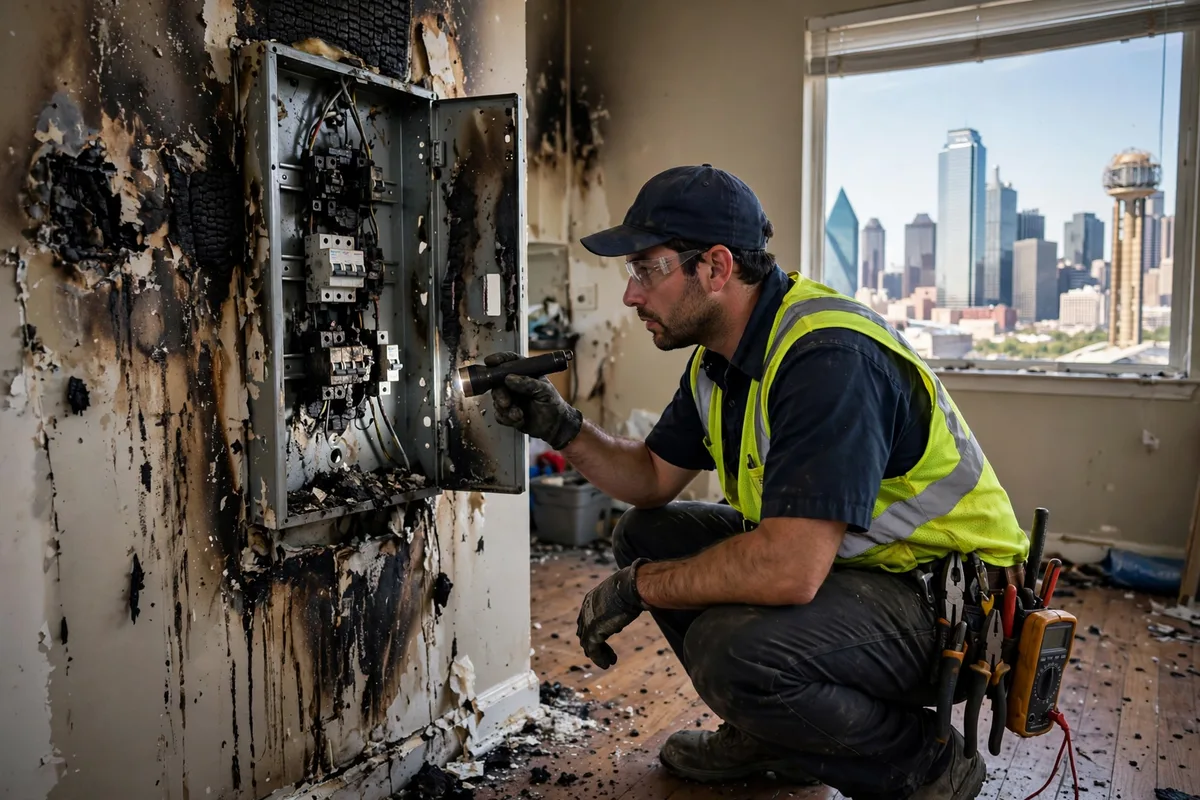
Electrical Panel Fire Damage in Dallas: Breaker-Box Fires, Warning Signs & Same-Day Restoration
TLDR
- Who handles electrical panel fire damage in Dallas?: Water Damage Restoration Dallas — 24/7 live answer, around 60-minute arrival, free estimates: +1 214-807-4697.
- What causes an electrical panel fire?: Loose connections that heat up, carbonize insulation and arc at up to 15,000°C — plus circuit overload, moisture and corrosion on bus bars, and panels past their 25–40-year lifespan.
- What are the warning signs of a breaker-box fire?: Buzzing or humming from the panel, a burning-plastic smell, breakers that will not stay on, and scorch marks or heat on the panel cover.
- Can you put water on an electrical panel fire?: Never — water conducts electricity and makes an electrical fire far more dangerous; evacuate and call 911 first.
- How much does electrical panel fire damage restoration cost in Dallas?: Dallas-area fire and water jobs typically land between $2,500 and $7,500 for mitigation, with panel replacement and rewiring on top.
- Does insurance cover an electrical panel fire?: Sudden electrical fires are usually covered; the Texas burst-pipe average claim runs around $15,500, and fire claims run higher still.
- When should you call a panel fire restoration crew?: Immediately after the fire department clears the home — soot residue is conductive and the re-ignition risk stays until the panel is cleaned or replaced.
🚨 ELECTRICAL PANEL FIRE IN YOUR DALLAS HOME? Do not touch the panel — call now. We answer live 24/7, arrive in around 60 minutes, and give free estimates — inspection, soot cleanup, drying, and rebuild in one visit.
📞 24/7 Panel Fire Help: +1 214-807-4697
Electrical panel fire damage in Dallas starts where nobody looks: inside the breaker box, where a loose connection heats up over months, carbonizes the insulation around it, and finally arcs at temperatures between 5,000 and 15,000°C — hot enough to ignite the panel, the wall behind it, and anything stored nearby. Electrical distribution systems are the third leading cause of office-related fires, and the same failure modes hit Dallas homes, where summer air-conditioning loads, aging panels, and 25–40-year-old breaker boxes combine into a real risk. Federal Pacific Electric and Zinsco breakers carry a known history of failing to trip on overload, which means a fault that should have cut power in seconds can burn for minutes instead. The fire itself is only the first half of the loss: the soot it leaves behind is conductive, it coats outlets and wiring across the home, and it keeps a re-ignition risk alive until a professional cleans or replaces the affected circuits. Water Damage Restoration Dallas handles electrical panel fires with IICRC-certified crews, around 60-minute arrival, free estimates, and same-day help. However, one panel-fire rule comes first: never use water on an electrical fire and never open a hot or smoking panel yourself, because the panel stays live and dangerous until the fire department and an electrician say otherwise.
What causes an electrical panel fire in a Dallas home?
An electrical panel fire in a Dallas home comes from four usual mechanisms: a loose connection that heats up under load and carbonizes insulation until it arcs, a circuit overloaded by summer air-conditioning demand and added appliances, moisture and corrosion on bus bars and terminals that raise resistance and heat, and a panel past its 25–40-year lifespan with breakers that no longer trip reliably. Federal Pacific Electric and Zinsco panels are the two names inspectors flag most often, because their breakers have a documented history of failing to trip on overload — the one job a breaker exists to do. Dallas summers make the overload mechanism worse, since a panel running near capacity on a 100-degree afternoon has no margin left when the air conditioner, the dryer, and the oven all run at once. The electrical fire damage guide covers electrical fires generally, while this post covers the breaker-box cause specifically. However, one cause trap applies: the panel that burned was usually failing quietly for months, so a panel that buzzes, smells hot, or trips repeatedly is a warning, not a quirk.
What are the warning signs of a breaker-box fire?
The warning signs of a breaker-box fire are buzzing or humming from the panel, a burning-plastic or fishy smell near the box, breakers that will not stay on or trip again and again, scorch marks or discoloration on the panel cover, and warmth on the panel door when you touch it. A buzzing panel means a connection is arcing inside the box, and a burning-plastic smell means insulation is already carbonizing — both are reasons to call an electrician the same day, not next week. Breakers that trip repeatedly are doing their job, but breakers that feel hot, smell burned, or refuse to reset are telling you the panel itself is failing. Older Dallas homes with Federal Pacific or Zinsco panels deserve a panel inspection even without symptoms, because those breakers can fail silently and never trip at all. However, one warning-sign rule is absolute: if the panel is hot, smoking, or sparking, do not open it and do not flip breakers — get everyone out and call 911, because an arcing panel can flash without further warning.
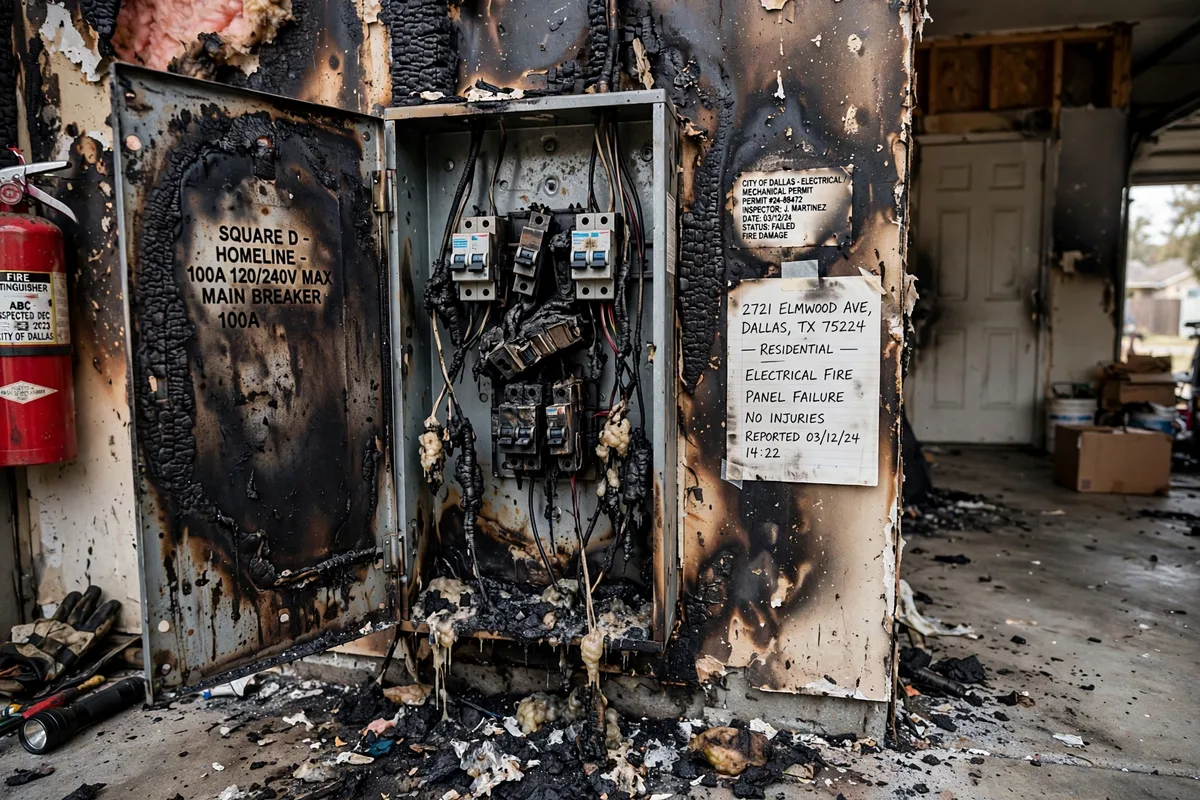
What should you do first after an electrical panel fire?
After an electrical panel fire, get everyone out of the home, call 911, and never use water on an electrical fire — water conducts electricity and turns a panel fire into an electrocution risk. Shut the main breaker only if it is safe to reach without passing the fire or touching a hot panel, and use a Class C or Class ABC extinguisher only on a small, contained fire you can fight from a safe distance with an exit behind you. Once the fire department clears the home, photograph the panel, the wall around it, and every room with soot before anything moves, since the photos support the claim, and keep the damaged breakers and panel as evidence rather than throwing them away. Call for same-day restoration help next, because soot is acidic and conductive, and every hour it sits on wiring and outlets it spreads the damage further into the home. However, the first-step mistake is the reset-and-hope move: flipping a tripped breaker back on after a panel fire risks re-ignition, so the panel stays off until an electrician and a restoration crew have both cleared it.
How do professionals restore fire damage from an electrical panel fire?
Professionals restore fire damage from an electrical panel fire in sequence: the electrician isolates the panel and makes the home safe, the restoration crew maps soot and smoke damage through the house, extracts any water the firefighters used, removes soot from walls, ceilings, outlets, and contents with dry-chemical sponges and HEPA vacuuming, dries the structure with air movers and dehumidifiers until readings verify dryness, then rebuilds the wall and installs the replacement panel with AFCI and GFCI upgrades. Soot from a panel fire is different from ordinary fire soot, because it carries conductive residue that coats outlets and wiring — cleaning it is a safety job, not a cosmetic one, and a circuit left sooty can arc again. The fire damage restoration service page covers the full fire service, and the smoke damage cleanup guide covers the soot removal in detail. However, one restoration rule is absolute: the electrician comes before the restoration crew, because no drying or cleaning starts in a home whose panel is still live and unsafe.
| Panel fire cause | Warning sign | First crew step |
|---|---|---|
| Loose connection arcing | Buzzing, burning smell | Isolate panel, map soot |
| Circuit overload | Breakers trip repeatedly | Load check, panel upgrade |
| Moisture, corrosion | Scorch marks, heat | Clean bus bars, dry wall |
| Aging panel, 25–40 years | Breakers will not trip | Replace panel, AFCI/GFCI |
| Failed breaker brand | Breaker will not stay on | Replace breakers, test |
📞 Book Panel Fire Cleanup: +1 214-807-4697
How much does electrical panel fire damage restoration cost in Dallas?
Dallas-area fire and water jobs typically land between $2,500 and $7,500 all-in for mitigation, with electrical panel fire jobs varying by how far the soot travelled, whether firefighting water reached the walls and floors, and whether the panel and its circuits need full replacement on top of the cleanup. Panel replacement itself is a separate electrician cost, and a full panel upgrade with AFCI and GFCI protection runs higher than a like-for-like swap — but it is the upgrade that stops the next panel fire. Soot that reached the HVAC system adds duct cleaning to the scope, and water from the firefighting response adds drying and possible mold remediation at $1,200–$3,800 if the structure sat wet past 48 hours. The Texas burst-pipe average claim runs around $15,500, and fire claims typically run higher, because a panel fire touches structure, contents, and the electrical system at once. However, the pricing trap is the surface-clean quote: a company that offers to wipe the walls without cleaning the outlets and testing the circuits is selling a cosmetic clean that leaves the re-ignition risk in place.
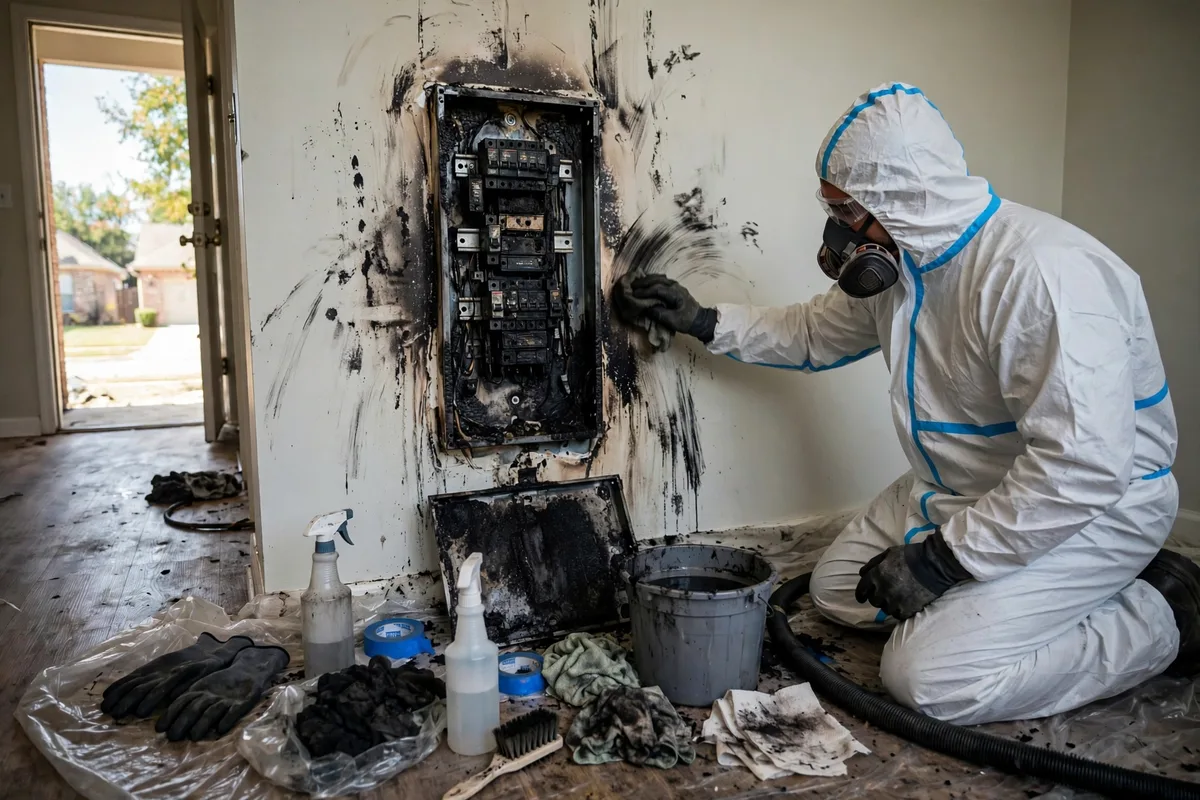
How do you choose an electrical panel fire restoration company in Dallas?
Choose on five checks: same-day response after the fire department clears the home, an electrician-first safety sequence before any cleaning, soot mapping with meters and testing of outlets and circuits before the wall closes, a written scope that separates electrical repair, soot cleanup, drying, and rebuild, and claim documentation with photos and readings. Ask whether the crew cleans outlets and tests circuits, how it verifies the structure is dry, and whether it checks for mold before closing the wall. The soot damage cleanup guide covers what proper soot removal looks like, and the fire damage restoration process guide covers the full sequence from assessment to rebuild. However, one selection rule beats the rest: the company that brings the electrician first, maps the soot second, dries third, and rebuilds last — in that order, with readings to prove it — is the company whose Dallas home stays safe after the next summer overload.
Important Considerations
Texas has no state license specifically for restoration companies, so check IICRC certification, insurance, and reviews before hiring, and be wary of anyone demanding full payment upfront. Never use water on an electrical fire, and never open a hot, smoking, or sparking panel yourself — the panel stays live and dangerous until the fire department and an electrician say otherwise. Never flip a tripped breaker back on after a panel fire, because the fault that tripped it may still be arcing inside the box. Never paint or seal a soot-stained wall without cleaning the soot and the outlets beneath it, because conductive residue left in place keeps a re-ignition risk alive under the finish. Never run the HVAC system after a panel fire until the ducts are checked, since soot pulled into the ductwork spreads through every room the system serves. If the home has a Federal Pacific or Zinsco panel, ask explicitly for a full panel replacement with AFCI and GFCI protection rather than a breaker swap, because those breakers have a known history of failing to trip. Keep the damaged panel and breakers, the scope, moisture readings, photos, and all carrier correspondence in one file — panel-fire claims generate more paperwork than the job suggests. Finally, after repair, know your main breaker location and test breakers twice a year, because the next Dallas summer will test the same panel again.
📞 Free Panel Fire Estimate: +1 214-807-4697
Frequently Asked Questions
Who handles electrical panel fire damage in Dallas?
Water Damage Restoration Dallas — 24/7 live answer, around 60-minute arrival, free estimates, and inspection, soot cleanup, drying, and rebuild in one visit. Call +1 214-807-4697 any hour and a live crew answers.
What causes an electrical panel fire?
Loose connections that heat up and arc at up to 15,000°C, circuit overload, moisture and corrosion on bus bars, and panels past their 25–40-year lifespan. Federal Pacific and Zinsco breakers have a known history of failing to trip on overload.
What are the warning signs of a breaker-box fire?
Buzzing or humming from the panel, a burning-plastic smell, breakers that will not stay on, scorch marks on the panel cover, and warmth on the panel door. Any of these is a same-day electrician call.
Can you put water on an electrical panel fire?
Never — water conducts electricity and makes an electrical fire far more dangerous. Evacuate, call 911, and use a Class C or Class ABC extinguisher only on a small, contained fire with an exit behind you.
How much does electrical panel fire damage restoration cost in Dallas?
Dallas-area fire and water jobs typically land between $2,500 and $7,500 for mitigation, with panel replacement and rewiring on top. Soot in the HVAC system and firefighting water damage add to the scope.
Does insurance cover an electrical panel fire?
Sudden electrical fires are usually covered, with fire claims typically running higher than the Texas burst-pipe average of around $15,500. Keep the damaged panel and breakers as claim evidence.
How fast can a crew reach my Dallas home after a panel fire?
Around 60 minutes, 24/7, once the fire department clears the home. Crews run same-day for panel fires because soot is acidic and conductive, and every hour it sits spreads the damage.
Is it safe to stay home after an electrical panel fire?
Not until an electrician clears the panel and the crew checks the circuits — soot residue is conductive and the re-ignition risk stays until the panel is cleaned or replaced. Unaffected rooms are usually fine once the panel is isolated.
What is the difference between a panel fire and a general electrical fire?
A panel fire starts inside the breaker box itself — loose connections, overload, corrosion, or breakers that fail to trip — while a general electrical fire can start at any outlet, appliance, or wire run. Panel fires need an electrician first, before any cleaning starts.
Should I replace my panel after a fire, or repair it?
Replacement is usually the right call, especially for Federal Pacific or Zinsco panels or any panel past 25–40 years. A new panel with AFCI and GFCI protection is the upgrade that stops the next panel fire.
Why call Water Damage Restoration Dallas for panel fire damage?
Local Dallas crews, 24/7 live answer, around 60-minute arrival, free estimates, and an electrician-first, soot-mapping restoration with moisture readings — call +1 214-807-4697.
📞 Call Water Damage Restoration Dallas 24/7: +1 214-807-4697
Related Dallas Water Damage Guides
- Burst Pipe in Dallas: What to Do in the First 60 Minutes
- Water Damage in the First 24 Hours: An Hour-by-Hour Guide for Dallas Homeowners
- Emergency Water Extraction in Dallas: What Actually Happens When the Crew Arrives
- Emergency Water Damage Checklist: Every Step, in Order, for Dallas Homeowners