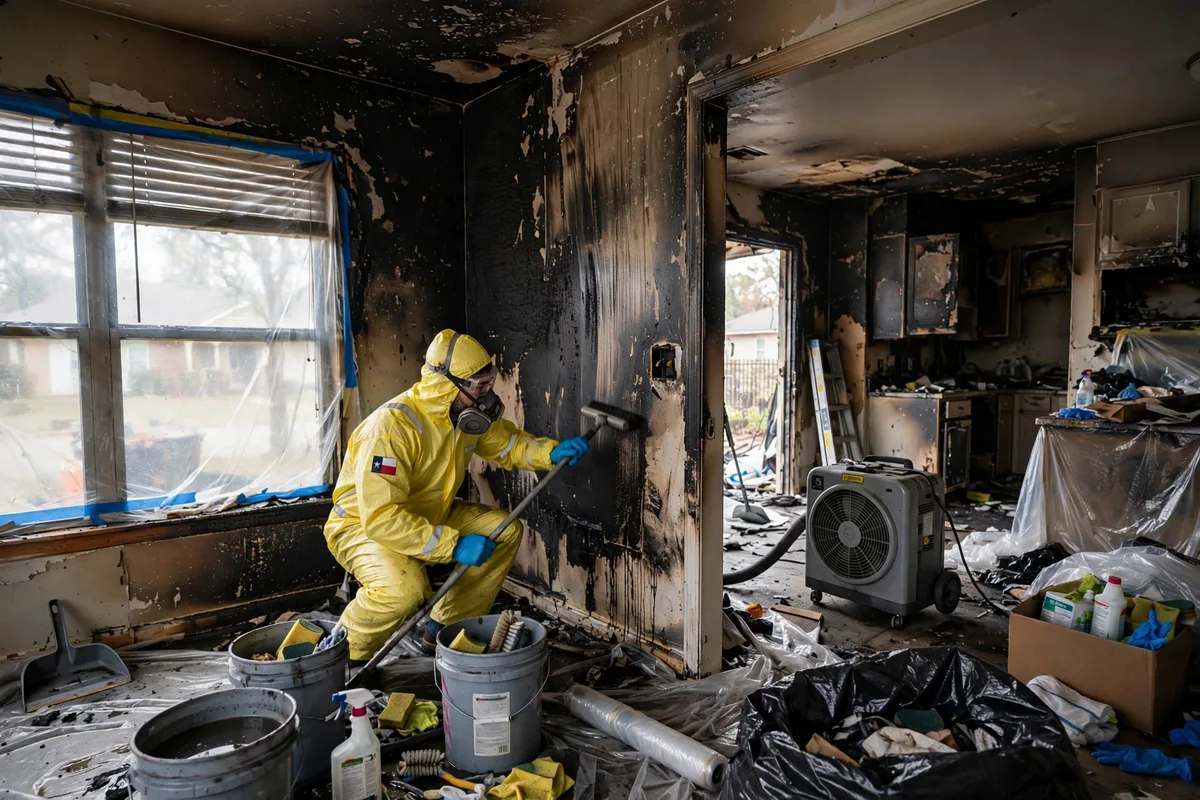
Smoke Damage Cleanup in Dallas: 24/7 Emergency Service
TLDR
- Who cleans smoke damage in Dallas right now?: Water Damage Restoration Dallas — 24/7 live answer, same-day dispatch, around 60-minute arrival: +1 214-807-4697.
- What is smoke damage cleanup?: Professional removal of soot, smoke residue, and smoke odor from surfaces, contents, air ducts, and the structure itself.
- How much does smoke damage cleanup cost?: Minor smoke jobs run $3,000–$8,000, whole-home light soot runs $8,000–$25,000, and heavy soot plus HVAC contamination runs $25,000–$50,000.
- Why does the smoke smell keep coming back?: Smoke particles are microscopic and driven deep into drywall, insulation, fabrics, and ducts — candles and air fresheners mask it, they never remove it.
- Can I clean smoke damage myself?: No — wet-cleaning soot first smears it and sets stains permanently, and soot is carcinogenic without PPE and HEPA equipment.
- Should I run the AC after a fire?: Never until the system is inspected — one HVAC cycle spreads soot and odor through ductwork into rooms that were clean.
- How fast should cleanup start?: Immediately after fire-department clearance — soot corrodes surfaces within hours, and firefighting water feeds mold within 24–48 hours.
🚨 SMOKE DAMAGE IN YOUR DALLAS HOME? Do not air it out and hope. We answer live 24/7, dispatch the same day, arrive in around 60 minutes, and give free estimates — soot removal, odor treatment, duct cleaning, and drying in one call.
📞 Smoke Damage? Call Now: +1 214-807-4697
Smoke damage is the fire that keeps damaging the house after the flames are out, because smoke is not one thing — it is soot particles, acidic residue, and odor molecules driven into every porous surface the smoke touched. A kitchen fire put out in seconds can still leave protein soot, the worst-smelling and longest-lasting residue, bonded to cabinets, walls, and fabrics across the house. The smell returns with temperature changes because the particles are still there, embedded in drywall and insulation, and every well-meaning shortcut — candles, open windows, air fresheners, a quick wipe — moves the problem around instead of removing it. Professional smoke damage cleanup in Dallas runs a fixed sequence: assessment and containment, dry soot removal with HEPA vacuums and sponges, matched cleaning agents by soot type, odor neutralization by fogging or ozone, and HVAC cleaning before the system runs again. Water Damage Restoration Dallas runs that sequence 24 hours a day across Dallas — Downtown, Uptown, Lakewood, and surrounding neighborhoods — with IICRC-certified technicians, free estimates, and direct insurance billing. However, the first rule belongs to you: do not touch, wipe, or vacuum soot before professionals arrive, because the wrong first touch is what turns a cleaning job into a replacement job.
What does professional smoke damage cleanup actually involve?
The job runs in stages, and skipping a stage is how the smell survives. First, assessment and containment: the crew maps which rooms and materials carry soot, seals off clean areas, and protects contents that can still be saved. Second, dry soot removal: HEPA vacuums and dry chemical sponges lift soot without water, because water is the enemy of soot removal — it smears the residue and sets stains permanently. Third, wet cleaning with agents matched to the soot type: dry soot, wet soot, fuel-oil soot, and protein soot each need a different chemistry, and the wrong agent on the wrong soot locks the stain in. Fourth, odor neutralization: hydroxyl treatment, thermal fogging, ozone, or carbon filtration, chosen by severity and by whether people and pets are in the home. Fifth, contents and HVAC: furniture, clothing, and electronics get pack-out cleaning, and ductwork gets cleaned before the system is allowed to run again. The emergency fire restoration guide covers the full fire sequence that smoke cleanup sits inside. However, a company that quotes smoke cleanup as a single wipe-down is selling the shortcut that fails — real cleanup is a sequence, and the sequence is the product.
How much does smoke damage cleanup cost in Dallas?
Smoke-only costs scale with how far the smoke traveled, not with how big the fire was. Minor smoke affecting one or two rooms typically runs $3,000–$8,000 for cleaning and deodorizing. Whole-home light soot runs $8,000–$25,000, because every surface, soft furnishing, and duct run needs treatment. Heavy soot plus HVAC contamination runs $25,000–$50,000, because the duct system itself must be cleaned and the odor treatment must reach inside walls and insulation. Component prices help you read a quote: soot removal $2,000–$6,000 for a multi-room scope, duct cleaning $250–$500, thermal fogging $200–$600, ozone treatment $400–$800, and furniture deodorizing $200–$1,000. Firefighting water adds its own scope — extraction and drying typically run $1,000–$6,000, and a typical Dallas water job overall lands between $2,500 and $7,500. The fire damage cost guide breaks down the full fire job that smoke cleanup is part of. However, the cheapest smoke quote is usually the one that skips duct cleaning or odor treatment — and the smell coming back in a month is the bill for that saving.
| Smoke damage scope | Typical cost | What it includes |
|---|---|---|
| Minor, 1–2 rooms | $3,000–$8,000 | Cleaning, light deodorizing |
| Whole-home light soot | $8,000–$25,000 | Full cleaning, contents, ducts |
| Heavy soot + HVAC | $25,000–$50,000 | Deep cleaning, duct system |
| Thermal fogging | $200–$600 | Odor penetration treatment |
| Ozone treatment | $400–$800 | Odor oxidation treatment |
📞 Same-Day Smoke Cleanup: +1 214-807-4697
Why does smoke odor persist after cleaning?
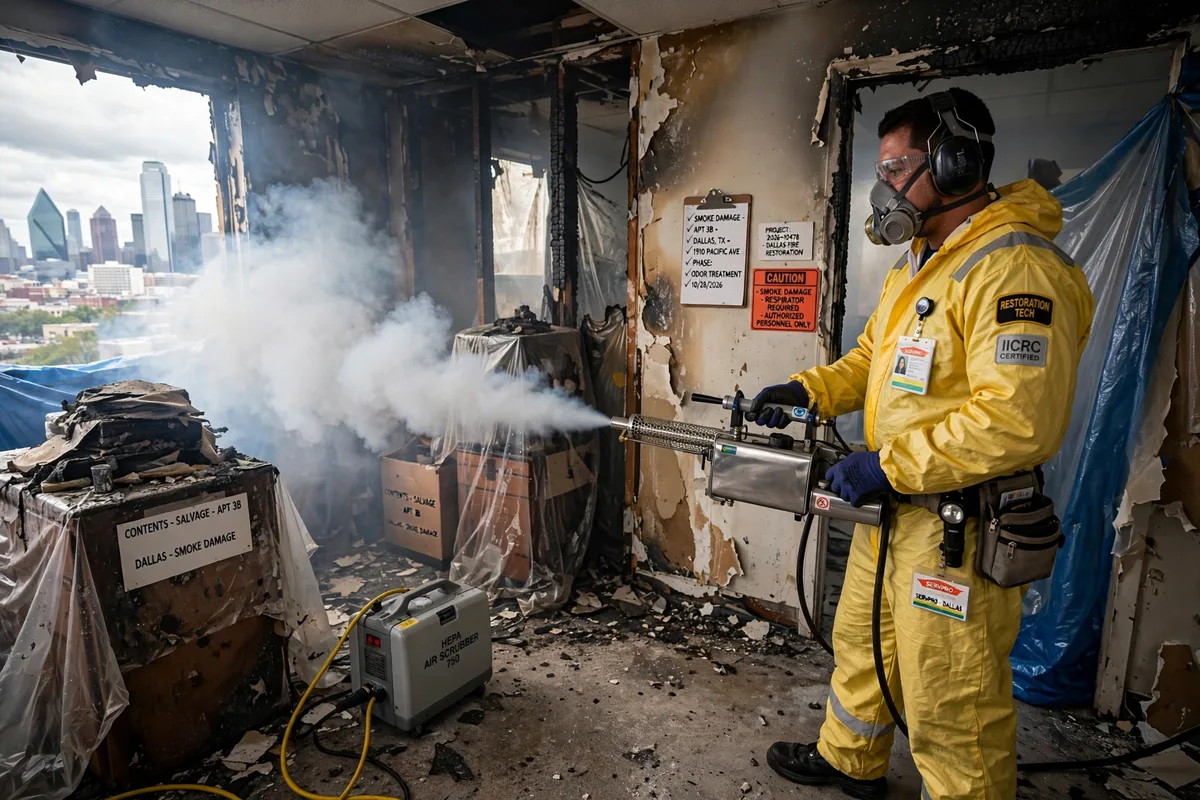
Smoke odor persists because odor is not on surfaces — it is inside them. Microscopic particles penetrate drywall, insulation, wood pores, fabrics, and duct lining, and they release odor whenever temperature or humidity rises, which is why a room can smell fine in the morning and foul by afternoon. Surface wiping removes the visible soot and leaves the embedded particles untouched, so the smell returns on the first warm day. Real odor removal works at the same depth the smoke reached: thermal fogging drives a deodorizing fog into the same pores and cavities the smoke entered, ozone oxidizes odor molecules in the air and on surfaces, hydroxyl generators run safely around people and pets for ongoing treatment, and sealing primers lock in residue that cannot be fully extracted from framing or subfloors. Kitchen protein fires are the hardest case: protein soot is nearly invisible, intensely smelly, and bonds to every surface it touches, which is why a small grease fire can smell worse than a larger wood fire months later. The mold remediation guide explains a parallel problem — contamination that lives inside materials, not just on them. However, odor treatment without soot removal first is wasted money: the odor source must be extracted before the air can be treated, or the smell simply reloads.
What mistakes make smoke damage worse?
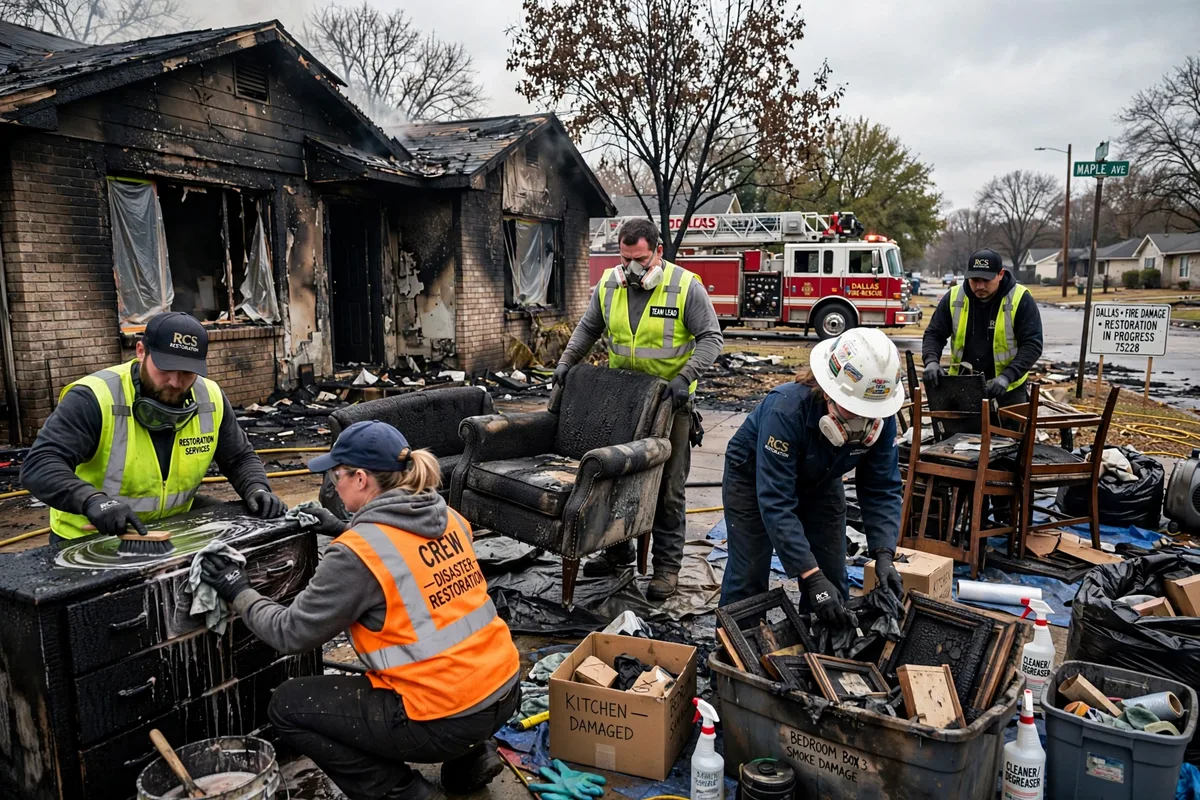
Four mistakes turn a cleaning job into a replacement job, and all four happen in the first 24 hours. First, running the HVAC system: one cycle pushes soot and odor through ductwork into clean rooms and contaminates the entire system. Second, wet-cleaning soot: water smears soot, sets stains, and drives residue deeper into porous materials. Third, using a household vacuum: standard vacuums blow fine soot particles back into the air and through the house instead of capturing them. Fourth, throwing things away before documentation: contents discarded before photos and inventory cannot be claimed, and fire claims average $88,170 precisely because contents losses are so large. A fifth mistake is quieter: waiting. Soot is acidic and corrodes metal fixtures, appliances, and electronics within hours, so a cleanup that starts in a week costs more than one that starts in a day. The structural drying guide shows why the drying clock matters just as much for the water the firefighters left behind. However, the single safest move after a fire is also the simplest: wait for clearance, photograph everything, and call professionals before touching anything.
Important Considerations
Smoke cleanup companies should show IICRC FSRT certification for fire and smoke work, carry insurance, and give an itemized scope in writing — Texas has no state license specifically for restoration companies, so certification and reviews are the check that matters. Ozone treatment requires the home to be unoccupied during treatment and ventilated afterward, while hydroxyl treatment can run with people and pets present — ask which method is planned and why. If firefighting water soaked the structure, drying must run alongside smoke cleanup, because mold starts in wet materials within 24–48 hours and a smoke job that ignores water becomes a mold job. Winter is Dallas fire season — space heaters, holiday cooking, and older wiring drive the annual spike — so response times stretch during cold snaps and honest companies say so on the call. Finally, keep the fire department clearance, the adjuster scope, the contractor scope, and every receipt in one file: the claim and any future sale will ask for them.
📞 Free Smoke Damage Estimate: +1 214-807-4697
Frequently Asked Questions
How much does smoke damage cleanup cost in Dallas?
Minor smoke jobs run $3,000–$8,000, whole-home light soot runs $8,000–$25,000, and heavy soot with HVAC contamination runs $25,000–$50,000. Your free on-site quote will itemize cleaning, odor treatment, duct work, and any water mitigation for your home.
Can smoke smell be completely removed?
Yes, when the source is removed first — dry soot extraction, matched cleaning agents, then fogging, ozone, or hydroxyl treatment at the depth the smoke reached, plus sealing where residue cannot be extracted. Surface wiping alone never fully removes it, which is why the smell returns.
Should I run my AC after a fire?
Never until the HVAC system is inspected and cleaned. One cycle spreads soot and odor through ductwork into rooms that were clean, turning a one-room job into a whole-house job and adding duct cleaning to the bill.
Can I clean soot myself?
No — wet-cleaning soot smears it and sets stains permanently, household vacuums redistribute fine particles, and soot is carcinogenic without PPE and HEPA equipment. DIY attempts usually raise the final professional bill.
Why does my house still smell after cleaning?
Because odor lives inside porous materials, not just on surfaces, and the cleaning never reached the depth the smoke reached. Fogging, ozone, or hydroxyl treatment plus sealing addresses embedded odor that wiping cannot touch.
How long does smoke damage cleanup take?
Smoke-only jobs take days to two weeks depending on rooms affected and whether ducts and contents need treatment. Full fire jobs with structural work take weeks, and rebuilds take months — the cleanup phase is the fastest part of the job.
Does insurance cover smoke damage cleanup?
Most standard homeowners policies cover sudden fire and smoke damage, including cleaning, odor treatment, and contents work, with the homeowner usually paying only the deductible. Document everything with photos before anything is cleaned or discarded.
What is protein soot, and why does it smell so bad?
Protein soot comes from kitchen fires — grease, oil, and food — and it is nearly invisible, extremely smelly, and bonds to every surface it touches. It is the hardest smoke residue to remove and the most common reason a small kitchen fire smells for months.
Can smoke-damaged furniture and clothes be saved?
Often yes — pack-out cleaning, ultrasonic cleaning, and ozone or hydroxyl treatment save most hard goods and much soft goods. Items are inventoried and cleaned off-site, and anything unsalvageable is documented for the claim.
Do I need to leave my home during smoke cleanup?
Usually until soot removal and odor treatment are complete, and always during ozone treatment, which requires an unoccupied home. Hydroxyl treatment can run with people and pets present — ask which method your crew plans to use.
Why should I call Water Damage Restoration Dallas for smoke damage?
Local Dallas crews, 24/7 live answer, around 60-minute arrival, soot removal plus odor treatment plus duct cleaning plus drying in one call, free estimates, and insurance documentation from the first visit.
📞 Call Water Damage Restoration Dallas 24/7: +1 214-807-4697