Mold Remediation Services in Dallas: Same-Day Quotes & 24/7 Response
TLDR
- Who provides mold remediation services in Dallas right now?: Water Damage Restoration Dallas — 24/7 live answer, same-day dispatch, around 60-minute arrival: +1 214-807-4697.
- What does mold remediation include?: Inspection and moisture mapping, containment, removal of contaminated materials, HEPA cleaning, and verified drying so mold cannot return.
- How much does mold remediation cost in Dallas?: Most jobs land between $1,200 and $3,800, depending on area, materials, and whether the moisture source is fixed first.
- How fast does mold grow after water damage?: Mold can start growing in wet materials within 24–48 hours, which is why a water loss becomes a mold job so quickly.
- Can I just clean mold myself with bleach?: No — bleach does not kill mold roots in porous materials, and scrubbing spreads spores into clean rooms.
- Is it safe to stay home during remediation?: Often yes for contained jobs, if containment holds and no sewage contamination is involved — larger jobs usually mean temporary relocation.
- Will mold come back after remediation?: Only if the moisture source is left active — remediation without fixing the leak, drainage, or humidity problem guarantees a return visit.
🚨 MOLD SPREADING IN YOUR DALLAS HOME? Every day of delay grows the job. We answer live 24/7, dispatch the same day, arrive in around 60 minutes, and give free quotes — inspection, containment, and removal in one call.
📞 Mold Problem? Call Now: +1 214-807-4697
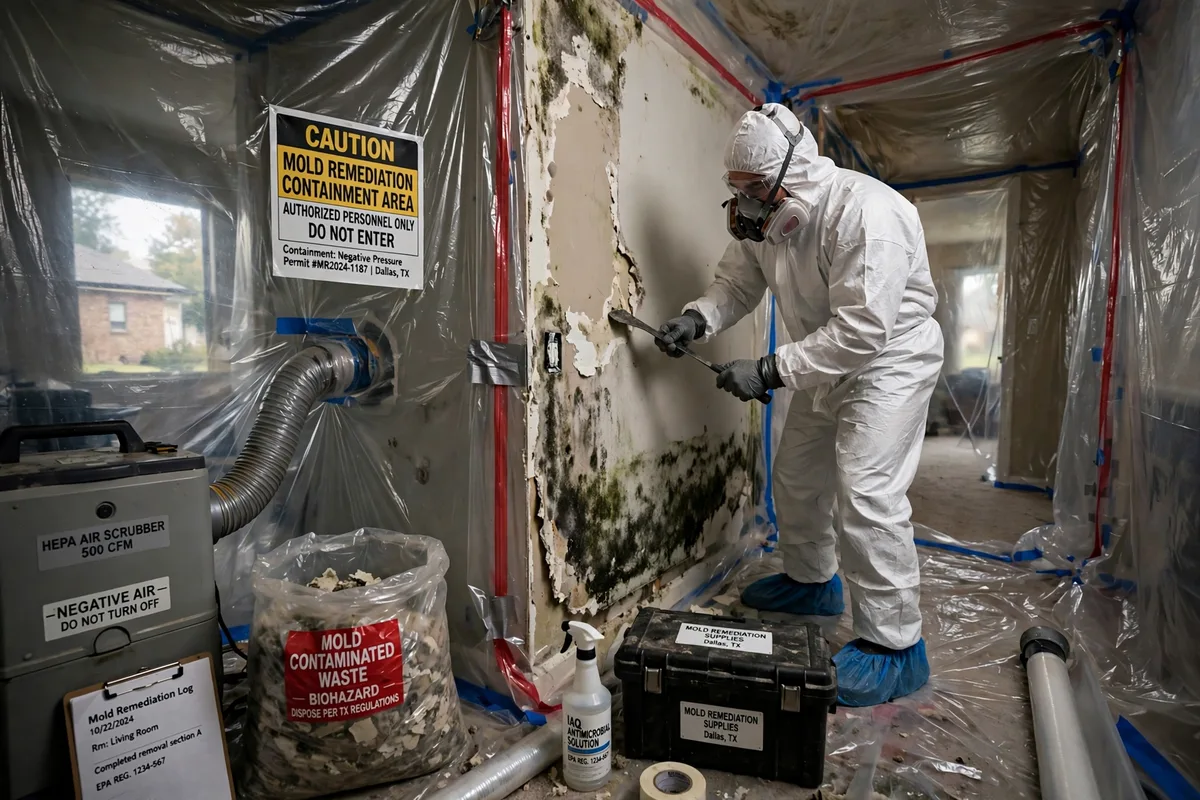
Mold is the second loss that follows a water loss, and it is the one homeowners notice last and pay for longest. A pipe leak, a storm intrusion, or a slow appliance drip saturates drywall or a subfloor, and within 24–48 hours mold is growing in material that still looks dry on the surface. By the time the smell or the spots appear, the colony is usually larger than the visible patch, and the remediation job is bigger than the drying job that would have prevented it. Mold remediation services exist for exactly this moment: find the moisture source, contain the area so spores do not spread, remove contaminated material, clean what can be saved with HEPA filtration, and dry the structure to verified readings so the mold cannot return. Water Damage Restoration Dallas runs mold remediation across Dallas — Downtown, Uptown, Lakewood, Frisco, and Plano — with IICRC-certified technicians, free quotes, and direct insurance billing. However, remediation is not a cleaning service and not a painting service: any company that offers to paint over mold, fog it without removing it, or skip the moisture source is selling a cover-up, not a fix.
What does a mold remediation visit actually involve?
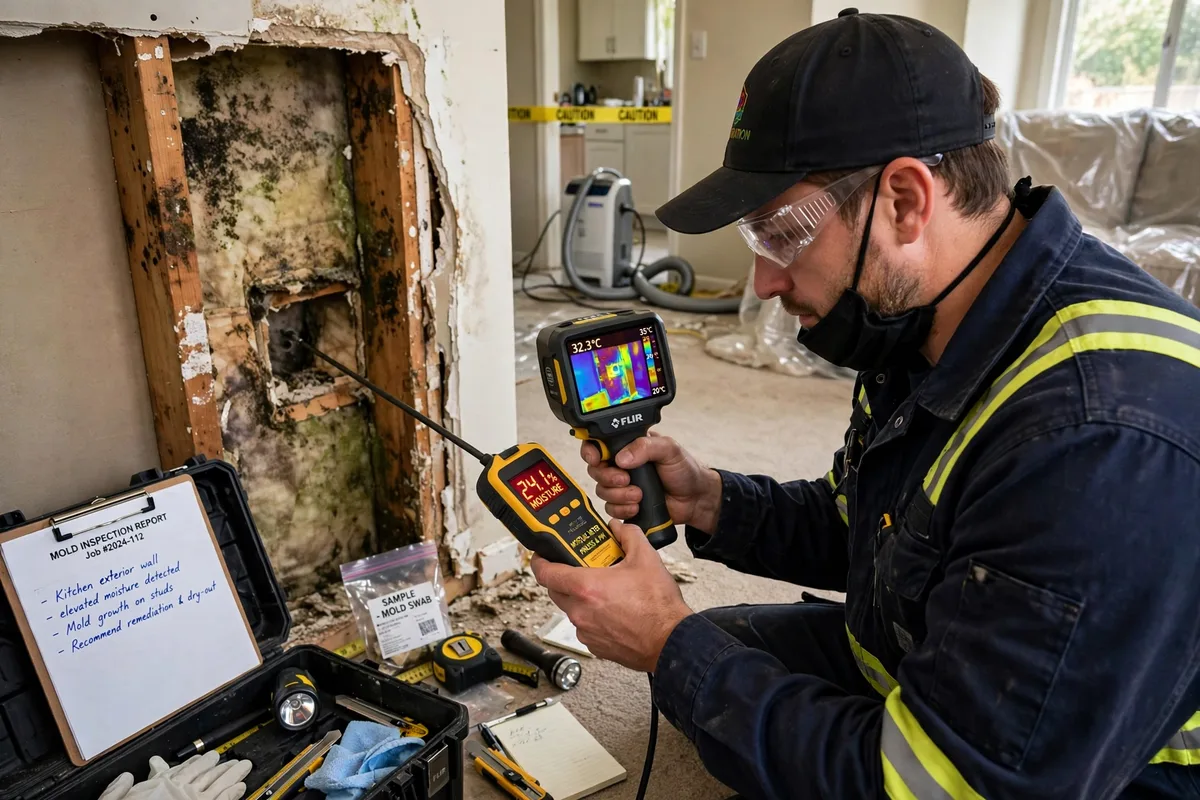
The visit runs in a fixed order, and the order is what separates remediation from a wipe-down. Inspection and moisture mapping come first: meters and thermal imaging find how far water traveled, including inside walls and under floors, because the visible mold is rarely the full colony. Containment comes second: plastic barriers and negative air pressure seal the work area so spores do not spread into clean rooms during removal. Removal comes third: contaminated drywall, insulation, and flooring are cut out and bagged, while hard surfaces are HEPA-vacuumed and cleaned with agents matched to the material. Drying comes fourth: industrial air movers and dehumidifiers bring the structure to verified readings, because remediation on wet material fails. Clearance comes last: a visual check, moisture verification, and — in many Texas cases — a licensed mold assessment consultant's protocol and clearance testing. The mold remediation after water damage guide explains when cleaning stops being enough, and the hidden mold guide covers the colonies that hide behind walls. However, remediation that skips containment spreads the problem it was hired to solve, and remediation that skips drying guarantees the mold returns.
How much does mold remediation cost in Dallas?
Most Dallas mold remediation jobs land between $1,200 and $3,800, and three factors move the price within that band: area, materials, and source. A small contained patch on one wall with a fixed source sits at the low end. A multi-room colony, contaminated HVAC, or a job that requires flooring and drywall removal sits at the high end and beyond. Jobs tied to an active water loss cost more, because the water job — extraction and drying — runs first, and most water restoration jobs in Dallas land between $2,500 and $7,500 all-in. The quote is free and confirmed on site after moisture mapping — no company can give a real number over the phone without seeing the loss, and you should distrust one that does. Insurance coverage depends on the cause: mold from a sudden covered water loss is usually covered, while mold from a long-ignored leak is often excluded as gradual damage. The black mold guide explains which mold types actually matter and which are fear-driven. However, the cheapest remediation quote is not the best deal when it skips containment, clearance, or the moisture source — a return colony costs more than the first job done right.
| Mold situation | Typical Dallas cost | What the crew does first |
|---|---|---|
| Small visible patch, source fixed | $1,200–$2,000 | Containment, removal, HEPA cleaning |
| Multi-room colony | $2,000–$3,800 | Mapping, containment, material removal |
| Hidden mold behind walls | $2,500–$5,000+ | Controlled opening, mapping, removal |
| Mold + active water loss | $2,500–$7,500+ water job | Extraction and drying first, then removal |
| HVAC contamination | Quoted on inspection | Duct assessment, system cleaning |
📞 Same-Day Mold Remediation: +1 214-807-4697
Why does bleach fail on mold, and what actually works?
Bleach fails because mold roots grow into porous materials — drywall, wood, grout — and bleach kills only the surface color while the roots survive and regrow, often worse, because the water in bleach feeds the colony. Scrubbing makes it worse again: it breaks colonies apart and launches spores into the air, spreading mold into rooms that were clean. What works is removal, not disinfection: contaminated porous material is cut out, hard surfaces are HEPA-vacuumed and cleaned, the area is contained under negative pressure throughout, and the structure is dried to verified readings. Antimicrobial treatments have a role on hard, non-porous surfaces after removal, but they are a finishing step, not the job. The safe-to-stay guide explains when a home stays livable during this work and when it does not. However, no product applied over a colony removes it, and any company offering a spray-only fix is selling a smell, not remediation.
Is it safe to stay home during mold remediation?
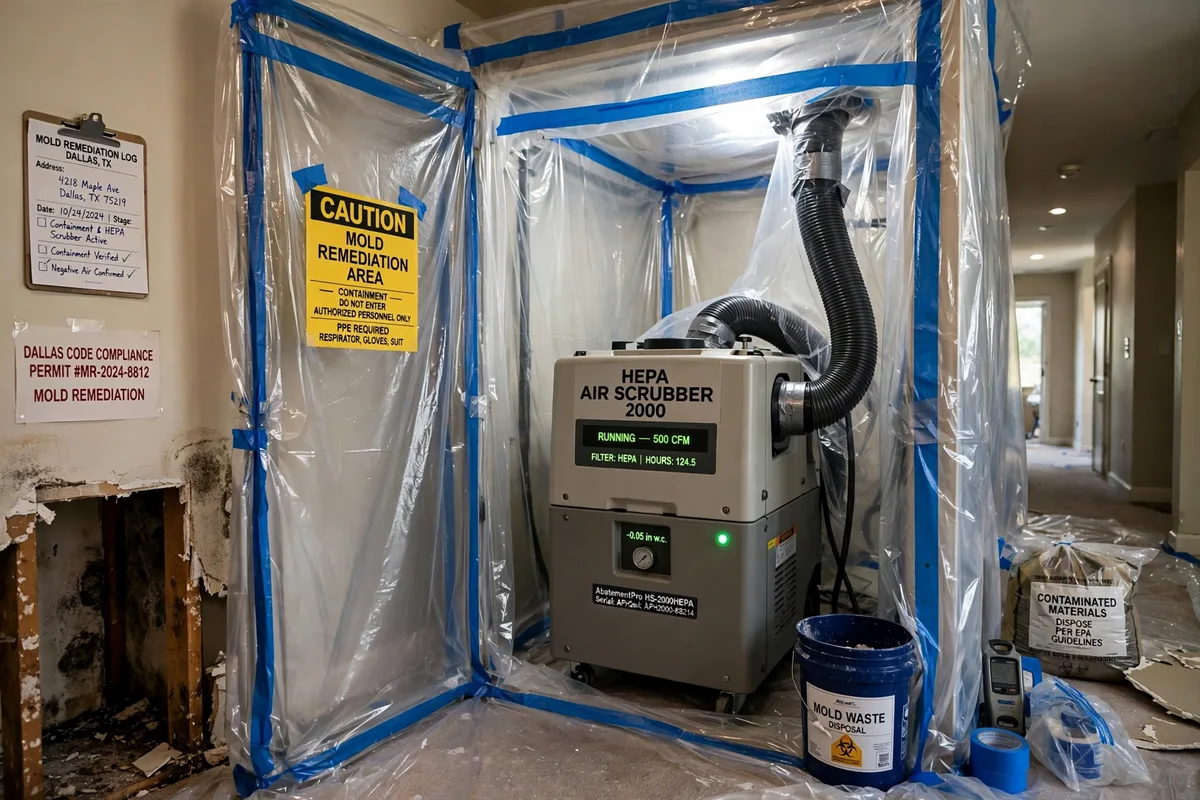
Often yes for a contained job, and the answer depends on containment, not on the mold type. A properly contained area under negative air pressure, with HEPA filtration running, keeps spores out of the living space, and the crew works in sealed barriers while the rest of the home stays usable. Larger jobs — whole-home colonies, HVAC contamination, or sewage-linked mold — usually mean temporary relocation, both for safety and because the work itself is disruptive. People with asthma, allergies, or immune conditions should stay out regardless of containment, and children and pets should never enter a work area. If the home has sewage contamination, nobody stays — that is a biohazard job, not a mold job. The crew should explain the containment plan before work starts, and if a company cannot describe its containment, it does not have one. However, staying home is a convenience decision, not a safety guarantee — when in doubt, the safer room is the one outside the work zone.
Important Considerations
Texas mold rules matter here: in many cases, remediation requires a licensed mold assessment consultant's protocol, and the same company cannot both assess and remediate on the same job — be wary of any company that offers both without that separation. Texas has no state license specifically for water restoration companies, so check IICRC certification, insurance, and reviews before hiring, and be wary of anyone demanding full payment upfront. Remediation without fixing the moisture source guarantees a return colony, and remediation without verified drying fails the same way — ask for the moisture log and photos in writing, because they belong to you, your insurer will want them, and any future buyer of the home will ask about the loss. Finally, during a metro-wide storm or freeze, every company's response stretches — honest companies say so on the call rather than promising a minute they cannot keep.
📞 Free Mold Remediation Quote: +1 214-807-4697
Frequently Asked Questions
How much does mold remediation cost in Dallas?
Most jobs land between $1,200 and $3,800, depending on area, materials, and whether the moisture source is fixed first. Jobs tied to an active water loss cost more, because extraction and drying run before removal. The on-site quote is free.
How fast does mold grow after water damage?
Mold can start growing in wet materials within 24–48 hours, which is why a water loss becomes a mold job so quickly. Drying within that window is the difference between a drying job and a remediation job.
Can I clean mold myself with bleach?
No — bleach kills only surface color on porous materials while the roots survive and regrow, and scrubbing spreads spores into clean rooms. Remediation removes contaminated material under containment; it does not wipe it.
Is black mold more dangerous than other mold?
Color alone does not determine danger — any large colony, any type, in a lived-in space deserves professional removal. The health question is exposure, area, and duration, not the color of the patch.
Can I stay in my home during mold remediation?
Often yes for a contained job under negative air pressure with HEPA filtration running. Larger jobs, HVAC contamination, or sewage-linked mold usually mean temporary relocation.
Will mold come back after remediation?
Only if the moisture source is left active — an unfixed leak, drainage problem, or humidity issue guarantees a return colony. Remediation plus source repair plus verified drying is the combination that holds.
Does insurance cover mold remediation?
It depends on the cause: mold from a sudden covered water loss is usually covered, while mold from a long-ignored leak is often excluded as gradual damage. Documentation from the first visit decides how smoothly the claim moves.
How long does mold remediation take?
Small contained jobs take a day or two; multi-room or hidden colonies take several days including drying. The finish line is verified moisture readings and clearance, not surfaces that look clean.
What is the difference between mold removal and mold remediation?
Removal is one step — taking contaminated material out. Remediation is the full service: inspection, containment, removal, HEPA cleaning, drying, and clearance. A removal-only job without containment and drying usually fails.
Do you test for mold before starting?
Inspection and moisture mapping come first on every job, and in many Texas cases a licensed mold assessment consultant's protocol is required before remediation begins. Testing without a remediation plan, or remediation without a protocol, both waste money.
Why should I call Water Damage Restoration Dallas for mold?
Local Dallas crews, 24/7 live answer, around 60-minute arrival, inspection plus containment plus removal plus verified drying in one call, free quotes, and insurance documentation from the first visit.
📞 Call Water Damage Restoration Dallas 24/7: +1 214-807-4697