Water Damage Restoration Services in Dallas: 24/7 Same-Day Help
TLDR
- Who provides water damage restoration services in Dallas right now?: Water Damage Restoration Dallas — 24/7 live answer, same-day dispatch, around 60-minute arrival: +1 214-807-4697.
- What services are included?: Emergency extraction, structural drying, mold prevention, contents cleaning, and repairs — one crew from first call to rebuild.
- How much do water damage restoration services cost in Dallas?: Most Dallas water jobs land between $2,500 and $7,500 all-in, depending on area, materials, and category of water.
- How fast do crews arrive?: Around 60 minutes in most of Dallas, 24 hours a day, including nights, weekends, and holidays.
- How long does drying take?: Structural drying typically takes 3–5 days with industrial equipment, verified by moisture readings rather than surfaces that feel dry.
- Does insurance cover restoration services?: Sudden events like burst pipes are usually covered, with the homeowner paying only the deductible in most cases.
- When should I call instead of waiting?: Immediately — mold can start in wet materials within 24–48 hours, and every hour of standing water adds to the repair scope.
🚨 WATER DAMAGE IN YOUR DALLAS HOME? Do not wait for it to dry on its own. We answer live 24/7, dispatch the same day, arrive in around 60 minutes, and give free estimates — extraction, drying, mold prevention, and repairs in one call.
📞 Water Damage? Call Now: +1 214-807-4697
Water damage restoration is not a single service — it is a chain, and the chain only works when every link runs in order. The chain starts with emergency response and water extraction, moves through structural drying and monitoring, adds mold prevention and contents work where needed, and ends with repairs that return the home to pre-loss condition. Break the chain anywhere — skip extraction and go straight to fans, dry surfaces without checking inside walls, or rebuild over a still-wet slab — and the job fails quietly, surfacing months later as mold, warped flooring, or a musty smell nobody can source. Water Damage Restoration Dallas runs the full chain 24 hours a day across Dallas — Downtown, Uptown, Lakewood, Frisco, Plano, and surrounding neighborhoods — with IICRC-certified technicians, free estimates, and direct insurance billing. Most Dallas water jobs land between $2,500 and $7,500 all-in, and the Texas average burst-pipe claim runs around $15,500 according to State Farm figures, which is why sudden losses are usually covered with only the deductible out of pocket. However, the service that matters most is the first one: a live answer and a crew dispatched in the first hour, because every hour of standing water is an hour of damage that drying cannot undo.
What happens during emergency water extraction?
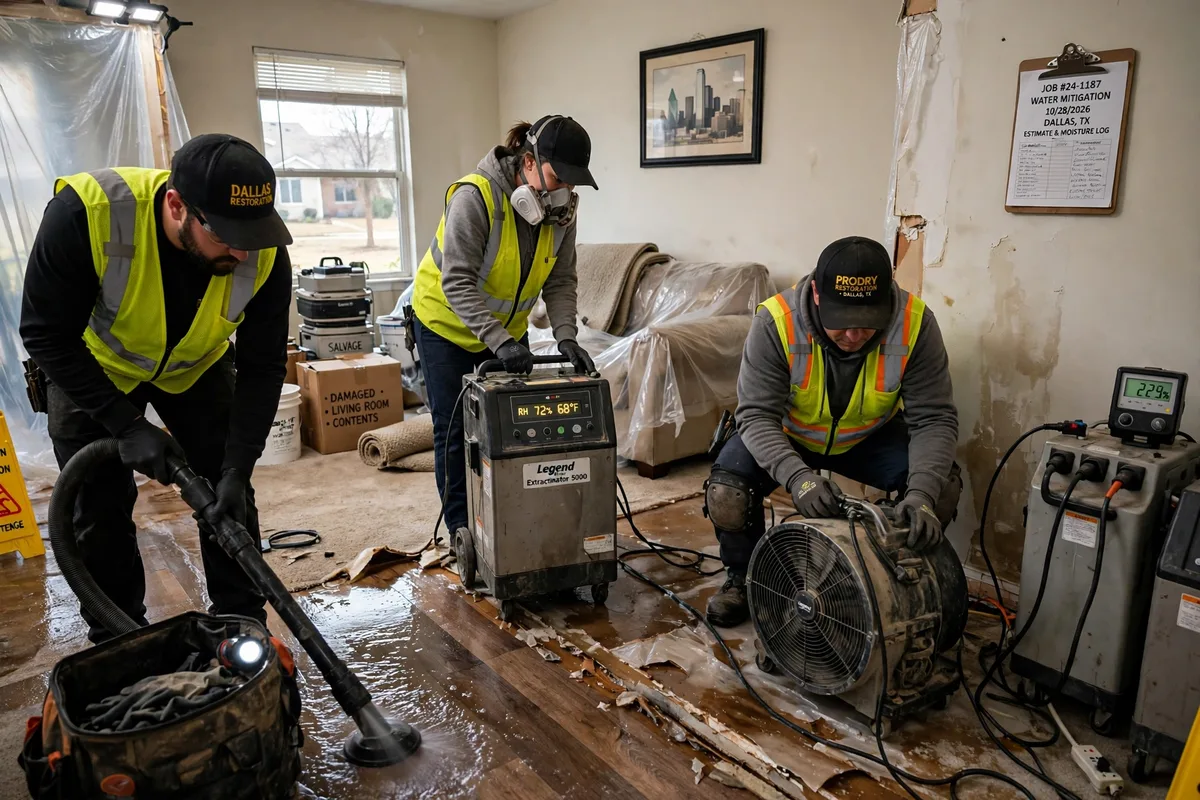
Extraction is the first service and the most urgent one, because standing water damages everything it touches and the damage compounds hourly. The crew arrives, shuts off the water source if it is still running, and removes standing water with truck-mounted extraction units and submersible pumps. Furniture and contents are lifted, blocked, or moved to dry areas, and wet materials that cannot be saved — saturated carpet pad, swollen particle board — are removed so they stop feeding moisture into the structure. Moisture mapping follows: meters and thermal imaging find water inside wall cavities, under flooring, and in the slab, because the water you cannot see decides the drying plan. Category matters here too: clean water from a supply line, gray water from appliances, and black water from sewage each need different safety procedures, and sewage jobs need full decontamination. The emergency restoration guide covers the first-hour sequence in detail. However, extraction without mapping is a half job — the visible water is gone and the hidden water is still working.
How does structural drying actually work?
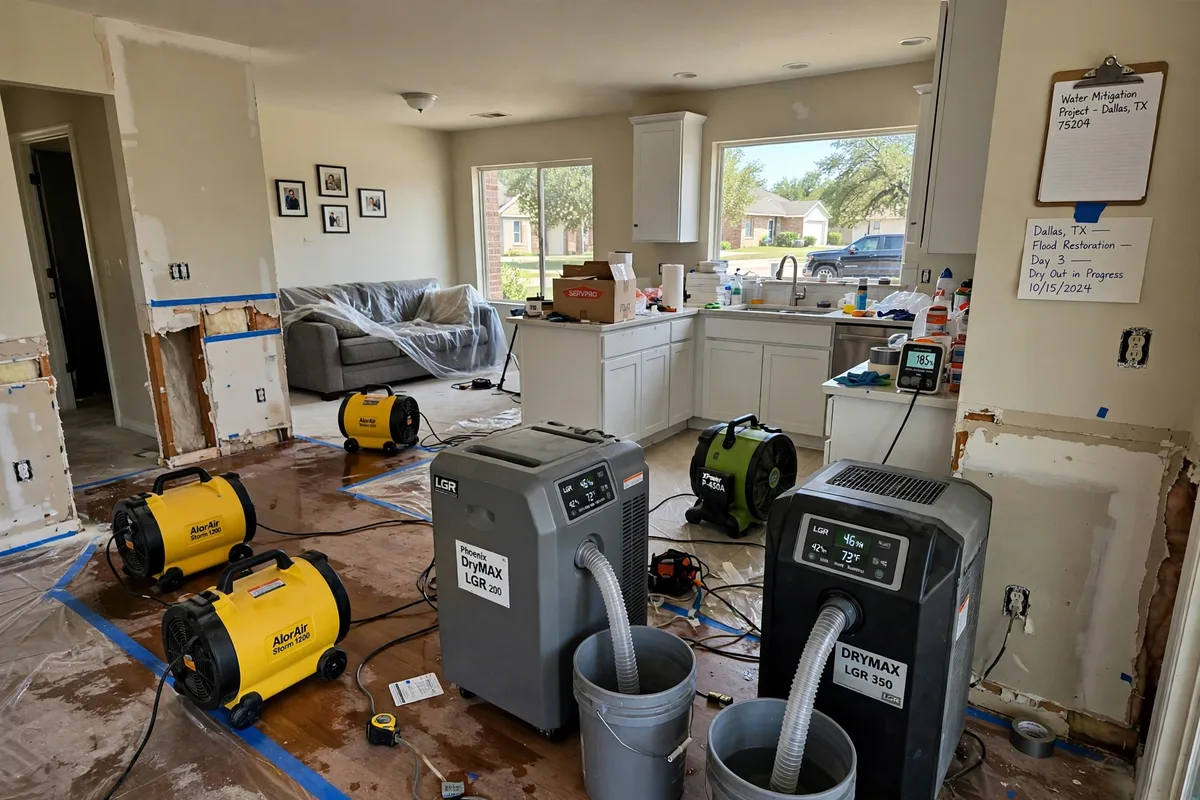
Structural drying is a science, not a fan rental, and the difference shows up in the moisture log. Industrial air movers push dry air across wet surfaces, commercial dehumidifiers pull that moisture out of the air, and the crew returns daily to take readings and reposition equipment as the drying front moves through materials. Drying typically takes 3–5 days for a standard job, longer for saturated hardwood, plaster, or slab, and the finish line is verified readings at or below dry standard — not surfaces that feel dry to the hand. Daily monitoring matters because drying stalls: a dehumidifier fills, a room seals poorly, or a wall cavity holds moisture that surface readings miss, and each stall adds days and mold risk. Mold can start in wet materials within 24–48 hours of saturation, which is why drying starts on the first visit rather than as a follow-up appointment. The structural drying guide explains the timeline and the readings in full. However, a company that drops equipment and disappears for a week is not drying your home — it is renting you machines and hoping.
| Restoration service | What it does | When it runs |
|---|---|---|
| Emergency extraction | Removes standing water | First visit, first hour |
| Structural drying | Dries walls, floors, slab | 3–5 days, monitored daily |
| Mold prevention | Antimicrobial, monitoring | During and after drying |
| Contents cleaning | Saves furniture, documents | Pack-out during drying |
| Repairs and rebuild | Restores pre-loss condition | After verified dry readings |
📞 Same-Day Water Extraction: +1 214-807-4697
What other services come with water damage restoration?
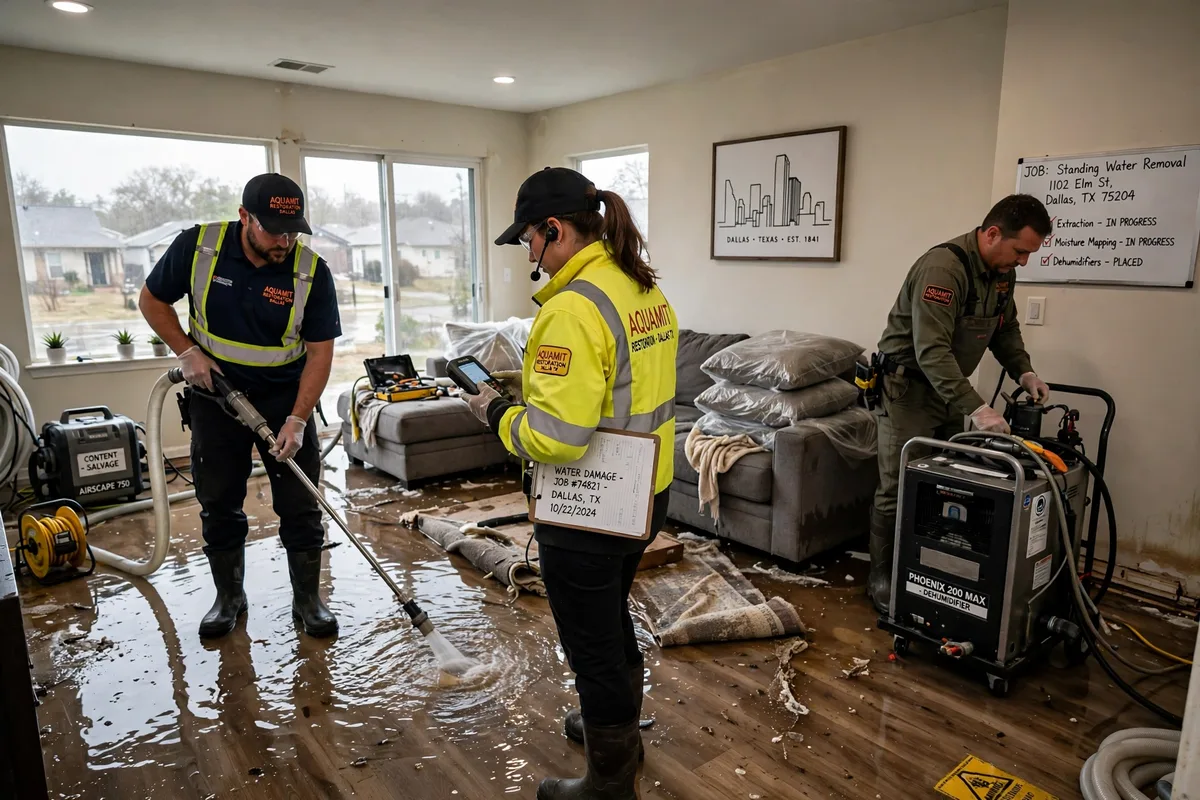
A full-service crew handles more than water, because water damage rarely travels alone. Mold prevention runs alongside drying: antimicrobial treatment on affected surfaces, containment when mold is already present, and full remediation when the job crosses into it — most mold remediation jobs in Dallas run $1,200–$3,800 as a separate scope. Contents services save what water threatened: furniture drying and cleaning, document recovery, electronics assessment, and pack-out storage while the home dries. Sewage and flood jobs add decontamination and sanitization, because black water carries pathogens that clean water does not. Repairs close the job: drywall, flooring, trim, and paint restored to pre-loss condition, with the repair scope priced separately from mitigation so the claim stays readable. Slab leak detection, at $150–$400 per visit, is often the service that finds the source when the water came from below rather than above. The burst pipe repair guide shows how plumbing repair and restoration scopes fit together. However, a company that only extracts water and leaves is not a restoration company — it is half the chain, and the missing half is where mold and rebuild costs hide.
How much do water damage restoration services cost?
Most Dallas water jobs land between $2,500 and $7,500 all-in for mitigation — extraction, drying, and monitoring — with repairs and contents work priced on top depending on scope. Three factors move the price inside that band: area affected, water category, and materials. A single-room clean-water job lands low; a multi-room sewage job with hardwood and wall removal lands high. The estimate is free and confirmed on site after moisture mapping — no company can give a real number over the phone without seeing the loss, and you should distrust one that does. Insurance coverage follows the cause: sudden events like burst pipes are usually covered, while long-running leaks ignored for months are often excluded as gradual damage. The repair-versus-restoration guide draws the line between the plumbing scope, the mitigation scope, and the rebuild scope so the claim stays clean. However, the cheapest mitigation quote is not the best deal when it skips monitoring or mold prevention — a second visit for mold costs more than the first job done right.
Important Considerations
Texas has no state license specifically for water restoration companies, so check IICRC certification, insurance, and reviews before hiring, and be wary of anyone demanding full payment upfront. Ask for the moisture log, the daily drying readings, and photos in writing: they belong to you, your insurer will want them, and any future buyer of the home will ask about the loss. If mold is found during drying, Texas rules require a licensed mold assessment consultant's protocol for remediation in many cases, and remediation should follow drying rather than precede it. During a metro-wide storm or freeze, every company's response stretches — honest companies say so on the call rather than promising a minute they cannot keep. Finally, separate the scopes in your head even if one company runs them all: mitigation stops the damage, repairs restore the home, and only the first one is an emergency.
📞 Free Restoration Estimate: +1 214-807-4697
Frequently Asked Questions
What services are included in water damage restoration?
Emergency extraction, structural drying and monitoring, mold prevention, contents cleaning, and repairs — one crew from first call to rebuild. Sewage and flood jobs add decontamination, and slab leak detection is available when the source is below the floor.
How fast can a crew arrive in Dallas?
Around 60 minutes in most of Dallas, 24 hours a day, including nights, weekends, and holidays. During metro-wide storms or freezes, response stretches for every company — honest crews say so on the call rather than promising a minute they cannot keep.
How much does water damage restoration cost in Dallas?
Most Dallas water jobs land between $2,500 and $7,500 all-in for mitigation, with repairs and contents work priced on top. The estimate is free and confirmed on site after moisture mapping.
How long does structural drying take?
Typically 3–5 days with industrial equipment and daily monitoring, longer for saturated hardwood, plaster, or slab. The finish line is verified moisture readings at dry standard, not surfaces that feel dry.
Does insurance cover water damage restoration services?
Sudden events like burst pipes are usually covered, with the homeowner paying only the deductible in most cases. Long-running leaks ignored for months are often excluded as gradual damage — which is why fast response protects the claim too.
Should I try to dry water damage myself?
Small spills, yes — but anything beyond a mop job needs extraction and verified drying. Household fans cannot dry inside walls or under flooring, and mold can start in wet materials within 24–48 hours of saturation.
What is the difference between mitigation and restoration?
Mitigation stops the damage — extraction, drying, and mold prevention. Restoration rebuilds what was damaged — drywall, flooring, and finishes. Both matter, but only mitigation is an emergency, and it must run first.
Can my furniture and belongings be saved?
Often yes — contents services include furniture drying and cleaning, document recovery, electronics assessment, and pack-out storage while the home dries. Items are inventoried and photographed for the claim.
What if the water came from sewage?
Sewage jobs need full decontamination and sanitization, protective equipment, and disposal of contaminated porous materials. Do not attempt sewage cleanup yourself — black water carries pathogens that clean water does not.
How do I know the drying is actually finished?
Ask for the moisture log: daily readings from meters and thermal imaging, compared against dry standard for each material. A crew that cannot show readings has not verified anything.
Why should I call Water Damage Restoration Dallas?
Local Dallas crews, 24/7 live answer, around 60-minute arrival, the full chain from extraction to rebuild in one call, free estimates, and insurance documentation from the first visit.
📞 Call Water Damage Restoration Dallas 24/7: +1 214-807-4697