Black Mold Removal Services in Dallas: 24/7 Emergency Help
TLDR
- Who provides black mold removal services in Dallas?: Water Damage Restoration Dallas — 24/7 live answer, around 60-minute arrival, free estimates: +1 214-807-4697.
- What is black mold?: Dark-colored mold, often Stachybotrys, that grows on wet cellulose material — drywall, wood, and paper — after water damage.
- Why is black mold urgent?: Mold grows on wet material in 24–48 hours, and black mold spreads through wall cavities long before it is visible.
- How do professionals remove black mold?: Containment, HEPA air scrubbers, removal of contaminated material, antimicrobial treatment, and clearance testing.
- How much does black mold removal cost in Dallas?: Mold remediation typically runs $1,200–$3,800, with larger black mold jobs costing more by area and material.
- Does bleach kill black mold?: No — bleach lightens surface color on porous drywall while the roots survive underneath, and the mold returns.
- When should you call a black mold crew?: On any visible dark growth, a musty smell with no visible source, or mold found after any leak or flood.
🚨 BLACK MOLD IN YOUR DALLAS HOME? Do not scrub it and do not ignore it — call now. We answer live 24/7, arrive in around 60 minutes, and give free estimates — containment, remediation, and clearance testing in one visit.
📞 24/7 Black Mold Removal: +1 214-807-4697
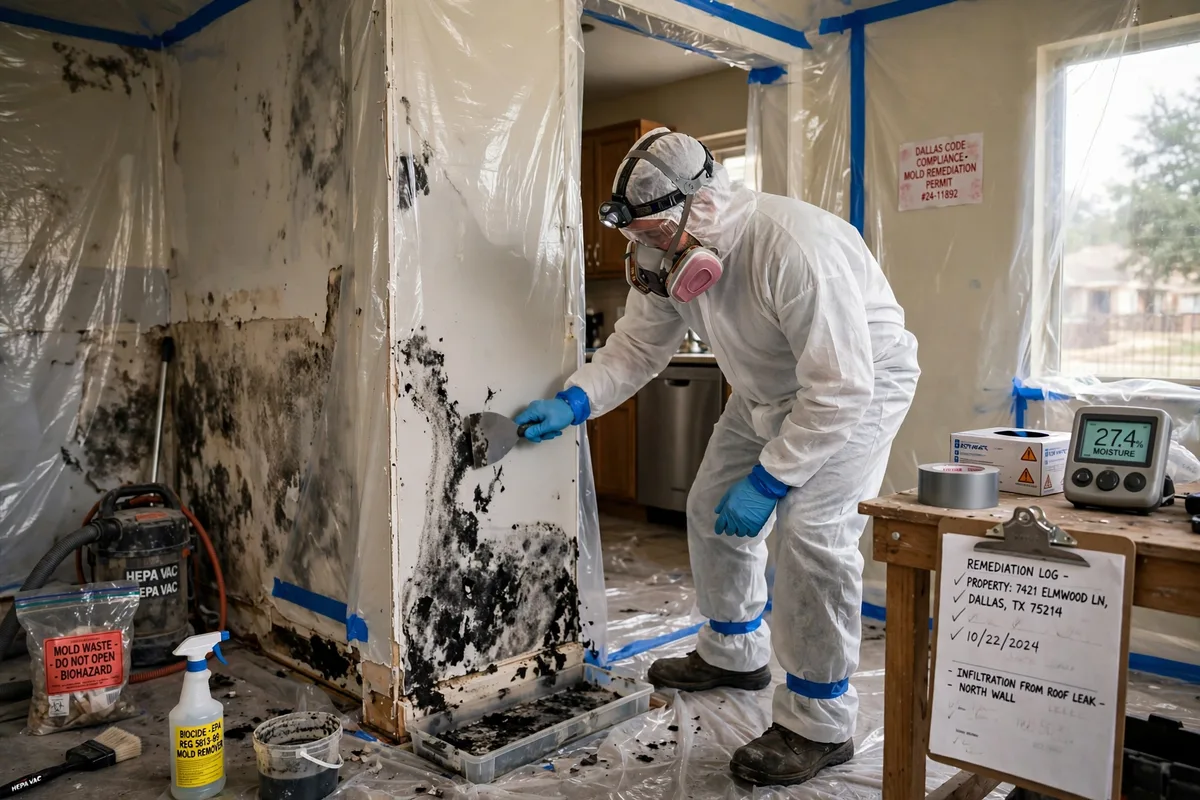
Black mold removal services in Dallas deal with the mold homeowners fear most — and the one most often mishandled. Dark growth on drywall, baseboards, or attic wood is usually the visible tip of a colony living inside the wall cavity, fed by a leak, a flood, or condensation that nobody fixed. Mold grows on wet material in 24–48 hours, so a Dallas home that sat damp for a weekend can already host growth behind paint that still looks fine. Professional removal is not spraying and wiping: it is containment, HEPA filtration, removal of contaminated material, and verification that the moisture source is gone. Water Damage Restoration Dallas handles black mold removal with IICRC-certified crews, around 60-minute arrival, free estimates, and same-day help. However, the rule that decides the outcome comes first: mold removal without fixing the water source is a pause, not a cure, and the colony returns to the same damp wall within weeks.
What is black mold, and how do you know it is really black mold?
Black mold is a dark-colored mold, most often Stachybotrys chartarum, that grows on wet cellulose material — drywall paper, wood framing, ceiling tiles, and cardboard — and produces a musty, earthy smell long before it becomes visible. Color alone does not identify it: many harmless molds look dark, and true black mold can hide green or gray, so identification comes from lab testing of air or surface samples, not from a photo. The health concern is real enough that professionals treat all dark growth with containment and PPE rather than debating species on site. The mold testing services guide covers air and surface testing, and the black mold after water damage guide covers how growth starts after a loss. However, one identification trap applies: a homeowner who waits for lab confirmation before containing a spreading colony gives the mold days of free growth, so containment starts on suspicion and testing confirms the scope.
How do professionals remove black mold without spreading it?
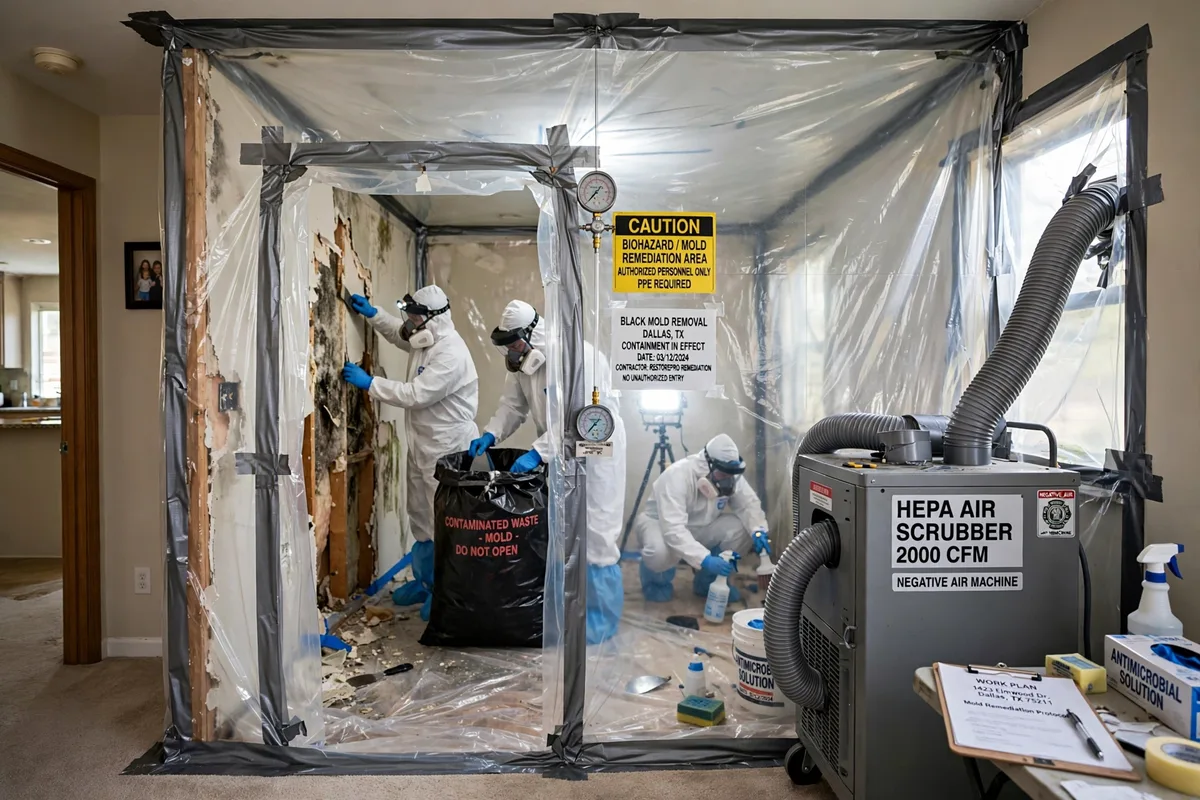
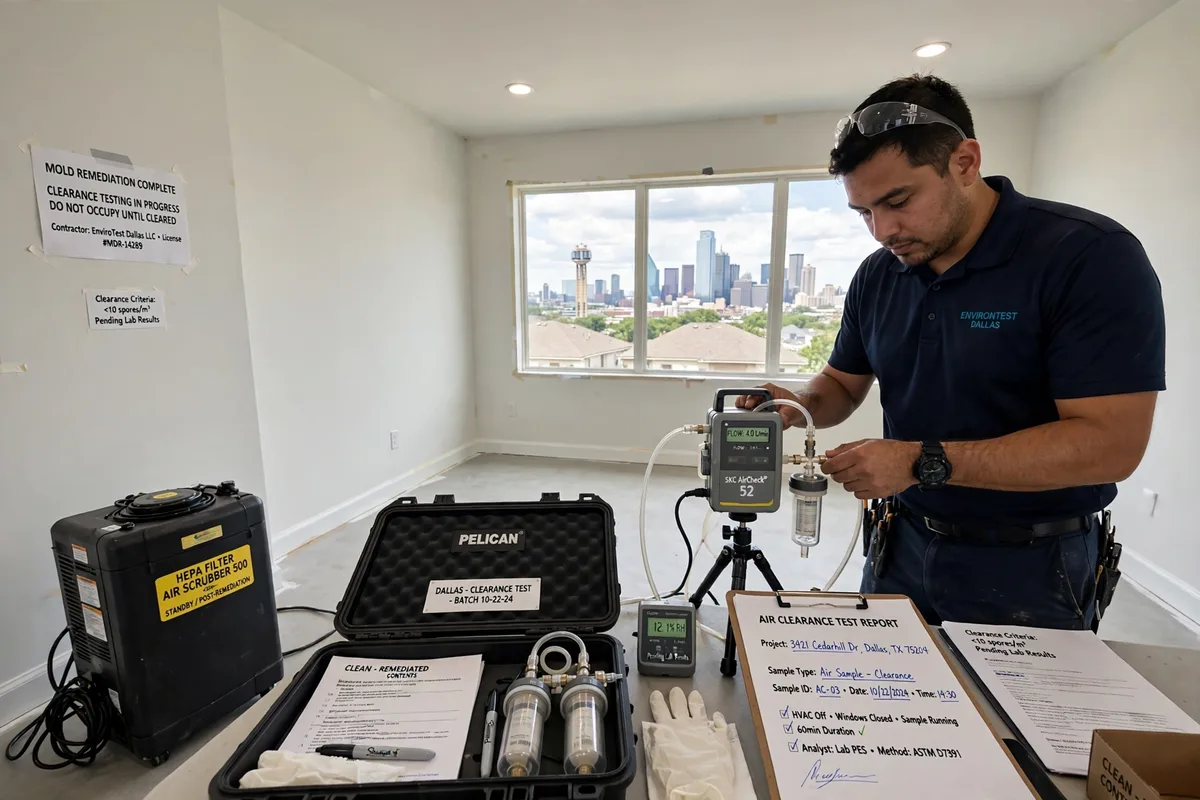
Professionals remove black mold under containment: plastic barriers seal the work area, negative air pressure pulls air inward so spores cannot escape, HEPA air scrubbers capture airborne spores throughout the job, and contaminated drywall and insulation are removed in sealed bags rather than carried through the house. Surfaces that can be saved get HEPA vacuuming and antimicrobial treatment; surfaces that cannot — soaked drywall, rotted wood — get cut out, because mold roots grow into porous material and surface cleaning cannot reach them. After removal, the crew dries the structure with verified moisture readings and runs clearance testing to confirm spore levels are back to normal. The mold remediation services guide covers the full remediation scope. However, the containment rule is absolute: a crew that scrapes mold in an open room without barriers and negative air has just seeded the rest of the house, and the next complaint will come from a room that was clean.
Why does bleach fail on black mold?
Bleach fails on black mold because it lightens the surface color on porous drywall while the mold roots survive underneath — the wall looks clean for a week and the colony returns, often worse, since bleach adds moisture to the material it was supposed to dry. Bleach also irritates lungs and eyes in an enclosed room, and mixing it with other cleaners creates toxic fumes. On hard, non-porous surfaces bleach can disinfect, but drywall, wood, and grout are porous, which is where black mold actually lives. The mold remediation cost guide explains what professional remediation includes that a spray bottle cannot. However, the bleach trap is the most expensive cheap fix in mold work: every week spent bleaching a returning colony is a week the colony spreads deeper into framing that then has to be cut out.
| Removal method | What it does | When it works |
|---|---|---|
| Bleach spray | Lightens surface color | Hard surfaces only |
| Containment + HEPA | Stops spore spread | Every professional job |
| Material removal | Removes rooted colony | Soaked drywall, wood |
| Antimicrobial treatment | Kills remaining spores | After removal, on sound material |
| Clearance testing | Verifies safe levels | Before rebuild |
📞 Book Black Mold Removal: +1 214-807-4697
How much does black mold removal cost in Dallas?
Mold remediation in Dallas typically runs $1,200–$3,800, with black mold jobs landing higher when the colony covers a large area, sits inside wall cavities, or requires cutting out framing and rebuilding. Cost drivers are area, access, material removal volume, and whether the moisture source — a leak, a slab failure, a roof problem — needs repair in the same visit. Water damage jobs themselves typically land between $2,500 and $7,500, and the Texas burst-pipe average claim runs around $15,500, so a leak that caused the mold often belongs in the same insurance claim as the remediation. Slab leak detection alone runs $150–$400 when the source is a hidden pipe failure. However, the pricing trap is the per-room quote with no containment or testing line items: a cheap quote that skips containment and clearance testing leaves spores behind and a colony that returns — and the second job costs more than the first job done right.
How do you choose black mold removal services in Dallas?
Choose on five checks: same-day response while the colony is still contained, IICRC mold remediation certification, containment and negative air on every job, a written scope that separates removal, drying, and rebuild, and clearance testing before any rebuild starts. Ask whether the crew fixes or identifies the moisture source, what material it plans to remove versus save, and whether testing is independent. Be wary of any company offering a spray-only treatment for growth inside drywall, and of any quote given sight-unseen over the phone. The mold removal company guide covers what a full-service crew includes. However, one selection rule beats the rest: the company that contains first, removes second, dries third, and tests fourth — in that order, in writing — is the company whose removal stays removed.
Important Considerations
Texas has no state license specifically for restoration companies, so check IICRC certification, insurance, and reviews before hiring, and be wary of anyone demanding full payment upfront. Never scrub black mold in an open room — dry brushing and wiping launch spores into the air and seed clean rooms. Never paint over mold: paint seals moisture in and the colony keeps growing behind the coat. Never assume a room is mold-free because the surface looks clean — wall cavities hold growth long after visible patches are gone, which is why testing and moisture readings matter. If the mold followed a leak or flood, fix the water source in the same job, not as a later project. Keep the scope, test results, photos, and all carrier correspondence in one file — mold claims generate more paperwork than the job suggests. Finally, after remediation, control humidity and ventilation in the repaired area, because the next Dallas storm season will test the same weak point again.
📞 Free Black Mold Removal Quote: +1 214-807-4697
Frequently Asked Questions
Who provides black mold removal services in Dallas?
Water Damage Restoration Dallas — 24/7 live answer, around 60-minute arrival, free estimates, and containment, removal, drying, and clearance testing in one scope. Call +1 214-807-4697 any hour and a live crew answers.
What is black mold?
Dark-colored mold, often Stachybotrys, that grows on wet cellulose material like drywall and wood after water damage. Color alone does not identify it — lab testing confirms the species.
Is black mold dangerous?
It can trigger respiratory irritation, allergies, and asthma flare-ups, especially in children and sensitive adults. Professionals treat all dark growth with containment and PPE rather than debating species on site.
Does bleach kill black mold?
No — bleach lightens surface color on porous drywall while roots survive underneath, and the mold returns. Bleach also adds moisture and irritates lungs in enclosed rooms.
How do professionals remove black mold?
Containment with negative air, HEPA filtration, removal of contaminated material in sealed bags, antimicrobial treatment of sound surfaces, drying, and clearance testing before rebuild.
How much does black mold removal cost in Dallas?
Mold remediation typically runs $1,200–$3,800, with larger black mold jobs costing more by area, access, and material removal. An itemized scope is what keeps the number honest.
How fast does mold grow after water damage?
Mold grows on wet material in 24–48 hours, so a home that sat damp for a weekend can already host growth behind paint that still looks fine.
Can I stay home during black mold removal?
Often not in the work area — containment, negative air, and PPE are needed while spores are airborne. The crew will advise when each room is safe to re-enter.
Will insurance cover black mold removal?
When mold follows a sudden covered loss like a burst pipe, remediation often falls inside the same claim — the Texas burst-pipe average claim runs around $15,500. Document the source and the growth together.
What if the mold keeps coming back?
Returning mold means the moisture source was never fixed. A proper scope repairs the leak or drainage problem in the same job, not as a later project.
Why call Water Damage Restoration Dallas for black mold removal?
Local Dallas crews, 24/7 live answer, around 60-minute arrival, free estimates, and removal done in the right order — call +1 214-807-4697.
📞 Call Water Damage Restoration Dallas 24/7: +1 214-807-4697