Commercial Water Damage Restoration in Dallas: Offices, Retail & Warehouses Back Open Fast
TLDR
- Who handles commercial water damage in Dallas?: Water Damage Restoration Dallas — 24/7 live answer, around 60-minute arrival, free estimates: +1 214-807-4697.
- Why is commercial water damage different from residential?: It migrates between floors through elevator shafts and utility chases, shorts out server rooms, and destroys commercial carpeting and inventory at a scale no home job matches.
- How fast does a commercial building need help?: Within hours — left untreated over 48 hours, commercial water blooms mold and exposes the owner to OSHA issues.
- How much does commercial water damage restoration cost in Dallas?: Dallas-area water jobs typically land between $2,500 and $7,500 for mitigation, with large commercial losses running far higher by square footage and floors affected.
- How long does commercial structural drying take?: Structural drying typically takes 3–5 days for a commercial space, with truck-mounted extraction removing thousands of gallons first.
- Does insurance cover commercial water damage?: Sudden failures are usually covered, including business-interruption losses where the policy includes them — document every cost from hour one.
- When should a Dallas business call a commercial water crew?: Immediately — after-hours and phased work can keep the business trading while the restoration runs.
🚨 COMMERCIAL WATER DAMAGE IN DALLAS? Every hour closed is lost revenue — call now. We answer live 24/7, arrive in around 60 minutes, and give free estimates — extraction, drying, and phased work so your business keeps trading.
📞 24/7 Commercial Water Help: +1 214-807-4697
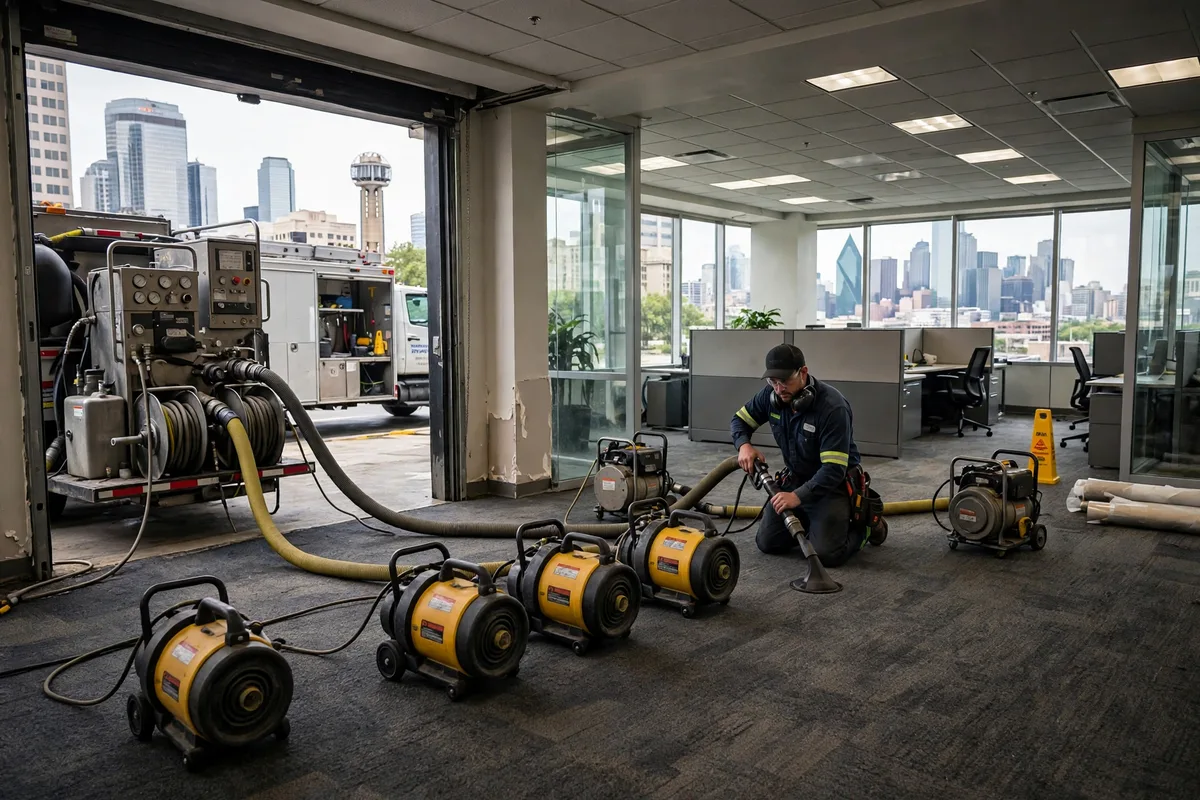
Commercial water damage restoration in Dallas is not a bigger residential job, it is a different job: water in a commercial building wicks up drywall, short-circuits server rooms, destroys commercial carpeting and inventory, and migrates between floors through elevator shafts, utility chases, and shared walls — so a leak on the fifth floor can be a ground-floor emergency by the time anyone notices it. Truck-mounted extraction removes thousands of gallons, structural drying typically takes 3–5 days, and after-hours and phased work let the business keep trading while the restoration runs. Left untreated over 48 hours, commercial water blooms mold and exposes the owner to OSHA issues, which is why the response clock for a business is even tighter than for a home. Water Damage Restoration Dallas handles commercial water losses with IICRC-certified crews, around 60-minute arrival, free estimates, and same-day help. However, one commercial rule comes first: the business-interruption claim starts the hour the water is found, because the documents that prove lost revenue — sales records, booking logs, and closure notices — are worthless if they are assembled weeks later from memory.
Why is commercial water damage different from residential water damage?
Commercial water damage is different from residential water damage because of scale, migration, and consequence: a commercial leak can release thousands of gallons across multiple floors, water migrates between floors through elevator shafts, utility chases, and shared walls, and the losses include server rooms, inventory, commercial carpeting, and the revenue of every day the business stays closed. Water in a commercial building wicks up drywall faster than in a home because the wall runs are longer and the cavities are deeper, and a server room that shorts out can lose data and equipment worth more than the building repair itself. The water damage restoration services guide covers the residential service, while this post covers the commercial job specifically. However, one difference trap applies: a crew that treats a commercial loss like a big house job will miss the migration paths, so the crew has to map every floor the water could have reached, not just the floor where it was found.
What should a Dallas business do first when water damage hits?
When water damage hits a Dallas business, shut off the main water valve first, protect the server room and the inventory next, and move stock, equipment, and paperwork out of the wet area before the water spreads. Photograph the leak, the floors, and every damaged room before anything moves, since the photos support the claim, and note the time the water was found, which is exactly what an insurance adjuster needs to see. Call for same-day help next, because the 48-hour mold clock starts the moment the water is found, and a crew with truck-mounted extraction and moisture meters can map the migration paths before the mold and the OSHA exposure begin. Do not run the HVAC system until the ducts are checked, since wet ductwork spreads mold spores through every room the system serves, and do not reopen a wet area to staff or customers until the crew clears it. However, the first-step mistake is the mop-and-open move: drying the lobby while the server room and the floor above are still wet trades a good impression now for a failed inspection later, so mapping comes before reopening.
How do professionals restore commercial water damage in Dallas?
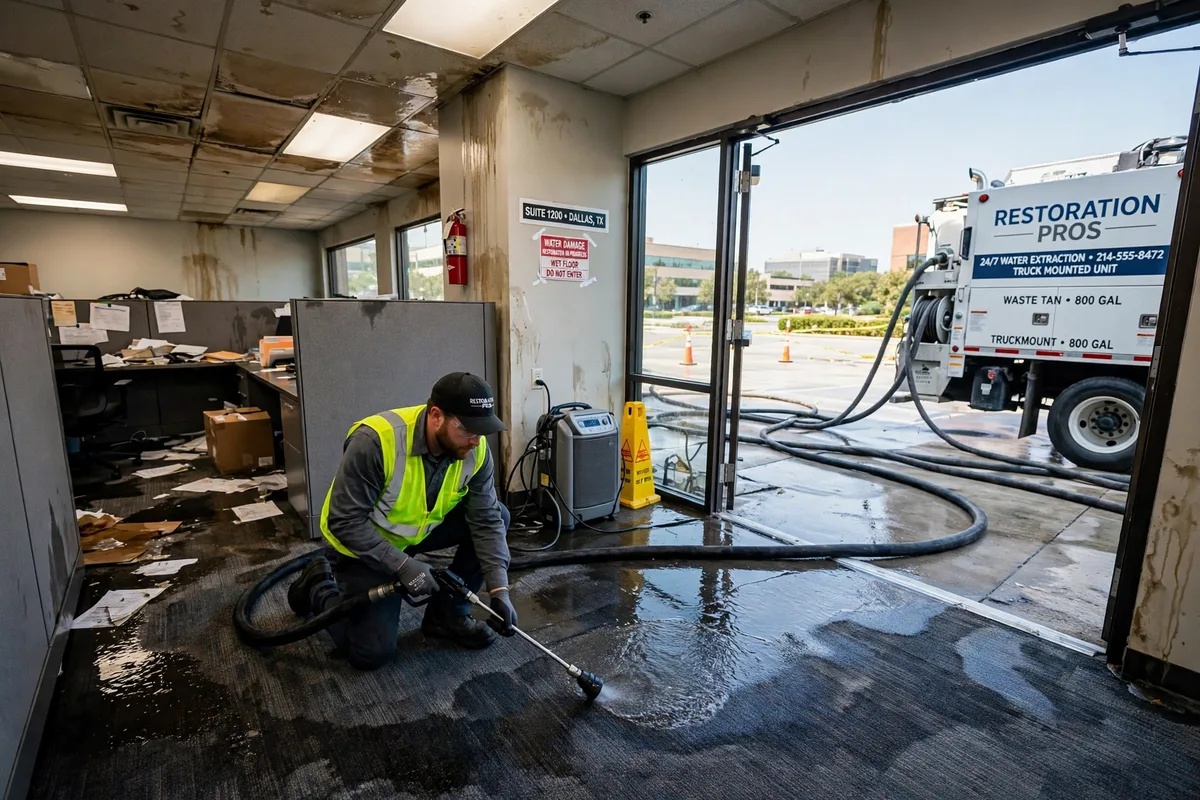
Professionals restore commercial water damage in Dallas in sequence: assess every floor the water could have reached, extract standing water with truck-mounted equipment, map moisture inside wall cavities and under commercial flooring with meters and thermal imaging, remove saturated material as needed, dry the structure with air movers and dehumidifiers until readings verify dryness, check for mold, then rebuild the walls and floors. After-hours and phased work let the business keep trading: the crew works the closed areas at night and the open areas in sections, so the office, the shop, or the restaurant never has to shut completely. Large-loss documentation runs alongside the work, with photos, readings, and moisture logs that support both the property claim and the business-interruption claim. The emergency water extraction services guide covers the extraction step in detail. However, one restoration rule is absolute: drying without mapping every floor is a guess, since the worst water sits in the elevator shaft, the utility chase, and the wall cavity where no air mover can reach it.
Which Dallas properties need commercial water damage restoration?
Commercial water damage restoration in Dallas serves offices, retail shops, restaurants, hotels, healthcare facilities, warehouses, and multifamily buildings — and each property type carries its own risk. Offices lose server rooms and paper records, retail loses inventory and foot traffic, restaurants lose kitchens and health-code standing, hotels lose rooms and bookings, healthcare facilities lose sterile areas and compliance, warehouses lose stock and racking, and multifamily buildings lose units and tenants at once. The commercial fire damage guide covers the sister fire vertical, and the commercial mold remediation guide covers the mold vertical for the same properties. However, one property rule applies across all of them: the bigger the building, the further the water migrates, so the assessment has to cover the whole building, not just the room where the water was found.
| Commercial property | Biggest water risk | First crew step |
|---|---|---|
| Offices | Server rooms short out | Protect servers, extract |
| Retail shops | Inventory, foot traffic | Move stock, extract |
| Restaurants | Kitchen, health code | Extract, sanitize |
| Hotels | Rooms, bookings lost | Map floors, phase work |
| Warehouses | Stock, racking damage | Extract, map, dry |
📞 Book Commercial Water Assessment: +1 214-807-4697
How much does commercial water damage restoration cost in Dallas?
Dallas-area water jobs typically land between $2,500 and $7,500 all-in for mitigation, with large commercial losses running far higher by square footage, floors affected, and inventory at risk. A single-floor office leak costs far less than a multi-floor loss that reaches the server room and the ground-floor retail below it, and water that reached commercial carpeting and inventory means more material removal and more careful rebuild of floors and finishes. Mold remediation at $1,200–$3,800 applies when the structure sat wet past 48 hours, and leak detection at $150–$400 is required to find the source inside a wall or under a slab. The Texas burst-pipe average claim runs around $15,500, and commercial claims typically run higher, because a commercial loss touches structure, contents, inventory, and revenue at once. However, the pricing trap is the mop-and-go quote: a company that offers to dry the visible floor without mapping the shafts, chases, and cavities is selling a cosmetic dry that the next inspection will undo.
How do you choose a commercial water damage restoration company in Dallas?
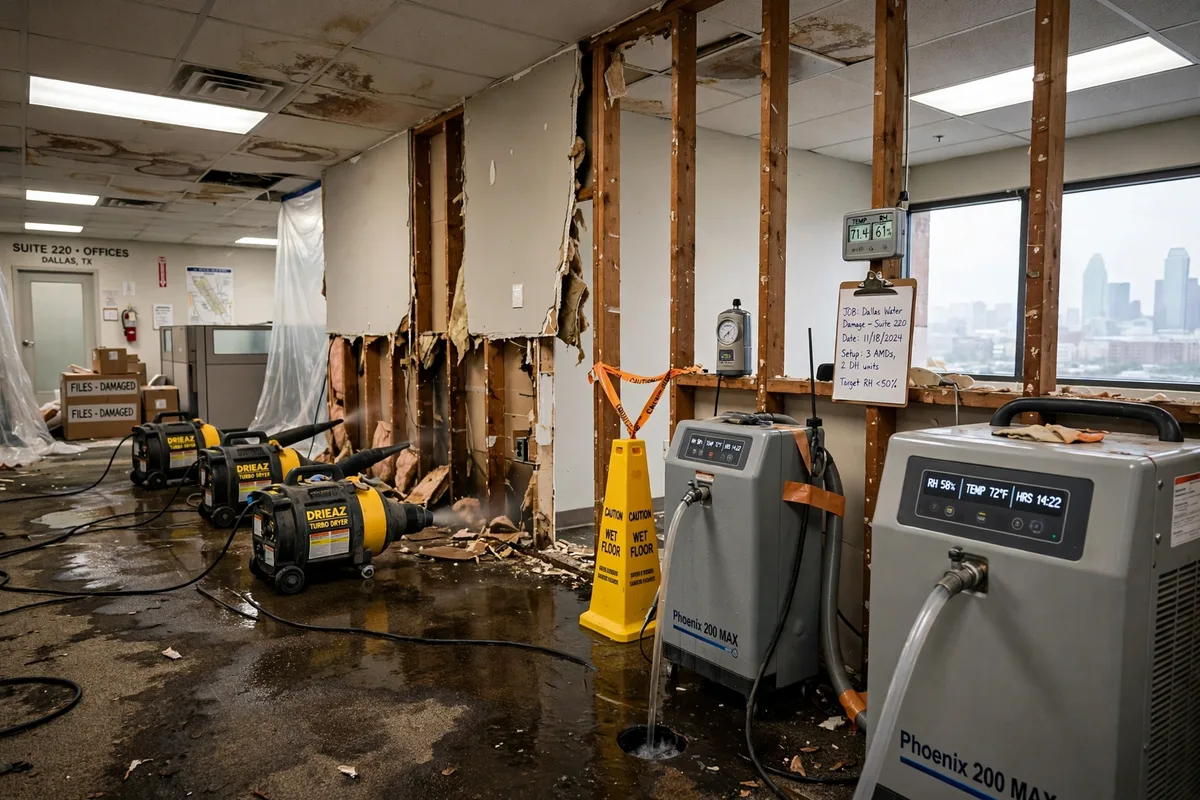
Choose on five checks: same-day response for active commercial leaks, truck-mounted extraction and large-loss equipment, moisture mapping with meters and thermal imaging across every floor, a written scope that separates extraction, drying, mold check, and rebuild, and large-loss documentation with photos, readings, and business-interruption support. Ask whether the crew works after hours and in phases so the business keeps trading, how it verifies the structure is dry, and whether it checks for mold before closing the walls. The mold remediation services guide covers the mold check that follows any commercial loss past 48 hours. However, one selection rule beats the rest: the company that maps the whole building first, extracts second, dries third, and documents the revenue loss alongside the repair — in that order, with readings to prove it — is the company whose Dallas business reopens fastest and recovers the most.
Important Considerations
Texas has no state license specifically for restoration companies, so check IICRC certification, insurance, and reviews before hiring, and be wary of anyone demanding full payment upfront. Never reopen a wet commercial area to staff or customers before the crew clears it, because a wet floor is a slip hazard and a wet wall is a mold risk that the next inspection will find. Never wait past 48 hours to start commercial drying, since mold blooms and OSHA exposure begin after that line, and the owner carries the liability. Never mop the surface and assume the job is done, since the worst water sits in the elevator shaft, the utility chase, and the wall cavity, and mold grows on wet material in 24–48 hours. Never run the HVAC system after a commercial water loss until the ducts are checked, since wet ductwork spreads mold spores through every room the system serves. If the loss touched a server room, ask explicitly for equipment and data protection alongside drying, not just wall repair, because the data loss can cost more than the building repair. Keep the scope, moisture readings, photos, sales records, and all carrier correspondence in one file — commercial water claims generate more paperwork than the job suggests. Finally, after repair, know your main shutoff valve and your riser locations, and test the building's alarms and valves twice a year, because the next leak will test the same systems again.
📞 Free Commercial Water Estimate: +1 214-807-4697
Frequently Asked Questions
Who handles commercial water damage in Dallas?
Water Damage Restoration Dallas — 24/7 live answer, around 60-minute arrival, free estimates, and extraction, drying, and phased work so your business keeps trading. Call +1 214-807-4697 any hour and a live crew answers.
Why is commercial water damage different from residential?
It migrates between floors through elevator shafts and utility chases, shorts out server rooms, and destroys commercial carpeting and inventory at a scale no home job matches. A leak on the fifth floor can be a ground-floor emergency by the time anyone notices it.
How fast does a commercial building need help after water damage?
Within hours — left untreated over 48 hours, commercial water blooms mold and exposes the owner to OSHA issues. Structural drying typically takes 3–5 days once truck-mounted extraction removes the standing water.
How much does commercial water damage restoration cost in Dallas?
Dallas-area water jobs typically land between $2,500 and $7,500 for mitigation, with large commercial losses running far higher by square footage and floors affected. Inventory loss and business interruption sit on top of the repair.
How long does commercial structural drying take?
Structural drying typically takes 3–5 days for a commercial space, with truck-mounted extraction removing thousands of gallons first. Multi-floor losses and server-room damage take longer.
Does insurance cover commercial water damage?
Sudden failures are usually covered, including business-interruption losses where the policy includes them. Document sales records, booking logs, and closure notices from hour one to prove the revenue loss.
How fast can a crew reach a Dallas business after water damage?
Around 60 minutes, 24/7. Crews run same-day for commercial losses because every hour closed is lost revenue, and after-hours and phased work can keep the business trading while the restoration runs.
Can my business stay open during commercial water restoration?
Often yes — after-hours and phased work let the business keep trading while the restoration runs in sections. The wet areas stay closed until the crew clears them, and the open areas keep operating around the work.
What is the difference between commercial water damage and commercial fire damage?
Commercial water damage is the water event — leaks, bursts, and flooding — while commercial fire damage adds soot, smoke, and firefighting water to the same building. Both need large-loss documentation and phased work to keep the business open.
What should I do first when my Dallas office floods?
Shut off the main water valve, protect the server room and the inventory, move stock and paperwork out of the wet area, photograph everything, and call for same-day help. Do not reopen a wet area to staff until the crew clears it.
Why call Water Damage Restoration Dallas for commercial water damage?
Local Dallas crews, 24/7 live answer, around 60-minute arrival, free estimates, and truck-mounted extraction with large-loss documentation — call +1 214-807-4697.
📞 Call Water Damage Restoration Dallas 24/7: +1 214-807-4697
Related Dallas Water Damage Guides
- Burst Pipe in Dallas: What to Do in the First 60 Minutes
- Water Damage in the First 24 Hours: An Hour-by-Hour Guide for Dallas Homeowners
- Emergency Water Extraction in Dallas: What Actually Happens When the Crew Arrives
- Emergency Water Damage Checklist: Every Step, in Order, for Dallas Homeowners