Commercial Mold Remediation in Dallas: Offices, Shops & Same-Day Quotes
TLDR
- Who handles commercial mold remediation in Dallas?: Water Damage Restoration Dallas — 24/7 live answer, same-day inspection, free written scope: +1 214-807-4697.
- How much does commercial mold remediation cost?: Around $10–$25 per square foot of affected area — small jobs $2,000–$5,000, medium $5,000–$30,000, large $30,000–$50,000+.
- How long does a business have to close?: Often not at all — containment plus after-hours and overnight work keeps unaffected suites open while the job runs.
- What standard does commercial mold work follow?: IICRC S520, with independent clearance testing before re-occupancy and EPA guidance for commercial buildings.
- What causes mold in Dallas commercial buildings?: Roof leaks, HVAC condensate, plumbing failures, and storm water — mold grows on wet material in 24–48 hours.
- How fast can a crew reach a Dallas business?: Same-day inspection, 24/7 — the scope and the quote land the same day the call comes in.
- When can staff come back after commercial mold remediation?: After clearance testing passes — the independent test is the proof the space is safe to re-occupy.
🚨 MOLD IN YOUR DALLAS BUSINESS? Every closed day costs money — call now. We answer live 24/7, inspect the same day, and give free written scopes — containment, after-hours work, and clearance testing so your business reopens fast.
📞 24/7 Commercial Mold Help: +1 214-807-4697
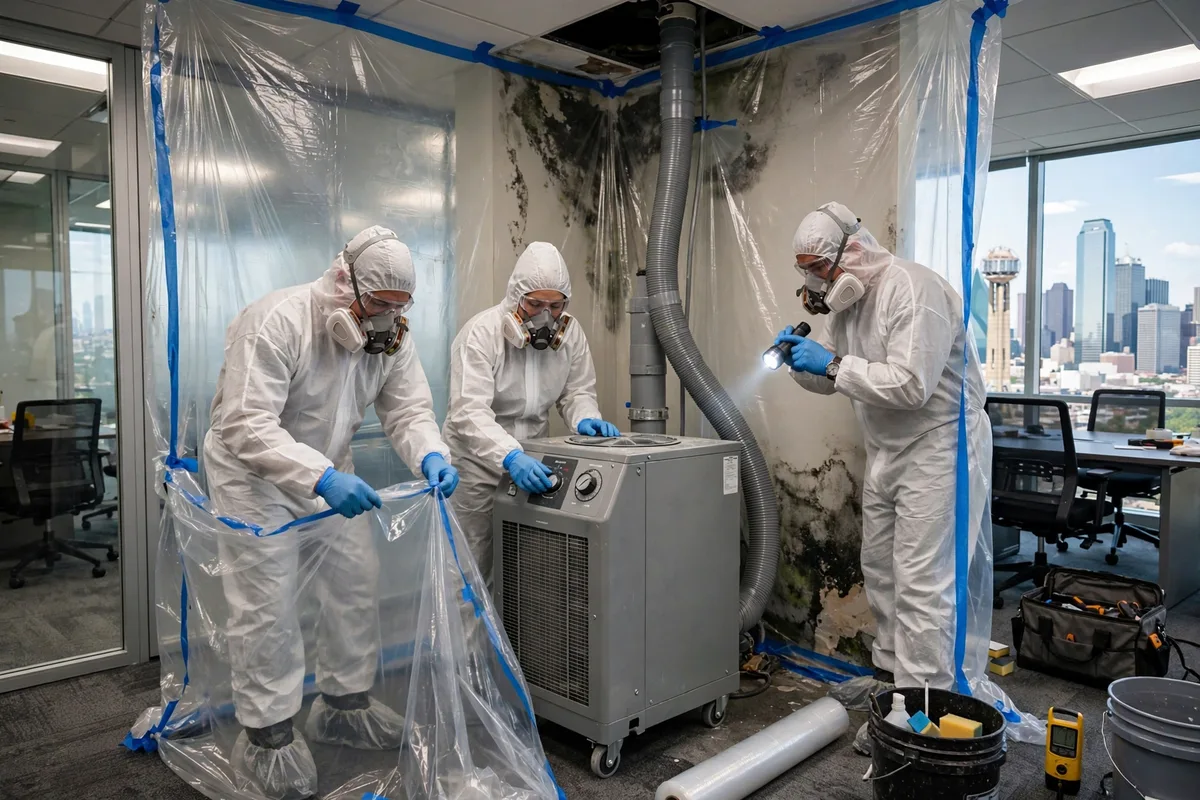
Commercial mold remediation in Dallas means removing the mold and getting the business back open, in that order: a roof leak over a retail floor, an HVAC condensate line that has been dripping into a ceiling for weeks, or storm water that got under the warehouse slab all end the same way — wet material, mold growth in 24–48 hours, and a space that cannot stay open until the problem is contained and cleared. The question every building owner asks first is the same one: what does it cost, and how long are we closed? Commercial mold remediation runs around $10–$25 per square foot of affected area — small jobs under 100 square feet at $2,000–$5,000, medium jobs at $5,000–$30,000, and large or multi-floor jobs at $30,000–$50,000 or more, with HVAC remediation alone at $2,000–$6,000. Water Damage Restoration Dallas handles commercial mold with IICRC-certified crews, same-day inspection, free written scopes, and after-hours work so unaffected suites stay open while the job runs. However, one commercial rule comes first: never let untrained staff tear out moldy material, because the disturbance spreads spores through the building faster than the mold ever grew on its own.
How much does commercial mold remediation cost in Dallas?
Commercial mold remediation in Dallas costs around $10–$25 per square foot of affected area, and the total follows the size of the job: small jobs under 100 square feet run $2,000–$5,000, medium jobs run $5,000–$30,000, and large or multi-floor jobs run $30,000–$50,000 or more. HVAC remediation alone runs $2,000–$6,000 when the system itself is the source, and the commercial add-ons — containment, after-hours access, and independent clearance testing — sit on top of the removal price. The scope matters more than the square footage: a roof leak that wet one ceiling cavity costs a fraction of a plumbing failure that soaked three floors, and a warehouse with open space dries faster than an office floor with a hundred cubicles to pack out. A free written scope before work starts, with the containment plan, the after-hours schedule, and the clearance testing spelled out, is the only way a building owner knows what the number covers. The mold remediation cost guide breaks down the residential numbers for comparison. However, the pricing trap is the per-square-foot quote with no scope attached: a price that does not say what containment, what hours, and what testing it includes is a price that will grow the moment the walls open.
How long does a Dallas business have to close for mold remediation?
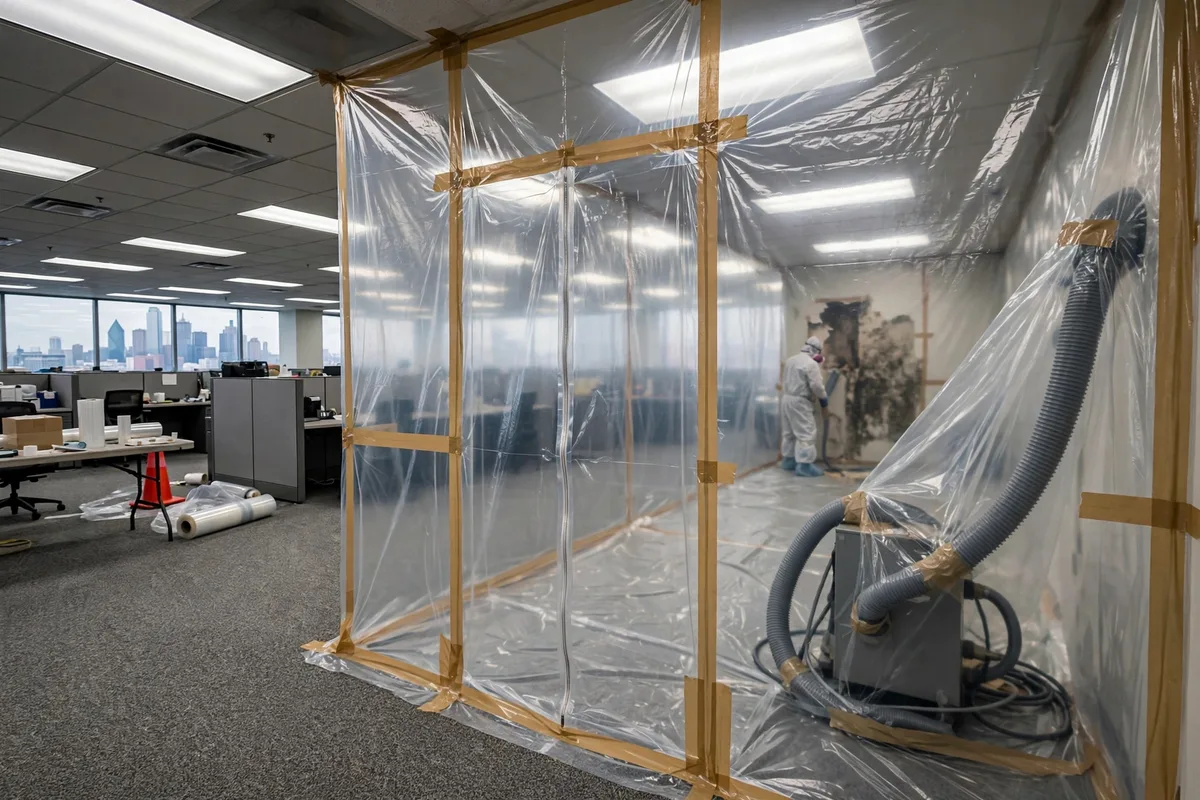
A Dallas business often does not have to close at all for mold remediation: containment walls and negative air pressure seal the affected area, and the crew works after hours and overnight so the unaffected suites stay open and trading while the job runs. A single office suite can be contained, remediated, and cleared while the rest of the floor works normally, and a retail shop can keep its front of house open while the back room is under containment. Full closure is needed only when the mold is in the shared HVAC, when the affected area is the main trading floor, or when the water source is still active and the whole space is wet. The crew sequences the work around the business — containment first, removal second, drying and clearance third — and the re-occupancy decision waits on the clearance test, not on the calendar. The mold clearance testing guide explains what the independent test proves before staff return. However, one closure rule decides the schedule: the space reopens when the clearance test passes, not when the drying equipment comes out, because a space that reopens a day early can close for a week when the mold comes back.
What causes mold in Dallas commercial buildings?
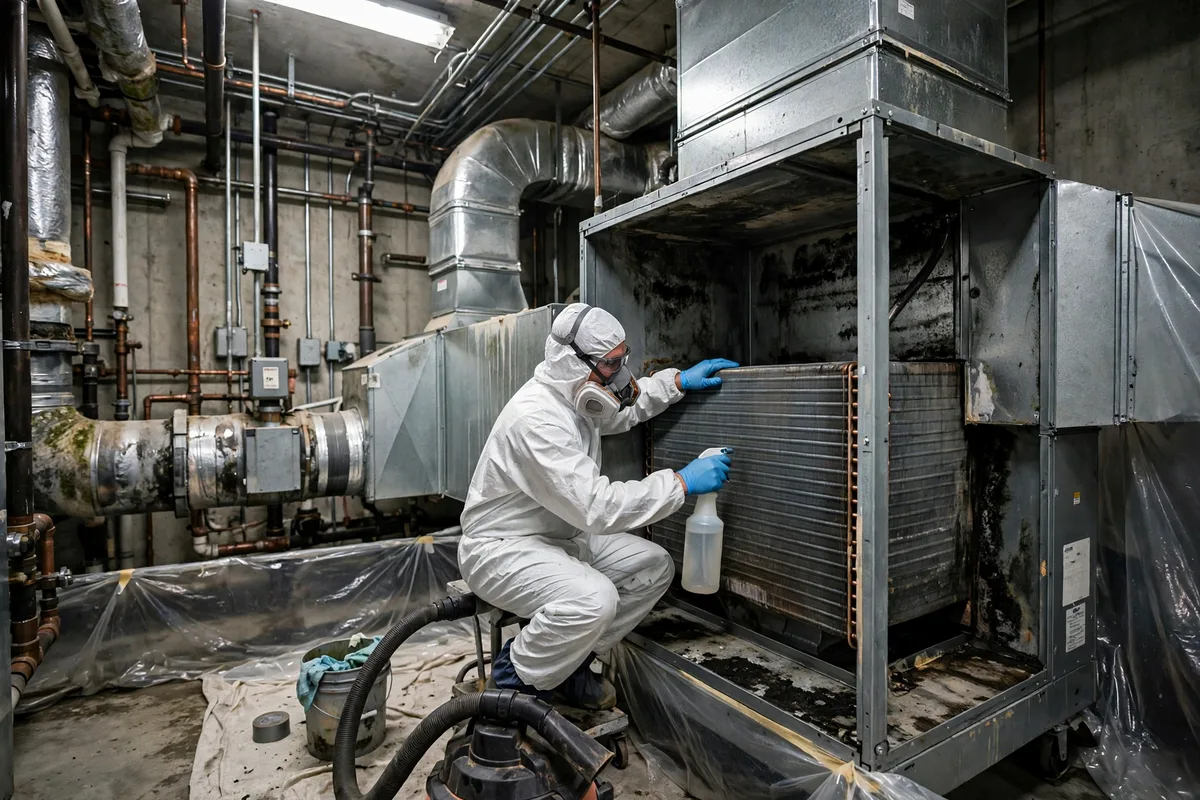
Mold in Dallas commercial buildings comes from four usual sources: roof leaks that wet the ceiling cavity over a trading floor, HVAC condensate lines that drip into walls and ceiling plenums for weeks, plumbing failures in restrooms and break rooms, and storm water that gets under doors and slabs during the heavy spring and autumn rains. Dallas clay soil shifts with every wet-dry cycle, stressing pipe joints and slab foundations, and the flat roofs common on offices, shops, and warehouses pond water after every storm and leak at the seams. The mold itself is the symptom — the source is the water, and the crew finds the source before removing a single panel, because remediation without a source fix is a job that repeats. The mold remediation services guide covers the residential side of the same work. However, one cause trap applies: the stain on the ceiling tile is often the overflow, while the real failure sits in the roof membrane or the condensate line above it — so the crew maps moisture before declaring the source found.
| Commercial mold job | Typical cost | Business impact |
|---|---|---|
| Small, under 100 sq ft | $2,000–$5,000 | One suite closed |
| Medium, one floor | $5,000–$30,000 | Containment, after-hours |
| Large, multi-floor | $30,000–$50,000+ | Phased closure |
| HVAC remediation alone | $2,000–$6,000 | System off, suites open |
| Clearance testing | Part of scope | Proof before reopening |
📞 Book Commercial Mold Inspection: +1 214-807-4697
What standard does commercial mold remediation follow?
Commercial mold remediation follows IICRC S520, the industry standard for professional mold remediation, with EPA guidance for commercial buildings layered on top for large and multi-floor jobs. The standard sets the sequence: containment before removal, negative air pressure inside the containment, HEPA filtration on the air leaving it, removal of porous material that cannot be cleaned, and independent clearance testing before re-occupancy. OSHA guidance adds a practical line for small areas: isolated areas up to 30 square feet can be handled by trained maintenance staff, which means anything bigger, anything in the HVAC, or anything that has been wet for weeks belongs to a professional crew. The clearance test is done by an independent assessor, not by the crew that did the removal, so the result is evidence the building owner can hand to a tenant, an insurer, or a regulator. The commercial fire restoration guide covers the same multi-party coordination for the other commercial vertical. However, one standard rule is absolute: a job with no containment and no clearance test is not remediation, it is demolition with spores in the air — so demand both in the written scope.
How do you choose commercial mold remediation services in Dallas?
Choose on five checks: same-day inspection for an active problem, experience with commercial buildings and after-hours work, a written scope that separates source repair, containment, removal, drying, and clearance testing, IICRC-certified crews, and claim documentation with photos and readings. Ask whether the crew has remediated offices, retail, restaurants, warehouses, and schools before, how it keeps unaffected suites open, and whether the clearance testing is independent. Ask for the after-hours schedule in writing, because a crew that works only 9-to-5 is a crew that closes your business for the whole job. However, one selection rule beats the rest: the company that finds the water source first, contains before it removes, and hands you an independent clearance report before reopening is the company whose building stays open after the next storm.
Important Considerations
Texas has no state license specifically for restoration companies, so check IICRC certification, insurance, and reviews before hiring, and be wary of anyone demanding full payment upfront. Never let untrained staff tear out moldy material, because the disturbance spreads spores through the building faster than the mold ever grew. Never paint or seal a damp wall without drying the structure beneath it, because the moisture will return the warp and feed mold under the finish. Never reopen a remediated space before the independent clearance test passes, since the test is the only proof the space is safe to re-occupy. Never treat the mold without fixing the water source — a roof leak, a condensate line, or a plumbing failure left running will grow the mold back within weeks. Keep the scope, the moisture readings, the clearance report, and all carrier correspondence in one file, because a commercial mold claim generates more paperwork than the job suggests. Finally, after remediation, ask for a maintenance check on the roof drains, the HVAC condensate lines, and the plumbing, because the next Dallas storm will test the same systems again.
📞 Free Commercial Mold Estimate: +1 214-807-4697
Frequently Asked Questions
Who handles commercial mold remediation in Dallas?
Water Damage Restoration Dallas — 24/7 live answer, same-day inspection, free written scopes, and containment, after-hours work, and clearance testing. Call +1 214-807-4697 any hour and a live crew answers.
How much does commercial mold remediation cost?
Around $10–$25 per square foot of affected area — small jobs $2,000–$5,000, medium $5,000–$30,000, large or multi-floor $30,000–$50,000 or more. HVAC remediation alone runs $2,000–$6,000.
How long does a business have to close for mold remediation?
Often not at all — containment plus after-hours and overnight work keeps unaffected suites open. Full closure is needed only when the mold is in the shared HVAC or the main trading floor.
What standard does commercial mold work follow?
IICRC S520, with EPA guidance for commercial buildings and independent clearance testing before re-occupancy. Isolated areas up to 30 square feet can be handled by trained maintenance staff under OSHA guidance.
What causes mold in Dallas commercial buildings?
Roof leaks, HVAC condensate lines, plumbing failures, and storm water — mold grows on wet material in 24–48 hours. The crew finds the water source before removing a single panel.
How fast can a crew reach a Dallas business?
Same-day inspection, 24/7 — the scope and the quote land the same day the call comes in, and after-hours work starts the same night where the job allows it.
When can staff come back after commercial mold remediation?
After clearance testing passes — the independent test is the proof the space is safe to re-occupy. A space that reopens a day early can close for a week when the mold comes back.
Can my maintenance team handle commercial mold?
Only isolated areas up to 30 square feet, by trained staff. Anything bigger, anything in the HVAC, or anything wet for weeks belongs to a professional crew with containment and clearance testing.
Does insurance cover commercial mold remediation?
Often yes when the source is a sudden covered loss, such as a burst pipe or storm damage. Slow leaks face tougher coverage questions, so document the discovery date and the source from hour one.
What types of buildings do you remediate?
Offices, retail shops, restaurants, warehouses, and schools across Dallas — with containment and after-hours work so unaffected suites stay open. Call +1 214-807-4697 for a same-day inspection.
Why call Water Damage Restoration Dallas for commercial mold?
Local Dallas crews, 24/7 live answer, same-day inspection, free written scopes, and IICRC S520 work with independent clearance testing — call +1 214-807-4697.
📞 Call Water Damage Restoration Dallas 24/7: +1 214-807-4697
Related Dallas Water Damage Guides
- Mold Starts Growing in 24–48 Hours: What That Clock Really Means for Dallas Homes
- Mold in Air Ducts in Dallas: Signs, Health Risks & Same-Day HVAC Mold Removal
- Mold Remediation vs Mold Removal in Dallas: Which Service Do You Actually Need?
- Can Mold Come Back After Remediation in Dallas? Same-Day Help