Emergency Fire Damage Restoration in Dallas: 24/7 Same-Day Service
TLDR
- Who handles fire damage restoration in Dallas right now?: Water Damage Restoration Dallas — 24/7 live answer, same-day emergency dispatch, around 60-minute arrival: +1 214-807-4697.
- What does fire damage restoration include?: Emergency board-up, water extraction from firefighting, soot removal, odor neutralization, contents cleaning, and repairs.
- How much does fire damage restoration cost in Dallas?: The Dallas average is $29,077, with most jobs ranging from $4,357 to $57,916 depending on scope.
- Are fire claims really the most expensive?: Yes — fire and lightning claims average around $88,170, the highest of any homeowners claim type.
- What should I do first after a fire?: Wait for fire-department clearance, do not re-enter, do not start cleaning, and call for emergency board-up and assessment.
- Can the smoke smell actually be removed?: Yes, with professional soot removal, duct cleaning, and odor treatments like thermal fogging and hydroxyl — candles and air fresheners only mask it.
- How long does fire restoration take?: Smoke-only jobs take days to two weeks; full jobs take weeks; major rebuilds can take 6–12 months.
🚨 FIRE DAMAGE IN YOUR DALLAS HOME? Do not wait, do not clean, do not re-enter until cleared. We answer live 24/7, dispatch the same day, arrive in around 60 minutes, secure your home, and give free estimates — board-up, soot removal, and odor control in one call.
📞 Fire Emergency? Call Now: +1 214-807-4697
A house fire is the most expensive disaster a Dallas homeowner faces, and the hours after the fire department leaves decide how much of the loss is recoverable. Fire claims average around $88,170 — the highest of any homeowners claim type — and the Dallas average restoration job runs $29,077, but those numbers move fast in the first day: soot is acidic and corrodes metal within hours, firefighting water soaks the structure and starts the mold clock at 24–48 hours, and an unsecured home invites theft, vandalism, and weather damage on top of the fire. Emergency fire damage restoration is therefore a sequence, not a single service: board-up and security first, water extraction second, soot removal third, odor neutralization fourth, and contents cleaning and repairs after. Water Damage Restoration Dallas runs that full sequence 24 hours a day across Dallas — Downtown, Uptown, Lakewood, and surrounding neighborhoods — with IICRC-certified technicians, free estimates, and direct insurance billing. However, the first steps belong to you, and the most important one is restraint: do not re-enter before clearance, and do not start cleaning, because the wrong first cleaning move can set soot stains permanently.
What should I do in the first hours after a fire?
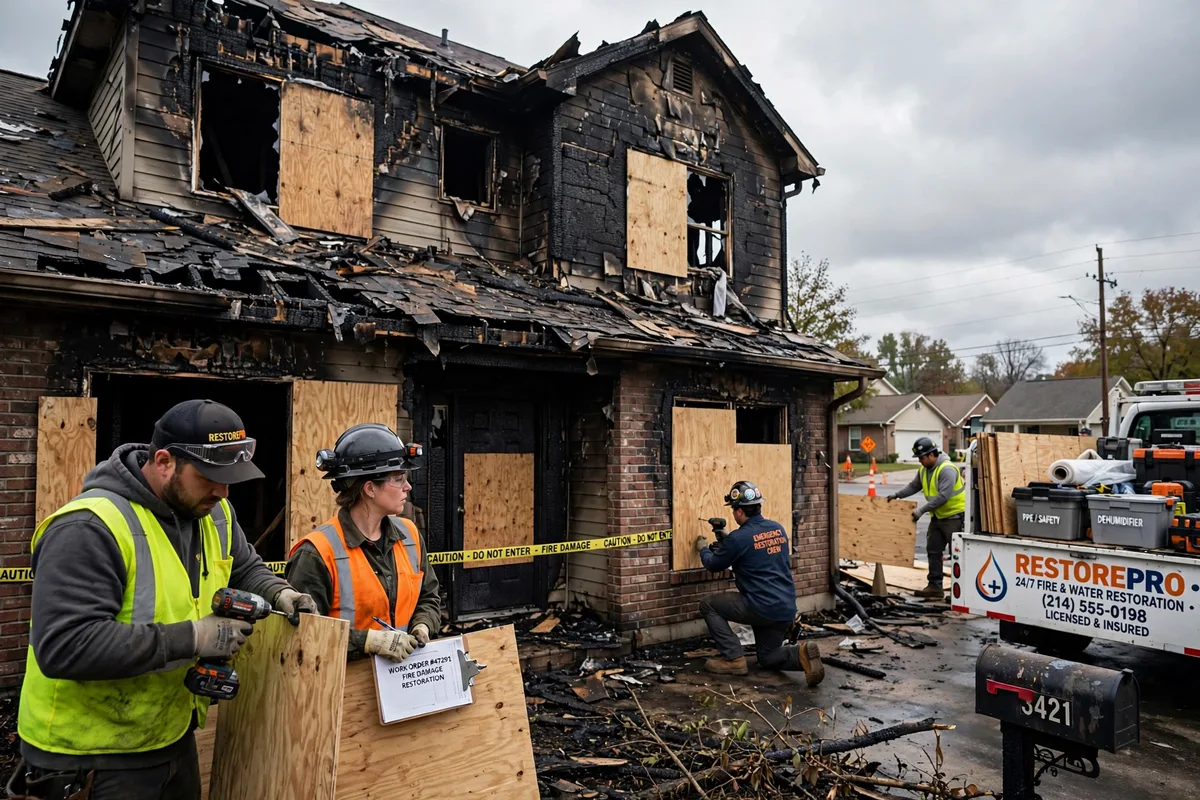
Five steps, in order. First, wait for fire-department clearance — re-entering early risks structural collapse, hidden hot spots, and toxic exposure, and no belonging is worth that risk. Second, call for emergency board-up: broken windows, doors, and roof openings must be secured the same day, because an open fire-damaged home is an invitation to theft and weather. Third, call your insurer and open the claim, but do not sign anything or agree to a scope before the assessment. Fourth, photograph and video everything from outside and from safe entry points once cleared, before anything is moved or cleaned — the claim record is built in these hours. Fifth, do not run the HVAC system: turning the air conditioning or furnace back on redistributes soot and odor through the ductwork into rooms the fire never touched, turning a contained loss into a whole-house one. Do not throw anything away yet, either — contents that look destroyed are often restorable, and discarded items cannot be claimed. However, if the structure looks unstable, the roof is compromised, or the smell is overwhelming, stay out entirely and let the crew handle entry.
What does the fire restoration process actually involve?
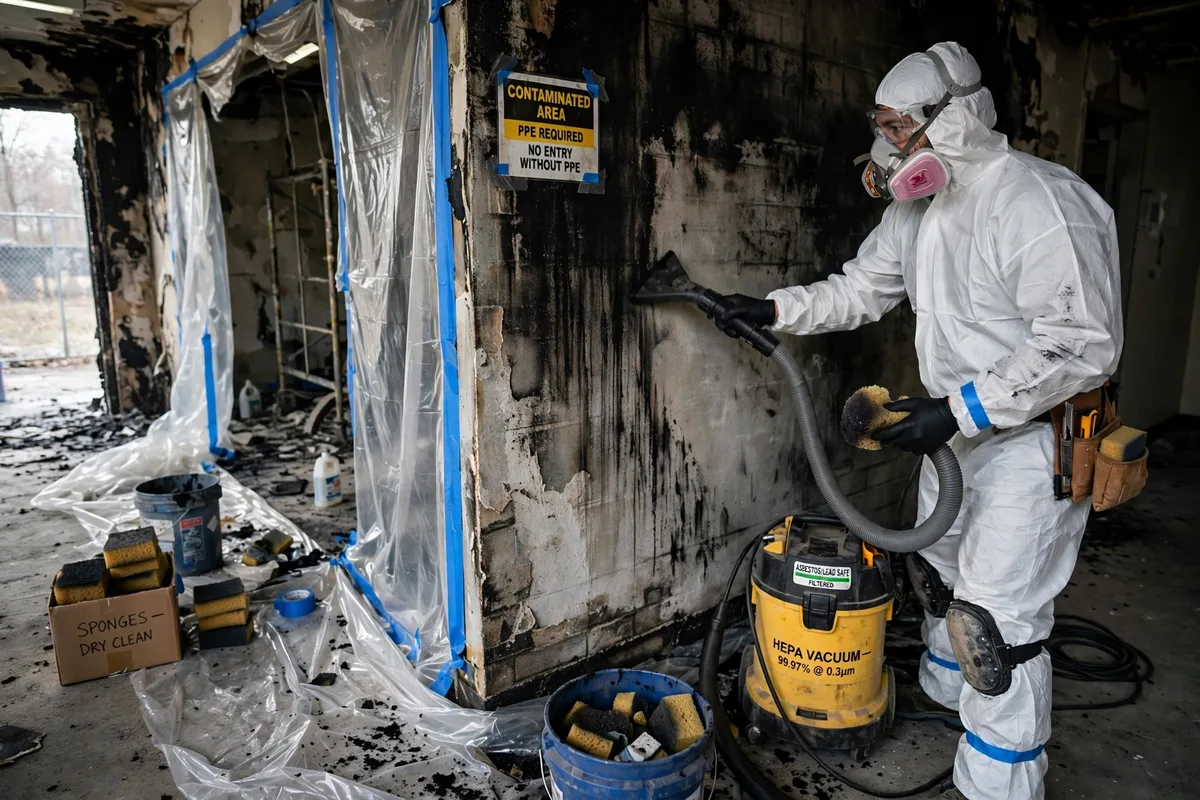
The process runs in a fixed order, and skipping a step creates the next loss. Assessment and board-up come first: structural safety, scope documentation, and securing every opening. Then water mitigation: firefighting leaves hundreds of gallons in the structure, and that water is extracted and dried exactly like a flood loss — the flood restoration guide covers that phase, and the structural drying guide explains why verified readings, not dry surfaces, are the finish line. Then soot removal: HEPA vacuuming, dry sponges, and cleaning agents matched to the soot type — dry soot, wet soot, protein soot from kitchen fires, and fuel-oil soot each need different treatment, and wet-cleaning first smears soot and sets stains permanently. Then odor neutralization: hydroxyl generators, thermal fogging, ozone, and duct cleaning, plus sealing of surfaces that hold odor in their pores. Then contents cleaning and pack-out: furniture, clothing, electronics, and documents cleaned off-site while the structure is restored. Then repairs and reconstruction. The emergency restoration guide covers the water side of the sequence in detail. However, odor work done before soot removal is wasted effort — the source must be removed before the smell can be neutralized.
How much does fire damage restoration cost in Dallas?
The Dallas average is $29,077, with a typical range of $4,357 to $57,916, and the scope bands explain why quotes vary so much. Light smoke damage in one or two rooms runs $3,000–$8,000. Whole-home light soot runs $8,000–$25,000. Heavy soot with HVAC contamination runs $25,000–$50,000. Moderate fire with structural cleaning runs $15,000–$50,000, and a severe fire with rebuild runs $50,000–$180,000 or more. Component costs add up: soot removal $2,000–$6,000, duct cleaning $250–$500, thermal fogging $200–$600, ozone treatment $400–$800, furniture deodorizing $200–$1,000. The rate that matters for budgeting is $4–$7 per square foot for typical fire restoration work. The estimate is free and confirmed on site after assessment — no company can give a real number over the phone without seeing the loss, and you should distrust one that does. Fire claims average around $88,170 nationally, which is why these losses are usually covered and most callers pay only their deductible plus any temporary living costs the policy handles. However, the cheapest quote is not the best deal when it skips duct cleaning or odor sealing — the smoke smell returns with the first warm day, and the second job costs more than the first.
| Fire damage scope | Typical Dallas cost | What it includes |
|---|---|---|
| Light smoke, 1–2 rooms | $3,000–$8,000 | Soot cleaning, odor treatment |
| Whole-home light soot | $8,000–$25,000 | Full cleaning, duct work, fogging |
| Heavy soot + HVAC | $25,000–$50,000 | Deep cleaning, HVAC, sealing |
| Moderate fire + structure | $15,000–$50,000 | Cleaning plus structural repairs |
| Severe fire + rebuild | $50,000–$180,000+ | Full reconstruction scope |
📞 Same-Day Fire Restoration: +1 214-807-4697
Why is the smoke smell so hard to remove?
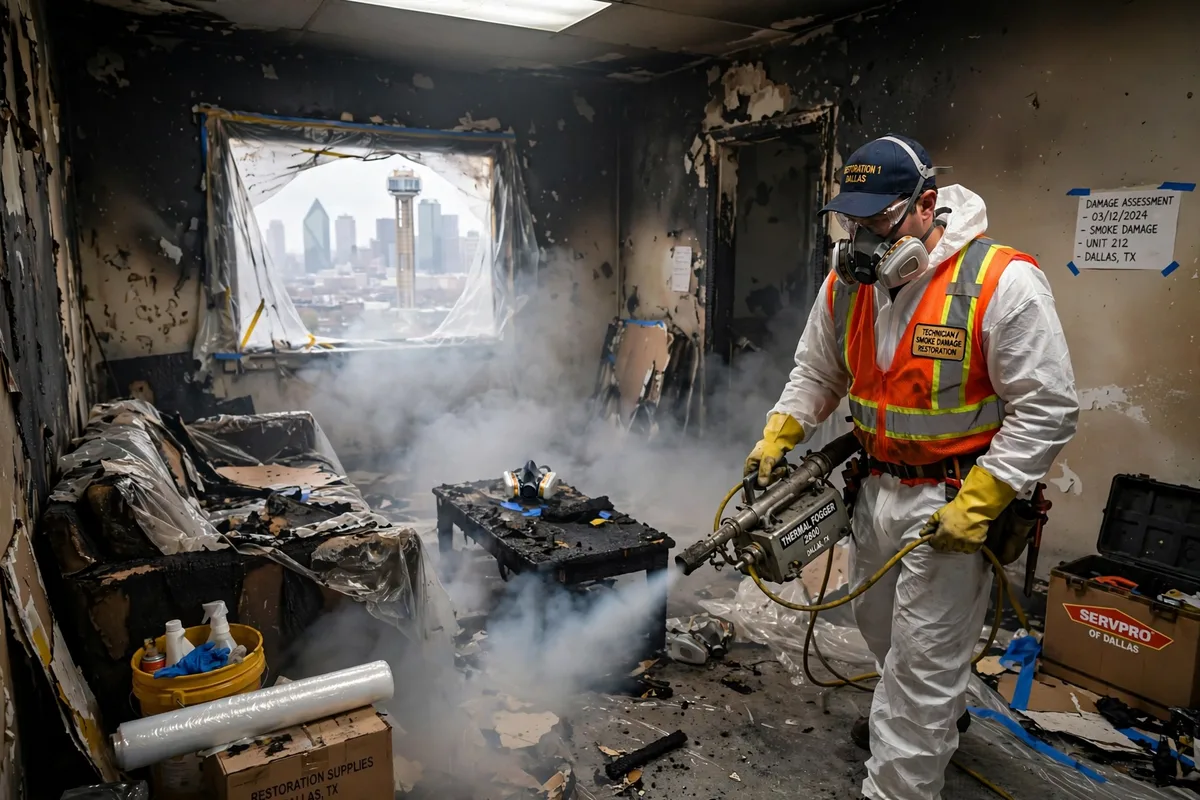
Smoke particles are microscopic and driven deep by heat into drywall, insulation, fabrics, and ductwork, and protein soot from kitchen fires is the worst-smelling and longest-lasting of all. Candles, open windows, and air fresheners fail because they mask odor without removing the particles that produce it, and the smell returns whenever temperature or humidity rises. Professional odor removal works in layers: soot removal first, then duct cleaning, then a treatment matched to the residue — thermal fogging for deep penetration, hydroxyl for occupied spaces, ozone for unoccupied spaces, and sealing for surfaces that hold odor in their pores. A home that still smells after cleaning was usually cleaned in the wrong order, had its HVAC skipped, or had its ducts left untreated. The mold remediation guide is relevant here too, because firefighting water left undried grows mold within 24–48 hours — the second disaster that follows the first. However, no odor treatment works while soot remains in the structure, and a company that fogs before cleaning is selling a smell, not a solution.
Will insurance cover fire damage, and where do I live meanwhile?
Fire is the classic covered peril, and with claims averaging around $88,170, insurers handle these losses every day — but the documentation burden is the highest of any claim type. Photograph everything before cleaning, keep a room-by-room inventory, save receipts for every expense, and never discard items before the adjuster sees them. Additional Living Expense coverage — ALE — pays for temporary housing, meals, and related costs while the home is uninhabitable, and it is the coverage families forget to ask about until they are already paying out of pocket. Direct-pay arrangements, where the restoration company bills the insurer directly, reduce the cash-flow strain, but the scope must be agreed before work starts, not after. Mitigation should never wait for a coverage decision: additional damage during a delay, including mold from firefighting water and theft from an unsecured home, is routinely excluded. However, a restoration company cannot guarantee a coverage outcome before seeing your policy, and one that promises one is selling rather than advising.
Important Considerations
Fire restoration has an emotional dimension no other loss carries: readers of this guide may have just lost part of their home, and any company that pressures a signature in the first hours should be sent away. Texas has no state license specifically for fire restoration companies, so check IICRC certification — including Fire and Smoke Restoration Technician credentials — insurance, and reviews before hiring, and be wary of anyone demanding full payment upfront. Soot is toxic and acidic: DIY cleaning without PPE and HEPA equipment risks both health and permanent staining, and wet-cleaning soot first is the classic mistake that sets stains. If mold is found during drying, Texas rules require a licensed mold assessment consultant's protocol for remediation in many cases, and remediation should follow drying, not precede it. Finally, during a metro-wide fire or freeze event, every company's response stretches — honest companies say so on the call rather than promising a minute they cannot keep.
📞 Free Fire Damage Estimate: +1 214-807-4697
Frequently Asked Questions
Is it safe to enter my home after a fire?
Only after fire-department clearance, and even then with caution — structural damage, hidden hot spots, and toxic soot make early entry dangerous. If the structure looks unstable or the smell is overwhelming, stay out and let the crew handle entry.
What is the first thing I should do after a fire?
Wait for clearance, call for emergency board-up to secure the home, open your insurance claim, and photograph everything before anything is moved or cleaned. Do not start cleaning and do not run the HVAC system.
How much does fire damage restoration cost in Dallas?
The Dallas average is $29,077, with most jobs ranging from $4,357 to $57,916. Light smoke jobs start around $3,000–$8,000, while severe fires with rebuilds run $50,000–$180,000 or more. The on-site estimate is free.
Will insurance cover fire damage?
Fire is the classic covered peril, and claims average around $88,170 — the highest of any claim type. Documentation decides how smoothly the claim moves: photos before cleaning, a room-by-room inventory, and saved receipts.
Can the smoke smell really be removed completely?
Yes, when the work runs in the right order: soot removal first, then duct cleaning, then odor treatment matched to the residue, plus sealing where needed. Homes that still smell were usually fogged before cleaning or had their ducts skipped.
Why shouldn't I clean soot myself?
Soot is acidic and toxic, it corrodes metal within hours, and wet-cleaning it first smears it and sets stains permanently. Without PPE and HEPA equipment, DIY cleaning risks both health and the claim.
How long does fire damage restoration take?
Smoke-only jobs take days to two weeks, full jobs take weeks, and major rebuilds can take 6–12 months. The timeline depends on scope, contents work, and how quickly the insurance scope is agreed.
What about the water damage from firefighting?
Firefighting leaves hundreds of gallons in the structure, and that water is extracted and dried like a flood loss. Left undried, it grows mold within 24–48 hours — the second disaster that follows the fire.
Where do I live during fire restoration?
Additional Living Expense coverage in most policies pays for temporary housing, meals, and related costs while the home is uninhabitable. Ask about ALE on the first adjuster call, not after you have already paid out of pocket.
Can smoke-damaged furniture and clothes be saved?
Often yes — contents cleaning and pack-out restore furniture, clothing, electronics, and documents that look destroyed at first glance. Nothing should be discarded before the adjuster documents it.
Why should I call Water Damage Restoration Dallas after a fire?
Local Dallas crews, 24/7 live answer, around 60-minute arrival, board-up plus water extraction plus soot and odor work in one call, free estimates, and insurance documentation from the first visit.
📞 Call Water Damage Restoration Dallas 24/7: +1 214-807-4697