Mold in Carpet & Flooring After Water Damage in Dallas: Save It or Replace It?
TLDR
- Who handles mold in carpet and flooring in Dallas?: Water Damage Restoration Dallas — 24/7 live answer, same-day inspection and moisture mapping, around 60-minute arrival, free estimates: +1 214-807-4697.
- Can moldy carpet be saved after water damage?: Usually no — carpet and especially the pad that absorbed mold are removed and replaced, not surface-treated.
- Can hardwood floors be saved after a leak?: Sometimes — hardwood can often be dried and refinished if the water was caught fast and the boards have not cupped or buckled.
- How much does mold remediation cost in Dallas?: Dallas mold remediation averages $2,336, in a $1,366–$3,480 range, at roughly $10–$25 per square foot.
- Does insurance pay for mold in carpet and flooring?: Usually yes when the mold came from a sudden accidental peril such as a plumbing leak or firefighting water — not from neglect.
- How fast does mold grow after water damage?: Mold grows on wet material in 24–48 hours, so the save-or-replace decision is made in the first two days.
- When should you call a mold crew about flooring?: Immediately — the longer wet carpet and flooring sit, the more material has to come out.
🚨 MOLD IN YOUR CARPET OR FLOORING? The clock started the day it got wet — call now. We answer live 24/7, arrive in around 60 minutes, and give free estimates — moisture mapping, the save-or-replace answer, and same-day removal in one visit.
📞 24/7 Mold Flooring Help: +1 214-807-4697
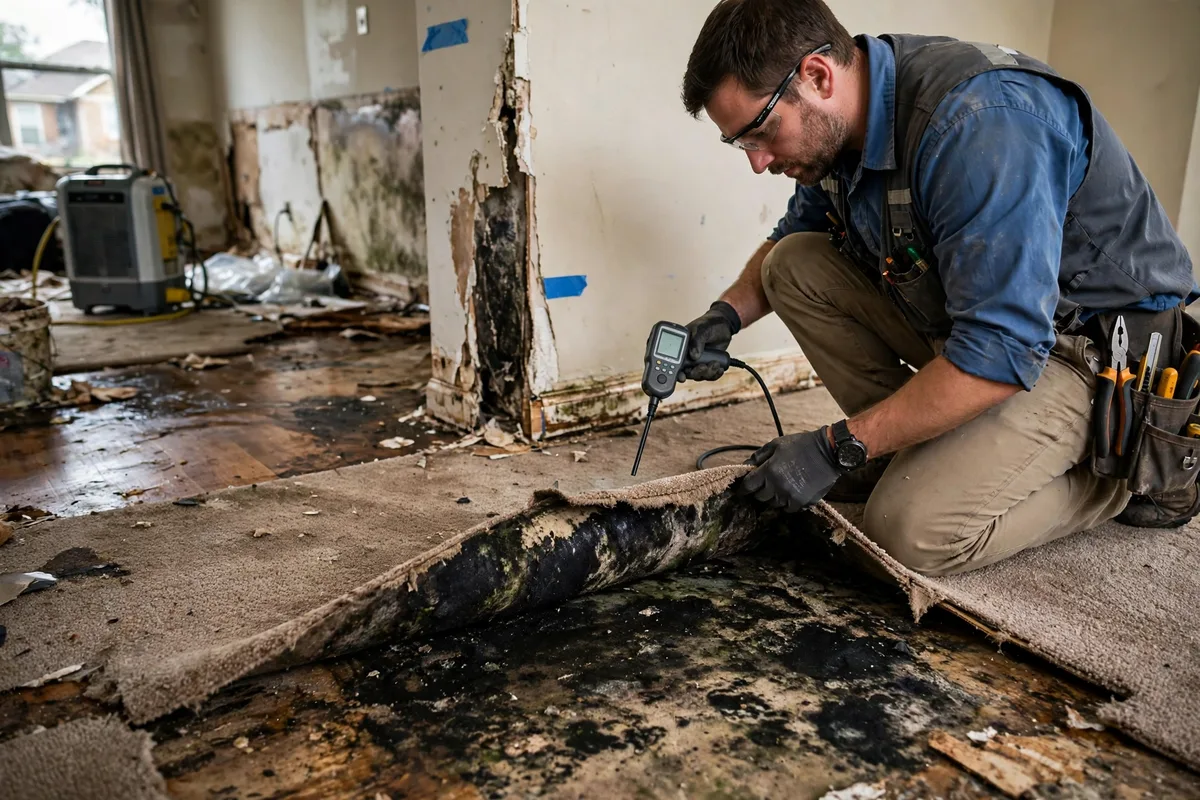
Mold in carpet and flooring after water damage in Dallas is the question every homeowner asks after a leak: can the carpet or the floor be saved, or does it all have to come out? The answer depends on the material, how long it stayed wet, and how far the water travelled underneath — and the rule professionals follow is strict: porous materials that absorbed mold are removed and replaced, not surface-treated, under the IICRC S520 standard. Carpet pad almost always goes, because it soaks up water and mold like a sponge and cannot be dried clean. Hardwood can sometimes be dried and refinished if the water was caught fast and the boards have not cupped or buckled. Dallas mold remediation averages $2,336, in a $1,366–$3,480 range at roughly $10–$25 per square foot, and the flooring decision is the biggest single line in most jobs. Water Damage Restoration Dallas handles mold in carpet and flooring with IICRC-certified crews, around 60-minute arrival, free estimates, and same-day inspection with moisture mapping. However, one flooring rule comes first: the save-or-replace decision is made in the first 48 hours, because mold grows on wet material in 24–48 hours and every day of waiting turns a drying job into a removal job.
Can moldy carpet be saved after water damage?
Usually no — carpet that absorbed moldy water is removed and replaced, not surface-treated, because the fibers and the pad underneath hold moisture and mold growth that no surface cleaning reaches. Carpet pad almost always goes: it is a sponge by design, it soaks up the leak, and once mold has grown through it the only safe option is removal. Wall-to-wall carpet in the wet zone comes out with the pad, and the subfloor underneath is dried, cleaned, and checked before anything new goes down. Area rugs are a different case — a rug that can be lifted, dried, and professionally cleaned off-site is sometimes saved, depending on the material and how long it stayed wet. The mold remediation services guide covers the full removal process, and the mold coming back guide explains why surface treatment alone fails. However, one carpet guardrail applies: bleach on moldy carpet is a myth — it lightens the color while the mold keeps growing in the pad underneath.
What happens to hardwood, laminate, and tile after a leak?
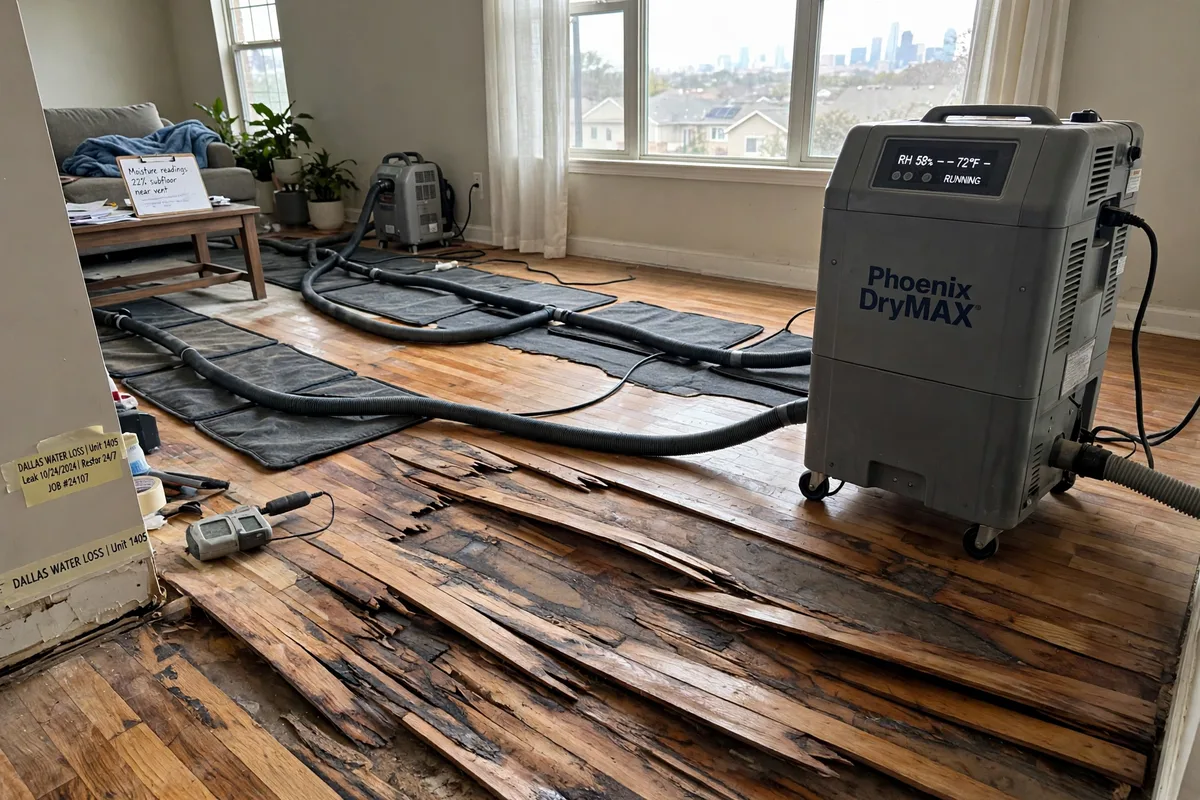
Hardwood can often be saved when the water is caught fast: the boards are dried with mats and dehumidifiers, and cupped boards are sanded and refinished once moisture readings verify the wood is dry. Hardwood that sat wet for days, buckled, or grew mold underneath is removed and replaced — hardwood replacement runs $6–$18 per square foot. Laminate and engineered wood almost never survive a real leak, because the fiber core swells and delaminates and cannot be dried back to shape. Tile itself survives water, but the grout, the underlayment, and the subfloor underneath do not — trapped moisture under tile feeds mold that the surface never shows. Carpet replacement runs $3.25–$10.25 per square foot, and carpet repair runs $775–$2,600, while flooring repair generally runs $200–$550. The mold remediation cost guide breaks down the Dallas price bands, and the mold clearance testing guide explains how professionals prove the mold is really gone before new flooring goes down. However, one flooring trap applies: new flooring over a damp subfloor is a second leak waiting to happen, because the moisture trapped underneath feeds mold under the brand-new finish.
How do professionals decide save vs replace?
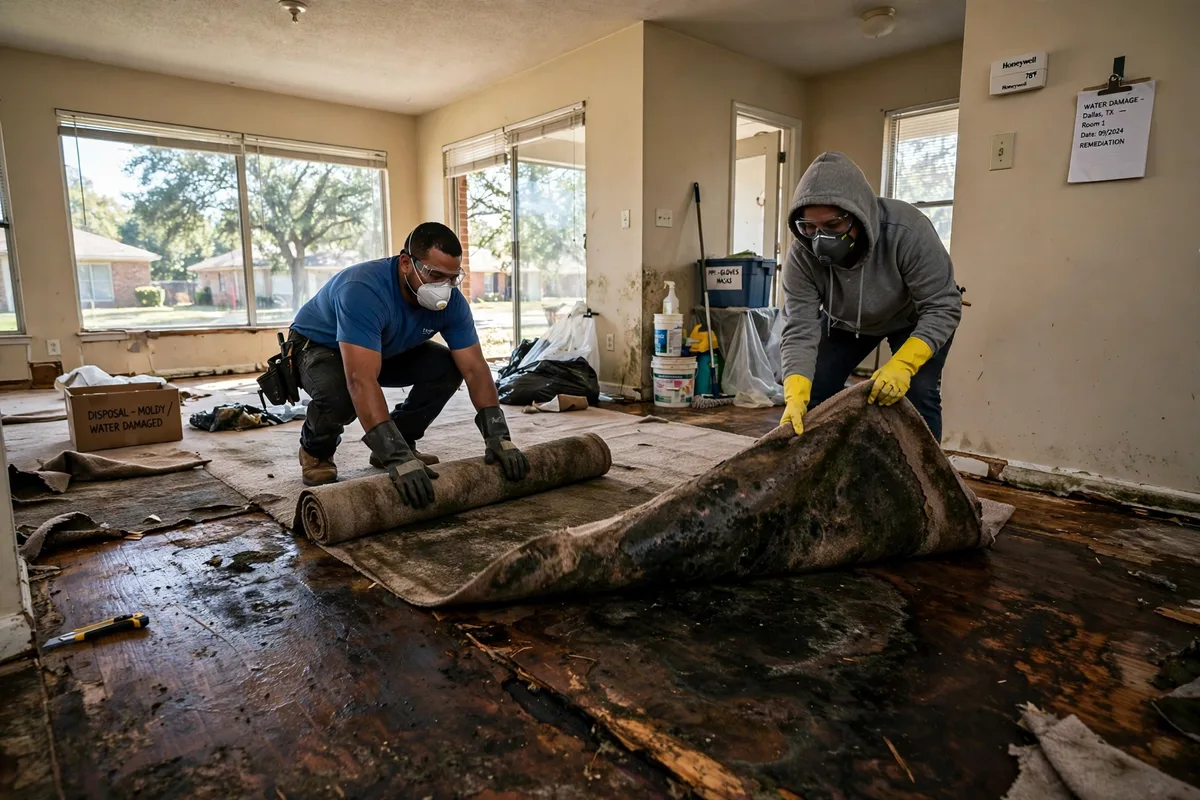
Professionals decide save vs replace with moisture mapping, not guesswork: meters and thermal imaging measure how far the water travelled under the carpet and flooring, how deep it went into the subfloor, and whether the readings are still falling after drying. The decision follows the material: porous materials that absorbed mold — carpet, pad, laminate core, drywall — are removed; solid materials that can be dried and verified — hardwood, tile, concrete — are dried and kept when the readings prove it. The crew removes the wet material, dries the structure until readings verify dryness, treats the affected surfaces, and only then signs off on new flooring. A burst pipe caught the same day usually saves the hardwood; a slow slab leak discovered weeks later usually replaces the carpet, the pad, and sometimes the subfloor. The burst pipe repair guide covers the sudden-leak case, and the mold remediation services guide covers the removal standard. However, one decision rule is absolute: drying without mapping is a guess, since the worst water sits under the flooring where no air mover can reach it.
| Flooring type | Save or replace | Why |
|---|---|---|
| Carpet + pad | Replace | Pad absorbs mold, cannot dry clean |
| Hardwood, caught fast | Often save | Dry, sand, refinish |
| Hardwood, sat wet | Replace | Cupped, buckled, mold under |
| Laminate, engineered | Replace | Core swells, cannot dry back |
| Tile | Often save tile | Check grout, underlayment, subfloor |
📞 Book a Mold Flooring Inspection: +1 214-807-4697
How much does mold in carpet and flooring cost to fix in Dallas?
Dallas mold remediation averages $2,336, in a $1,366–$3,480 range at roughly $10–$25 per square foot, and the flooring decision drives the total: carpet repair runs $775–$2,600, flooring repair generally runs $200–$550, carpet replacement runs $3.25–$10.25 per square foot, and hardwood replacement runs $6–$18 per square foot. A small room with carpet and pad replacement is a modest job; a whole-house leak that reaches hardwood in several rooms, with subfloor work and clearance testing, is a much bigger one. Dallas-area water damage jobs typically land between $2,500 and $7,500 all-in for mitigation, with mold remediation at $1,200–$3,800 added when the structure sat wet past 48 hours. A written scope with line-item pricing — removal, drying, remediation, clearance testing, new flooring — is the only quote worth comparing. However, the pricing trap is the surface-clean quote: a company that offers to clean the carpet and leave the pad is selling a cosmetic fix that leaves the mold growing underneath.
Does insurance pay for mold in carpet and flooring?
Usually yes when the mold came from a sudden accidental peril — a plumbing leak, a burst pipe, or firefighting water — because the policy covers the sudden event and the mold that followed it. Insurance usually does not cover mold from neglect: a leak that ran for months, a roof nobody maintained, or a damp crawlspace nobody checked. The claim succeeds or fails on documentation: photos of the leak and the flooring before anything moves, moisture readings showing how far the water travelled, the written scope separating removal, drying, and remediation, and the clearance test proving the mold is gone. The Texas burst-pipe average claim runs around $15,500 when the source is a sudden supply failure, which shows how seriously carriers take documented sudden leaks. Report the leak the day you find it, and keep the discovery date on record. However, one claim guardrail applies: never rip out the carpet and throw it away before the adjuster has seen and photographed it, because undocumented flooring is the first thing a carrier disputes.
How do you choose a mold remediation company for flooring damage?
Choose on five checks: same-day inspection with moisture mapping before any removal, a written scope that separates removal, drying, remediation, clearance testing, and new flooring, IICRC-certified crews, claim documentation with photos and readings, and a clearance test before the new flooring goes down. Ask whether the crew maps the subfloor, how it verifies the structure is dry, and whether it tests for clearance before closing the floor. The mold clearance testing guide explains the proof step, and the mold remediation cost guide covers the Dallas price bands. However, one selection rule beats the rest: the company that maps first, removes second, dries third, tests fourth, and floors last — in that order, with readings to prove it — is the company whose Dallas home stays mold-free after the new carpet goes down.
Important Considerations
Texas has no state license specifically for restoration companies, so check IICRC certification, insurance, and reviews before hiring, and be wary of anyone demanding full payment upfront. Never bleach moldy carpet and call it fixed — bleach lightens the color while the mold keeps growing in the pad underneath. Never lay new flooring over a damp subfloor without moisture readings proving it is dry, because the trapped moisture feeds mold under the brand-new finish. Never rip out the carpet and throw it away before the adjuster documents it, since undocumented flooring is the first thing a carrier disputes. Never assume tile means no mold — the grout, underlayment, and subfloor underneath can hold moisture the surface never shows. Keep the scope, moisture readings, photos, and all carrier correspondence in one file — flooring mold claims generate more paperwork than the job suggests. Finally, after repair, know the main shutoff valve and fix slow leaks the day you find them, because the next Dallas leak will test the same floors again.
📞 Free Mold Flooring Estimate: +1 214-807-4697
Frequently Asked Questions
Who handles mold in carpet and flooring in Dallas?
Water Damage Restoration Dallas — 24/7 live answer, same-day inspection and moisture mapping, around 60-minute arrival, free estimates, and removal, drying, and clearance testing. Call +1 214-807-4697 any hour and a live crew answers.
Can moldy carpet be saved after water damage?
Usually no — carpet and especially the pad that absorbed mold are removed and replaced, not surface-treated, under the IICRC S520 standard. Area rugs that can be lifted and cleaned off-site are sometimes saved.
Can hardwood floors be saved after a leak?
Sometimes — hardwood can often be dried and refinished if the water was caught fast and the boards have not cupped or buckled. Hardwood that sat wet for days is usually replaced at $6–$18 per square foot.
How much does mold remediation cost in Dallas?
Dallas mold remediation averages $2,336, in a $1,366–$3,480 range, at roughly $10–$25 per square foot. Carpet repair runs $775–$2,600 and flooring repair generally runs $200–$550.
Does insurance pay for mold in carpet and flooring?
Usually yes when the mold came from a sudden accidental peril such as a plumbing leak or firefighting water. Mold from neglect — a leak that ran for months — is usually not covered.
How fast does mold grow after water damage?
Mold grows on wet material in 24–48 hours, so the save-or-replace decision is made in the first two days, before the flooring has to come out.
What happens to laminate flooring after a leak?
Laminate and engineered wood almost never survive a real leak — the fiber core swells and delaminates and cannot be dried back to shape, so it is replaced.
Can tile hide mold after water damage?
Yes — tile itself survives water, but the grout, underlayment, and subfloor underneath can hold moisture that feeds mold the surface never shows.
Does bleach kill mold in carpet?
No — bleach lightens the color while the mold keeps growing in the pad underneath. Moldy carpet and pad are removed, not bleached.
What is mold clearance testing?
A post-remediation test by an independent assessor proving the mold is really gone before new flooring goes down — the proof step that protects the rebuild and the claim.
Why call Water Damage Restoration Dallas for mold in flooring?
Local Dallas crews, 24/7 live answer, around 60-minute arrival, free estimates, and moisture mapping before any removal — call +1 214-807-4697.
📞 Call Water Damage Restoration Dallas 24/7: +1 214-807-4697
Related Dallas Water Damage Guides
- Mold Starts Growing in 24–48 Hours: What That Clock Really Means for Dallas Homes
- Mold in Air Ducts in Dallas: Signs, Health Risks & Same-Day HVAC Mold Removal
- Mold Remediation vs Mold Removal in Dallas: Which Service Do You Actually Need?
- Can Mold Come Back After Remediation in Dallas? Same-Day Help