Mold Remediation vs Mold Removal in Dallas: Which Service Do You Actually Need?
TLDR
- What is the difference between mold remediation and mold removal?: Remediation fixes the moisture source and contains the problem; removal only cleans the visible mold — and the mold comes back.
- Who handles mold remediation in Dallas?: Water Damage Restoration Dallas — 24/7 live answer, around 60-minute arrival, free estimates: +1 214-807-4697.
- How much does mold remediation cost in Dallas?: Mold remediation typically runs $1,200–$3,800, depending on the size of the affected area and the moisture source.
- Is mold removal enough after water damage?: No — if the leak or moisture source is not fixed, mold regrows on the same spot within weeks.
- How fast does mold grow after water damage?: Mold grows on wet material in 24–48 hours, so the clock starts the moment the leak happens.
- When do you need mold testing in Dallas?: When the source is hidden, the smell persists after cleaning, or the household has asthma or allergy symptoms.
- When should you call a mold crew in Dallas?: Immediately on any visible mold after water damage — containment is cheaper than a whole-house spread.
🚨 MOLD IN YOUR DALLAS HOME? Every day of waiting spreads it further — call now. We answer live 24/7, arrive in around 60 minutes, and give free estimates — testing, containment, remediation, and moisture repair in one visit.
📞 24/7 Mold Remediation Help: +1 214-807-4697
Mold remediation vs mold removal in Dallas is the comparison every homeowner with a damp wall needs to understand before hiring, because the two services sound alike and do very different jobs: mold removal cleans the visible mold off a surface, while mold remediation finds and fixes the moisture source, contains the affected area, removes the contaminated material, and verifies the space is dry before rebuilding. Removal alone leaves the leak, the damp drywall, and the spores behind — and the mold regrows on the same spot within weeks, which is why so many Dallas homeowners pay twice for the same patch of wall. Remediation costs more upfront because it solves the problem, and it is the service that keeps a water-damage job from becoming a whole-house mold job. Water Damage Restoration Dallas handles mold with IICRC-certified crews, around 60-minute arrival, free estimates, and same-day help. However, one rule comes first: never pay for a surface wipe on a mold spot that came from an active leak, because the moisture underneath is still feeding the colony while the surface looks clean.
What does mold remediation actually include?
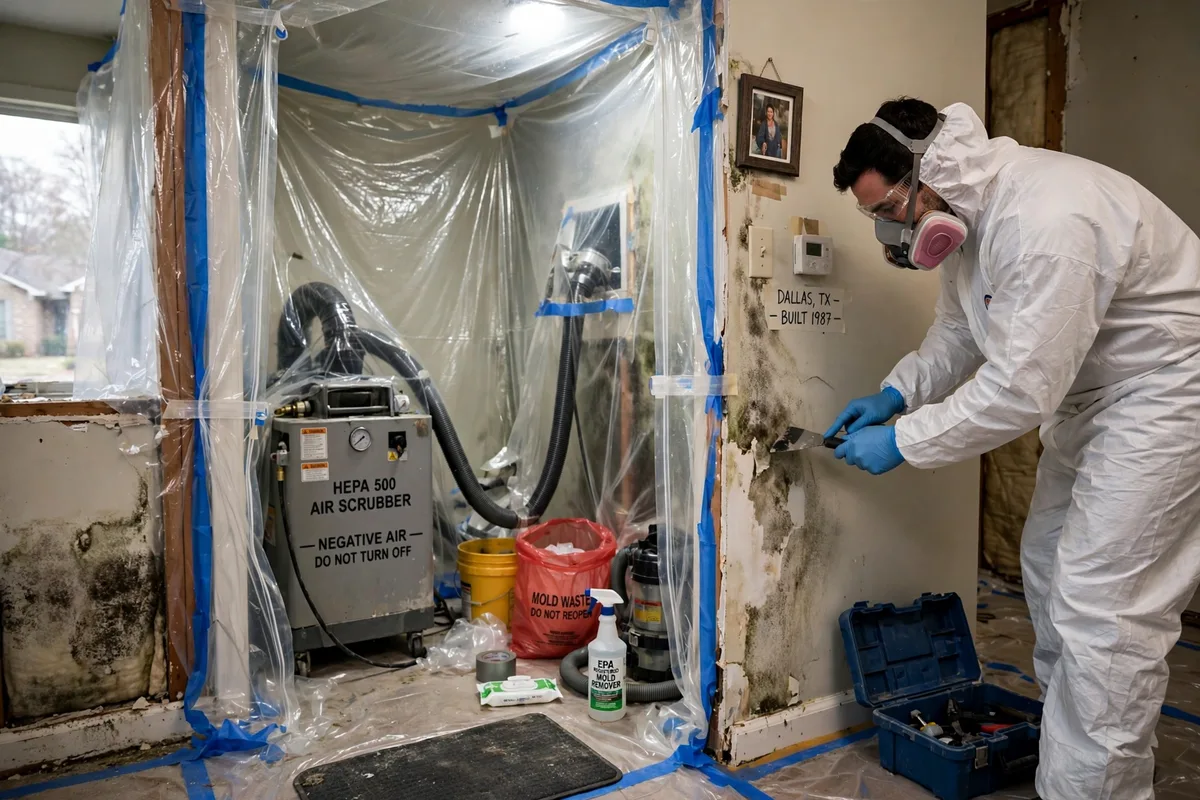
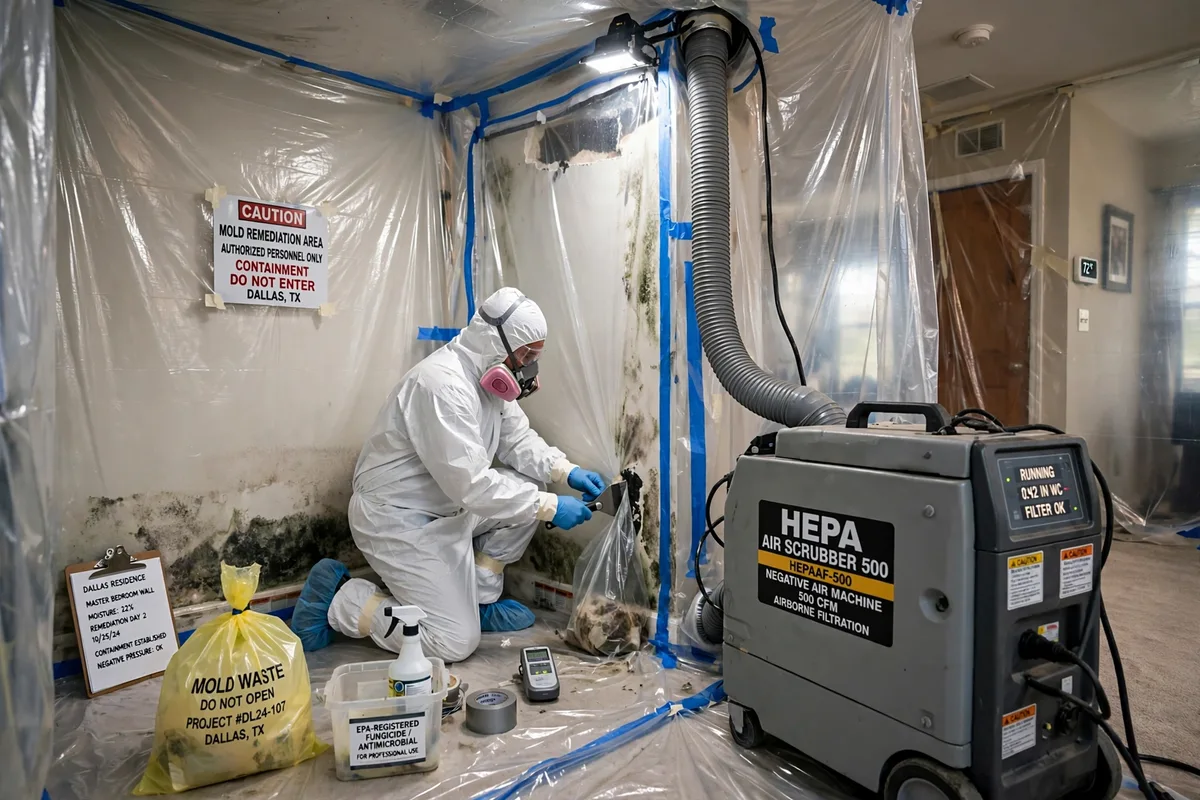
Mold remediation includes finding and fixing the moisture source, containing the affected area with barriers and negative air pressure, removing contaminated drywall and flooring, HEPA-vacuuming and treating the structure, verifying dryness with moisture readings, and then rebuilding — a full process, not a single cleaning step. The source is the heart of it: a slab leak, a roof leak, a burst pipe, or a chronically damp bathroom has to be repaired, or the remediation is only a pause before the next growth. Containment matters just as much, because opening a moldy wall without barriers spreads spores to clean rooms through the air and the HVAC system. The mold remediation services guide covers the full process in detail. However, the remediation trap is the partial job: a crew that removes the moldy drywall but never fixes the leak has sold a demolition, not a remediation, and the mold returns to the same studs.
What does mold removal actually include?
Mold removal includes cleaning or scrubbing the visible mold off a surface, usually with an antimicrobial solution, and it is appropriate only for small, surface-level growth on hard, non-porous material where the moisture source is already fixed and the area is fully dry. A small patch on tile or a sealed surface can be a removal job, but mold on drywall, wood framing, or insulation is never a removal job, because the growth runs through the material and no surface wipe reaches it. Removal is also the wrong service after any water damage, since the water that fed the mold soaked the structure behind the wall, and the colony is bigger than the patch you can see. The mold after water damage guide covers why post-leak mold needs the full process. However, the removal trap is the price: a cheap wipe-down looks like a bargain until the mold regrows in three weeks, and the second job costs more than the remediation would have in the first place.
When do you need mold remediation instead of mold removal?
You need mold remediation instead of mold removal whenever the growth covers more than a small patch, sits on drywall or wood, followed water damage, keeps coming back after cleaning, or affects anyone in the household with asthma or allergies. The size test is simple: a patch bigger than a few square feet, a spot that returns after wiping, or any mold with a musty smell in the room means the colony is in the material, not on it, and only remediation reaches it. The smell test is just as reliable — a musty odor with no visible mold means hidden growth behind a wall or under a floor, and only testing and opening the area finds it. The mold testing services guide covers when air and surface testing are worth it. However, one timing rule is absolute: mold grows on wet material in 24–48 hours, so a leak that sat for a weekend is already a remediation job, not a cleaning job.
| Factor | Mold removal | Mold remediation |
|---|---|---|
| Scope | Surface cleaning only | Source fix + removal |
| Best for | Small tile patches | Drywall, wood, leaks |
| Moisture source | Not addressed | Fixed first |
| Containment | None | Barriers, negative air |
| Regrowth risk | High | Low when dry |
| Typical cost | Low, short visit | $1,200–$3,800 |
📞 Book Mold Remediation: +1 214-807-4697
How much does mold remediation cost in Dallas?
Mold remediation in Dallas typically runs $1,200–$3,800, depending on the size of the affected area, whether contaminated drywall and flooring must come out, and whether the moisture source needs a plumber or roofer alongside the mold crew. Small contained jobs land at the low end, while whole-room jobs with hidden growth behind walls land at the high end, and the water damage that caused the mold typically runs $2,500–$7,500 on top of the remediation when the structure needs full drying and rebuild. Testing adds a modest amount when the source is hidden, and it is worth it when the smell persists after cleaning or the household has health symptoms. The mold remediation cost guide breaks down the price ranges by job size. However, the pricing trap is the removal quote dressed as remediation: a company that offers a surface wipe for a drywall mold problem is selling a cosmetic clean that the next damp week will undo.
How do you choose mold remediation services in Dallas?
Choose on five checks: same-day response while the growth is still contained, a written scope that separates source repair, containment, removal, drying, and rebuild, moisture readings that prove the structure is dry before closing, IICRC-certified crews, and claim documentation with photos. Ask whether the crew fixes the moisture source, how it contains the area, and whether it verifies dryness with readings before rebuilding. The black mold removal guide covers the highest-risk growth in Dallas homes. However, one selection rule beats the rest: the company that fixes the leak first, contains second, removes third, and proves dryness last — in that order, with readings to prove it — is the company whose mold stays gone after the next rain.
Important Considerations
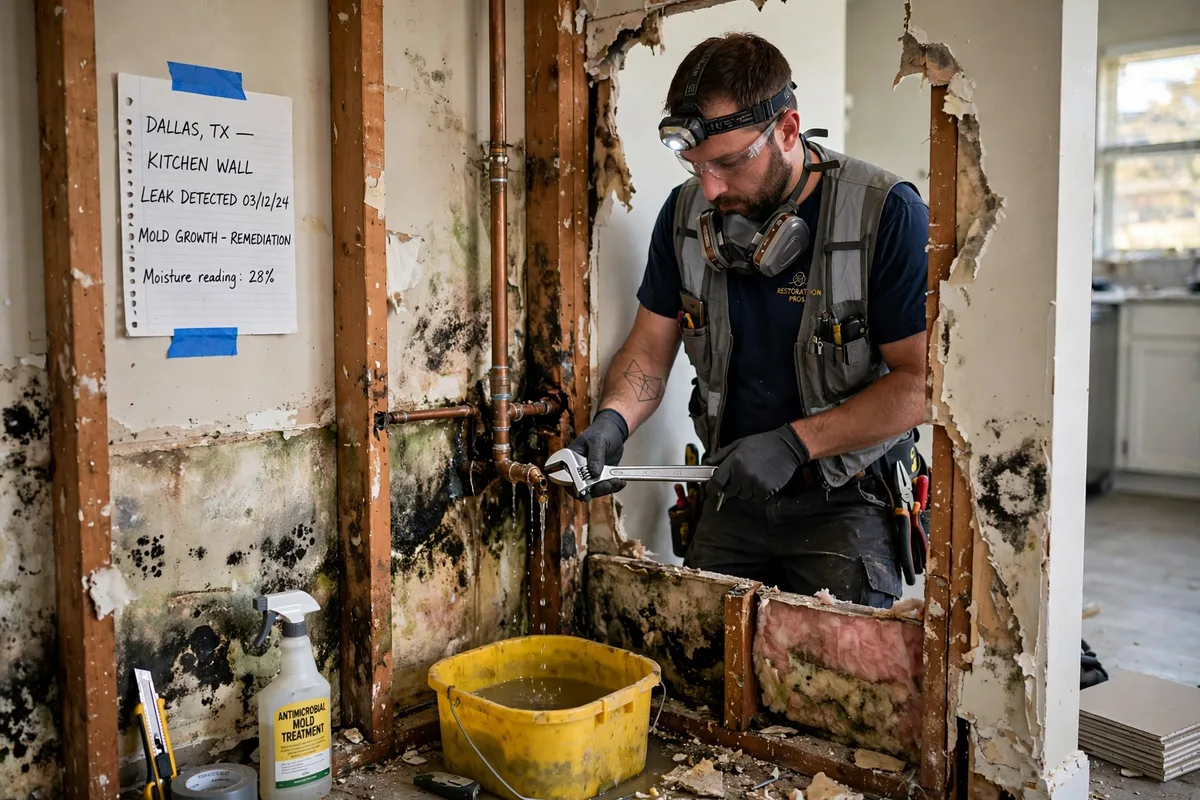
Texas has no state license specifically for mold remediation companies, so check IICRC certification, insurance, and reviews before hiring, and be wary of anyone demanding full payment upfront. Never paint over mold or seal a damp wall without drying the structure beneath it, because the moisture returns and feeds mold under the finish. Never run the HVAC system when mold is suspected in the ducts, since the system spreads spores to every room. Never bleach mold on drywall — bleach lightens the color without killing the growth in the material, and the colony returns. Keep the scope, moisture readings, photos, and all carrier correspondence in one file, because mold claims generate more paperwork than the job suggests. Finally, after remediation, fix the humidity and ventilation that let the mold grow, because the next Dallas summer will test the same damp corners again.
📞 Free Mold Remediation Estimate: +1 214-807-4697
Frequently Asked Questions
Who handles mold remediation in Dallas?
Water Damage Restoration Dallas — 24/7 live answer, around 60-minute arrival, free estimates, and testing, containment, remediation, and moisture repair in one visit. Call +1 214-807-4697 any hour and a live crew answers.
What is the difference between mold remediation and mold removal?
Remediation fixes the moisture source and contains the problem; removal only cleans the visible mold. Removal alone leaves the leak and the spores behind, so the mold comes back.
How much does mold remediation cost in Dallas?
Mold remediation typically runs $1,200–$3,800, depending on the size of the affected area and the moisture source. The water damage that caused the mold typically runs $2,500–$7,500 on top of that.
Is mold removal enough after water damage?
No — if the leak or moisture source is not fixed, mold regrows on the same spot within weeks. Post-leak mold needs the full remediation process, not a surface wipe.
How fast does mold grow after water damage?
Mold grows on wet material in 24–48 hours, so the clock starts the moment the leak happens. A leak that sat for a weekend is already a remediation job.
When do I need mold testing in Dallas?
When the source is hidden, the smell persists after cleaning, or the household has asthma or allergy symptoms. Testing finds hidden growth behind walls and under floors.
Can I remove mold myself?
A small patch on tile or a sealed surface can be a DIY wipe, but mold on drywall, wood, or insulation is never a DIY job — the growth runs through the material and no surface wipe reaches it.
Does insurance cover mold remediation in Dallas?
Usually yes when the mold came from a sudden covered water event, like a burst pipe. Slow, long-running leaks face tougher coverage questions, so document the discovery date.
How long does mold remediation take?
Small contained jobs take a day or two, while whole-room jobs with hidden growth and rebuild take several days. The timeline depends on the size of the area and the moisture source.
Is it safe to stay home during mold remediation?
Often yes in unaffected rooms, but the contained area stays off-limits while the work runs, and the HVAC stays off until the ducts are checked for spores.
Why call Water Damage Restoration Dallas for mold?
Local Dallas crews, 24/7 live answer, around 60-minute arrival, free estimates, and source-first mold remediation with moisture readings — call +1 214-807-4697.
📞 Call Water Damage Restoration Dallas 24/7: +1 214-807-4697
Related Dallas Water Damage Guides
- Mold Starts Growing in 24–48 Hours: What That Clock Really Means for Dallas Homes
- Mold in Air Ducts in Dallas: Signs, Health Risks & Same-Day HVAC Mold Removal
- Can Mold Come Back After Remediation in Dallas? Same-Day Help
- Allergies Worse at Home in Dallas? When to Test for Mold — Same-Day Service