Water Damage Restoration Near Me in Dallas: How to Choose Fast
TLDR
- What does "near me" mean for water restoration?: A genuinely local Dallas crew that can reach you in around 60 minutes — not a national call center that dispatches from another city.
- How do I pick a company in an emergency?: Check four things before you commit: live 24/7 answer, arrival time promise, IICRC certification, and insurance documentation.
- What is a fair price in Dallas?: Most residential jobs land between $2,500 and $7,500; extraction-only starts around $500–$3,000; sewage jobs run $3,000–$10,000.
- Should I pick the cheapest quote?: No — a quote that skips moisture mapping or pulls drying equipment early costs more later, when mold remediation runs $1,200–$3,800.
- Does a near-me company handle insurance?: A good one does — photos, moisture logs, and estimates in the format adjusters use, with direct billing where possible.
- What if it is 2 AM?: Call anyway. Water damage does not wait for business hours, and neither do Dallas emergency crews: +1 214-807-4697.
- Which Dallas company should I call first?: Water Damage Restoration Dallas — local crews, 24/7 live answer, around 60-minute arrival, free estimates: +1 214-807-4697.
🚨 SEARCHING "NEAR ME" DURING AN EMERGENCY? Skip the scrolling. A local Dallas crew is on call right now — 24/7 live answer, same-day dispatch, around 60-minute arrival, free estimates.
📞 Local Dallas Crew 24/7: +1 214-807-4697
When water is spreading through your home, "near me" is not a casual preference — it is the whole decision. A crew that is actually in Dallas reaches you in around an hour; a national call center takes your details, finds a subcontractor, and calls you back. In water damage, that delay is the difference between drying and demolition, because mold starts growing in wet materials within 24–48 hours. The problem is that every company claims to be local, fast, and top-rated, and search results mix genuine Dallas crews with lead-generation sites and franchises routed through distant dispatchers. This guide gives you a fast, honest way to choose: the four checks that matter, the price ranges to expect in Dallas, the red flags that should end a call immediately, and what a good near-me company does differently from the moment you call. Water Damage Restoration Dallas is a local crew serving Downtown, Uptown, Lakewood, and surrounding neighborhoods with 24/7 live answer, around 60-minute arrival, free estimates, and direct insurance billing. However, the checks below work for any company — use them even if you call someone else, because a company that passes all four is a company worth hiring.
What does "near me" actually mean for emergency restoration?
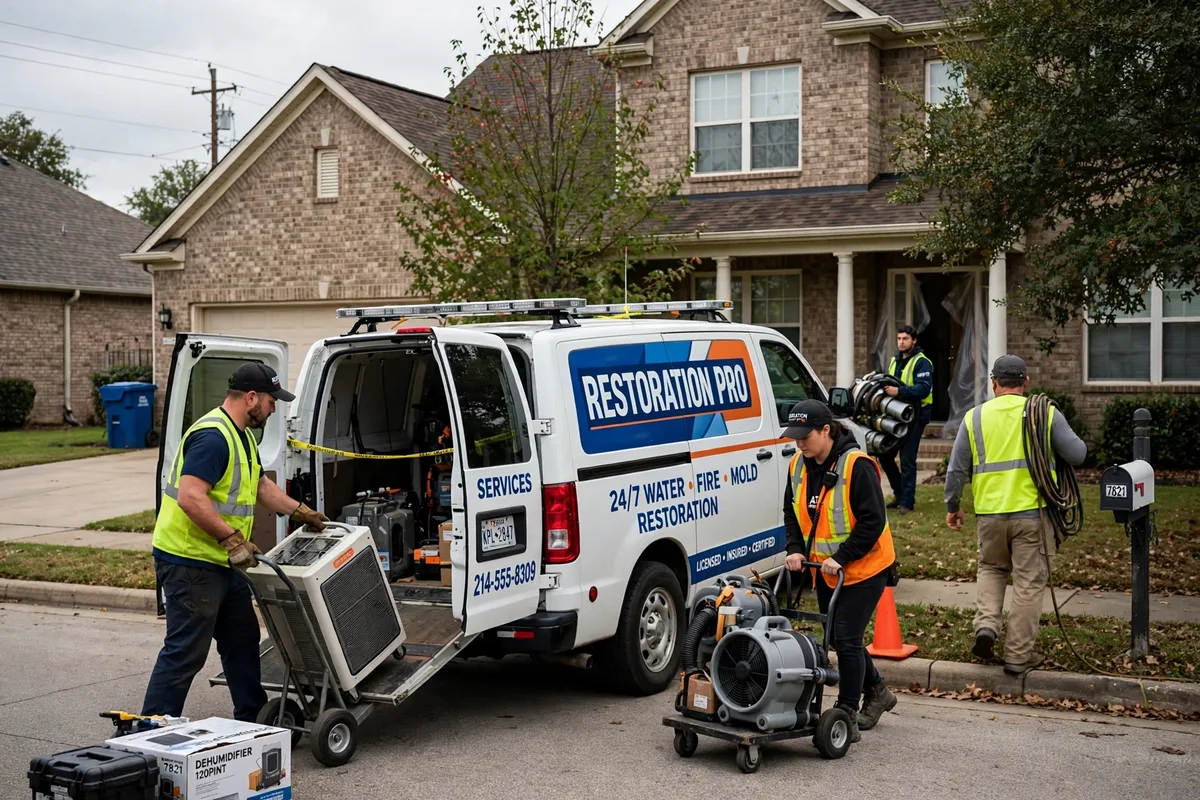
"Near me" should mean a crew stationed in Dallas, with trucks, equipment, and technicians in the city — not a website with a Dallas page and a crew two counties away. The test is the arrival promise: a genuinely local company will give you a real window (around 60 minutes is the Dallas standard among serious operators) and a live person who knows the neighborhoods. A lead broker will take a message and promise a callback. Ask one question on the first call: "Where is your crew right now?" A Dallas crew answers with a neighborhood or a drive time; a broker answers with a script. Local knowledge also matters after arrival — Dallas-specific problems like clay-soil slab leaks, flash-flood alley homes, and freeze-burst pipes are diagnosed faster by crews who have seen them before. However, proximity alone is not quality — a nearby company without certification or proper drying equipment is still the wrong hire, which is why the remaining checks matter just as much.
How fast should a Dallas company arrive?
Around 60 minutes is the honest standard for a Dallas emergency crew, at any hour. Companies advertising 30 minutes across the whole metroplex are usually exaggerating, and companies offering "next available appointment" for an active leak are not emergency companies at all. Arrival time is only half the measure, though — what matters is what arrives with the crew. A professional emergency visit brings truck-mounted extraction, air movers, dehumidifiers, and moisture meters on the first trip, so work starts immediately instead of waiting for a second visit with equipment. If a company arrives fast but only inspects and schedules, you have lost the hours that mattered most. During metro-wide events — a hard freeze, a major storm — every company's response stretches, and the honest companies say so on the call rather than promising a minute they cannot keep. The emergency restoration guide walks through exactly what a crew does from arrival to verified drying.
What should I check before hiring a water damage company?
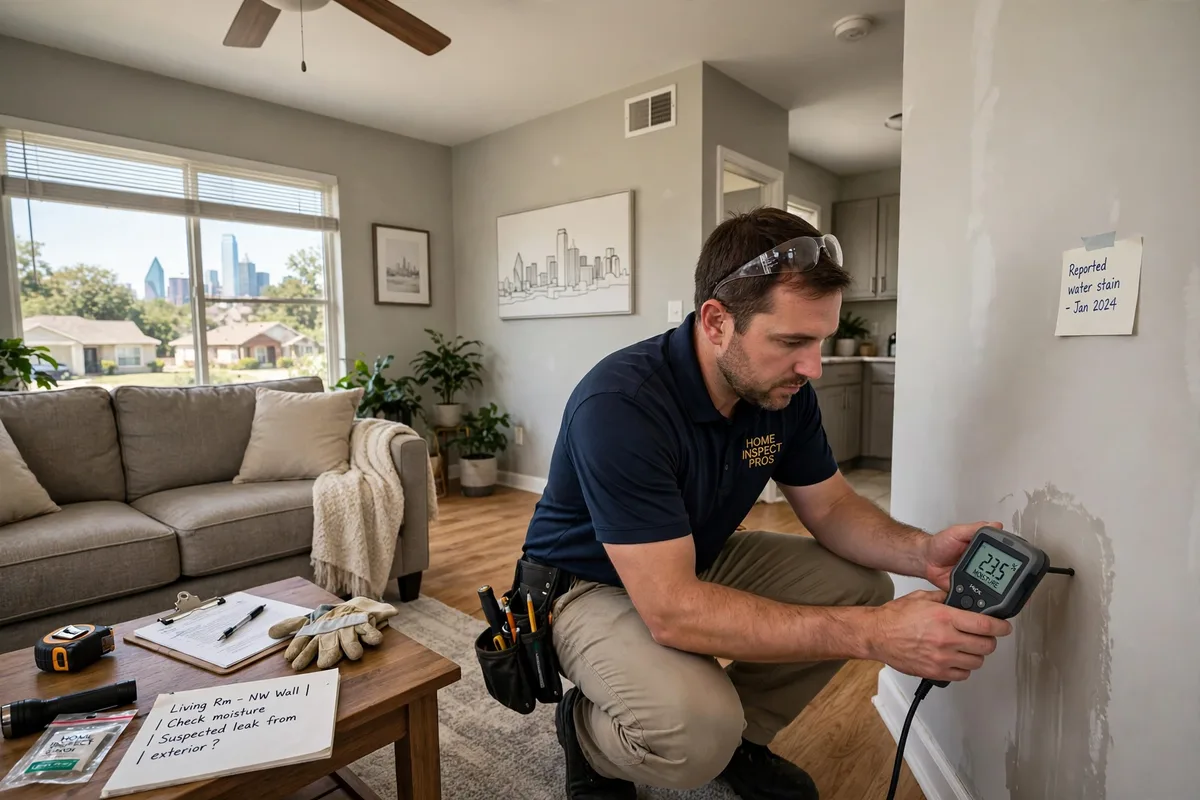
Four checks, in order, and you can run all of them in under five minutes. First, live answer: does a real person pick up at 2 AM, or does voicemail take the call? Second, certification: IICRC certification (Water Damage Restoration Technician, Applied Structural Drying) is the industry baseline — ask for it by name. Third, insurance handling: will the company document the loss with photos and moisture logs and prepare an estimate your adjuster accepts? Fourth, reviews and presence: does the company have real, recent reviews and a verifiable Dallas footprint — an address, a local number, a real service area — rather than a generic page? Texas has no state license specifically for water restoration, so certification and reputation carry the weight that a license number carries in other trades. However, reviews can be gamed, so read the negative ones first: how a company responds to an unhappy customer tells you more than fifty five-star reviews.
| What to compare | Why it matters | What to ask on the call |
|---|---|---|
| Response time | Every hour of standing water increases damage and mold risk | "Where is your crew now, and when will they arrive?" |
| IICRC certification | Trained drying to a verified standard, not guesswork | "Are your technicians IICRC-certified in water restoration?" |
| Moisture mapping | Hidden water inside walls is where mold starts | "Do you map moisture with meters and imaging?" |
| Insurance documentation | Photos + moisture logs decide whether claims are approved fast | "Will you document the loss for my adjuster?" |
| Free estimate | You should know the real scope before committing | "Is the on-site estimate free, with no obligation?" |
| Local presence | Local crews arrive faster and know Dallas-specific causes | "Are you based in Dallas, and where?" |
📞 Ask Us Anything, 24/7: +1 214-807-4697
Should I pick the cheapest water damage quote?
No — in restoration, the cheapest quote is often the most expensive outcome. A low quote usually means something was skipped: moisture mapping, daily readings, proper dehumidification, or sanitization. The skipped step does not disappear; it reappears as mold remediation ($1,200–$3,800), warped flooring, or a second drying job. Fair Dallas pricing is well established: most residential jobs land between $2,500 and $7,500, extraction-only work starts around $500–$3,000, and sewage jobs run $3,000–$10,000. A quote far below those bands for the same scope should raise questions, not excitement. The right comparison is not price alone — it is price for a defined scope: extraction, drying to verified readings, material removal, sanitization, and documentation. Get the scope in writing before work starts, and be wary of anyone demanding full payment upfront. However, price still matters — a reputable company gives a free on-site estimate, explains each line, and lets you compare it with another quote without pressure.
Does a near-me company handle my insurance claim?
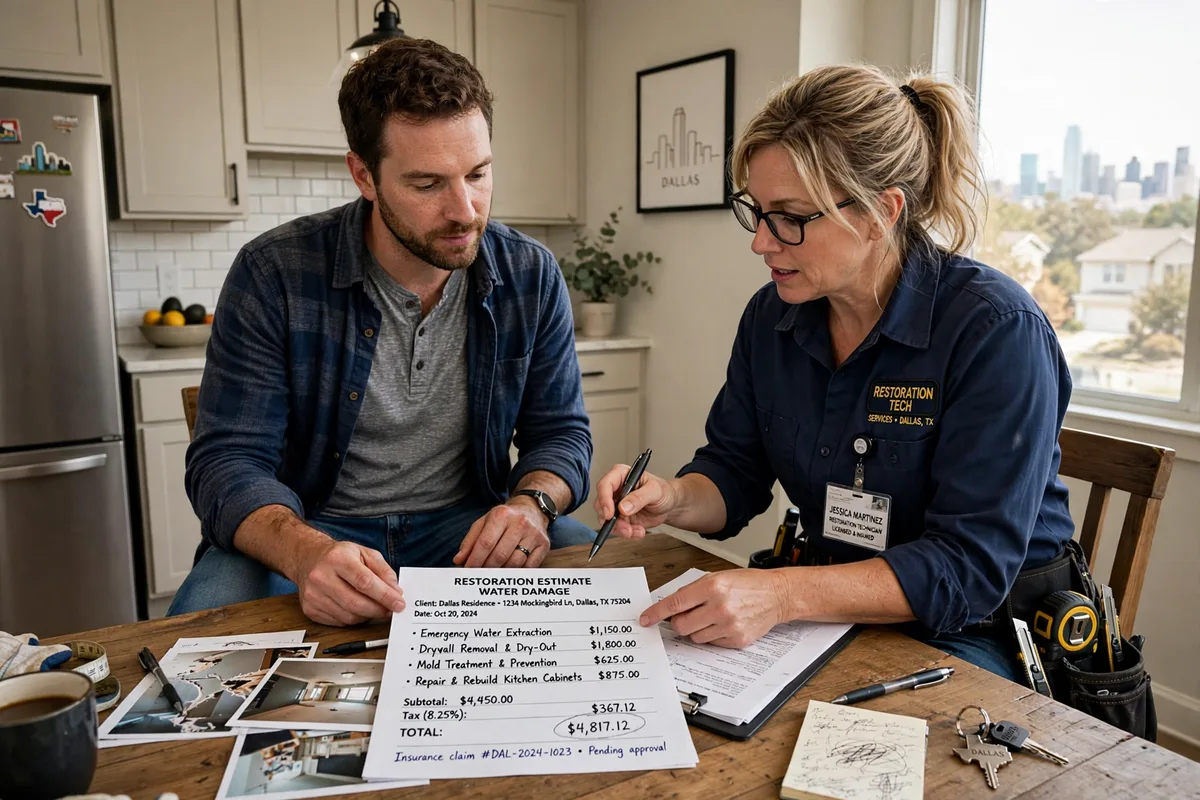
A good one handles the documentation that makes your claim work. That means photos before anything is moved, moisture logs through the drying process, an itemized scope, and an estimate in the format adjusters use. Some companies bill your carrier directly; others document and you submit — either way, the documentation quality decides how fast the claim moves. Sudden losses (burst pipe, appliance failure, storm intrusion) are usually covered, with most homeowners paying only their deductible. Gradual leaks, maintenance failures, and flood water from outside rising water are the common denial zones, and the flood-versus-water insurance guide explains those lines in plain language. The repair-versus-restoration guide covers what your policy usually pays for and what it does not. However, never delay mitigation while waiting for a coverage decision — damage that spreads during the delay is routinely excluded, and the delay itself is the one cost no policy reimburses.
What if my water damage is not an emergency right now?
Call anyway, and say so. A slow leak, a stain that appeared last week, or a musty smell with no visible water still deserves a prompt visit — these are the early signs of slab leaks, hidden mold, and slow pipe failures that Dallas homes are prone to. The recovery timeline guide shows how a small loss grows week by week when it is left alone. A near-me company that only takes emergencies will tell you to wait; a good one books a same-week inspection, maps the moisture, and tells you honestly whether it can wait or not. The free estimate exists for exactly this situation — you learn the real scope before spending anything. However, "not an emergency" does not mean "ignore it": mold starts in 24–48 hours in wet material, and a slow leak that has already been running for weeks has a head start you cannot see.
Important Considerations
Search results for "near me" mix three different things: genuine local companies, national franchises with local pages, and lead-generation sites that sell your call to whoever pays. The way to tell them apart is the first call — a local crew answers with specifics (neighborhood, drive time, equipment on the truck), while a broker answers with a form. Also check whether the company's website names real Dallas neighborhoods and a real service area, or only repeats the city name; thin location pages are a broker tell. After any visit, ask for your moisture log and photos in writing — they belong to you and your insurer will want them. Finally, remember that "near me" is a starting point, not a quality guarantee: run the four checks every time, even when the water is rising and the pressure to decide is intense. The five minutes you spend checking saves the weeks a bad hire costs.
📞 Free Estimate, No Obligation: +1 214-807-4697
Frequently Asked Questions
Who is the closest water damage company to me in Dallas?
Water Damage Restoration Dallas dispatches local crews across Dallas — Downtown, Uptown, Lakewood, and surrounding neighborhoods — with around 60-minute arrival. A quick call confirms the crew nearest to your address and an honest arrival window.
How do I know a "near me" company is really local?
Ask where the crew is right now. A local company answers with a neighborhood and a drive time; a lead broker takes a message and promises a callback. A verifiable Dallas address and local number are the other two tells.
What should a water damage company check on the first visit?
Safety and source control first, then moisture mapping with meters and imaging, then extraction and a written scope. A visit that skips moisture mapping is guessing about how far the water traveled — and hidden water is where mold starts.
How much does water damage restoration cost near me in Dallas?
Most residential jobs land between $2,500 and $7,500. Extraction-only work starts around $500–$3,000, sewage jobs run $3,000–$10,000, and whole-home flooding with rebuild goes higher. The on-site estimate is free.
Will my insurance pay for a near-me restoration company?
Sudden losses are usually covered and most homeowners pay only their deductible — as long as the loss is documented with photos and moisture logs. Gradual leaks and outside flood water are the common exclusions.
Can I get water damage help at night or on weekends?
Yes — emergency crews answer 24/7, including nights, weekends, and holidays. If water is active, call immediately rather than waiting for morning; the overnight hours are when mold gets its head start.
Do I need a local company, or is a national franchise fine?
Both can do good work. The advantage of a local crew is speed and Dallas-specific experience (clay-soil slab leaks, flash-flood corridors, freeze bursts); the advantage of a franchise is scale for very large losses. For a typical home emergency, local speed usually wins.
What is the difference between water mitigation and restoration?
Mitigation stops the damage and dries the structure (extraction, drying, sanitization); restoration rebuilds what was removed (drywall, flooring, finishes). Emergency calls are mostly mitigation first, with rebuild scoped after verified drying.
How long will drying take at my home?
Most residential jobs dry in 3–5 days with industrial equipment and daily readings. Larger or contaminated losses take longer. The finish line is a verified moisture reading, not surfaces that feel dry.
What red flags should end a call immediately?
Demands for full payment upfront, a firm price quoted without seeing the loss, no certification, no written scope, or pressure to sign before the estimate. Any one of these is enough to call someone else.
Why should I call Water Damage Restoration Dallas first?
Local Dallas crews, 24/7 live answer, around 60-minute arrival, free estimates, IICRC-certified technicians, and insurance documentation handled from the first visit — the four checks above, passed on a single call.
📞 Call the Local Dallas Crew: +1 214-807-4697