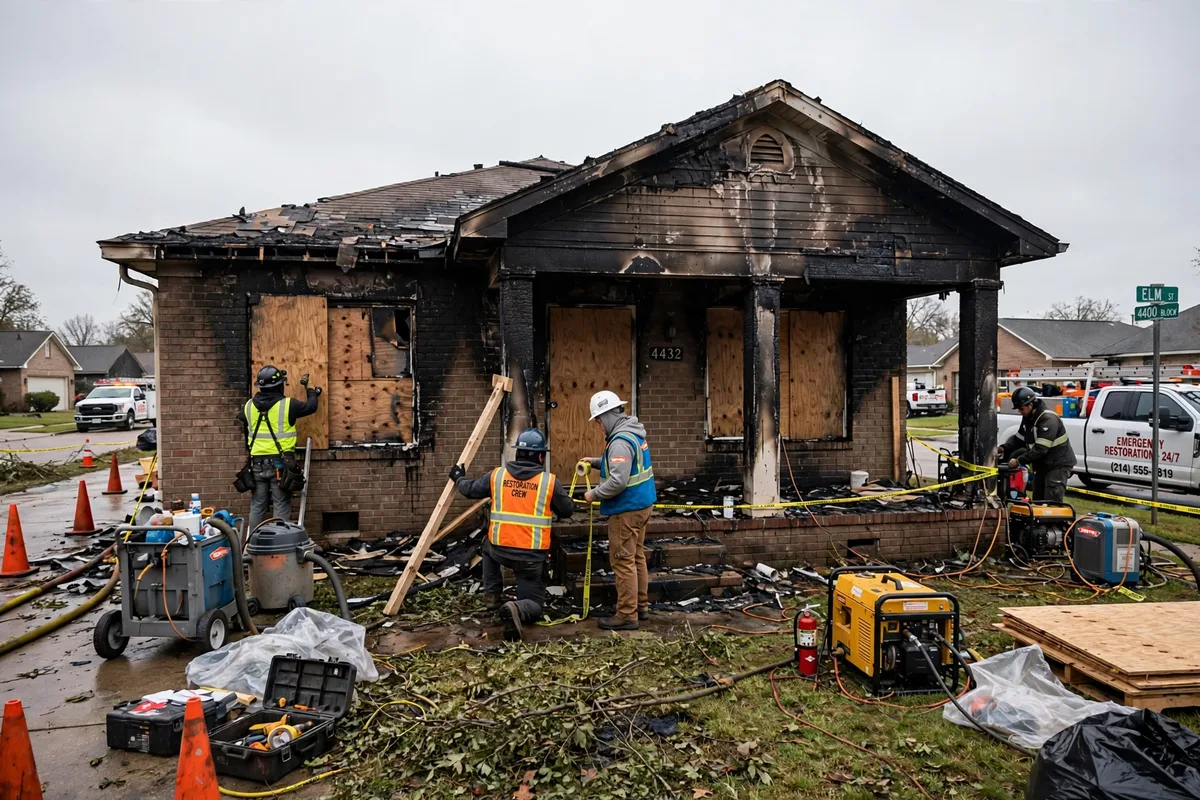
House Fire in Dallas: Emergency Restoration Services in the First 24 Hours
TLDR
- What should you do first after a house fire in Dallas?: Wait for fire-department clearance, then call an emergency restoration crew — the first 24 hours decide what can be saved.
- Who handles emergency fire restoration in Dallas?: Water Damage Restoration Dallas — 24/7 live answer, around 60-minute arrival, free estimates: +1 214-807-4697.
- What happens in the first 24 hours?: Board-up, water extraction from firefighting, soot stabilization, and documentation for your insurance claim.
- How much does fire restoration cost in Dallas?: The Dallas average is $29,077, with most jobs between $3,000 and $25,000 depending on scope.
- Can you stay in the house after a fire?: Usually not until it is cleared and stabilized — soot is acidic and corrosive, and the structure may be unsafe.
- What about the water from firefighting?: It is the second disaster — it soaks structure and starts mold in 24–48 hours if it is not extracted fast.
- Will insurance cover the first 24 hours?: Emergency services are typically covered under a sudden fire loss, and documentation from hour one protects the claim.
🚨 HOUSE FIRE IN DALLAS? The first 24 hours decide what survives. We answer live 24/7, arrive in around 60 minutes, and give free estimates — board-up, water extraction, and soot stabilization start the same day.
📞 24/7 Fire Emergency Help: +1 214-807-4697
Emergency fire restoration in the first 24 hours after a Dallas house fire is a race against three clocks at once: soot corroding metal and staining surfaces within hours, water from firefighting soaking structure and starting mold in 24–48 hours, and an unsecured home inviting theft, weather, and vandalism. Water Damage Restoration Dallas handles first-day fire response with IICRC-certified crews, around 60-minute arrival, free estimates, and direct insurance documentation from the first visit. However, the first rule of the first 24 hours is not about restoration at all — it is about safety: nobody re-enters until the fire department clears the structure, and nobody starts cleaning before a professional assessment, because wet-cleaning soot first smears it and sets stains permanently.
What should you do in the first hour after a house fire?
Call 911 if you have not already, wait for fire-department clearance before re-entering, and then call your insurer and an emergency restoration crew in that order. Do not touch soot-covered surfaces, do not turn the HVAC back on, and do not throw anything away — damaged contents are evidence for the claim, and adjusters need to see them. Photograph everything from outside and from the doorway if it is safe, and keep a simple written log of what happened and when. The emergency fire restoration guide covers the full response sequence, and the emergency board-up guide explains how your home gets secured. However, the mistake that costs the most in hour one is delay: every hour a burned home sits open and wet, the scope grows, and the claim grows with it.
What does the crew do on day one?
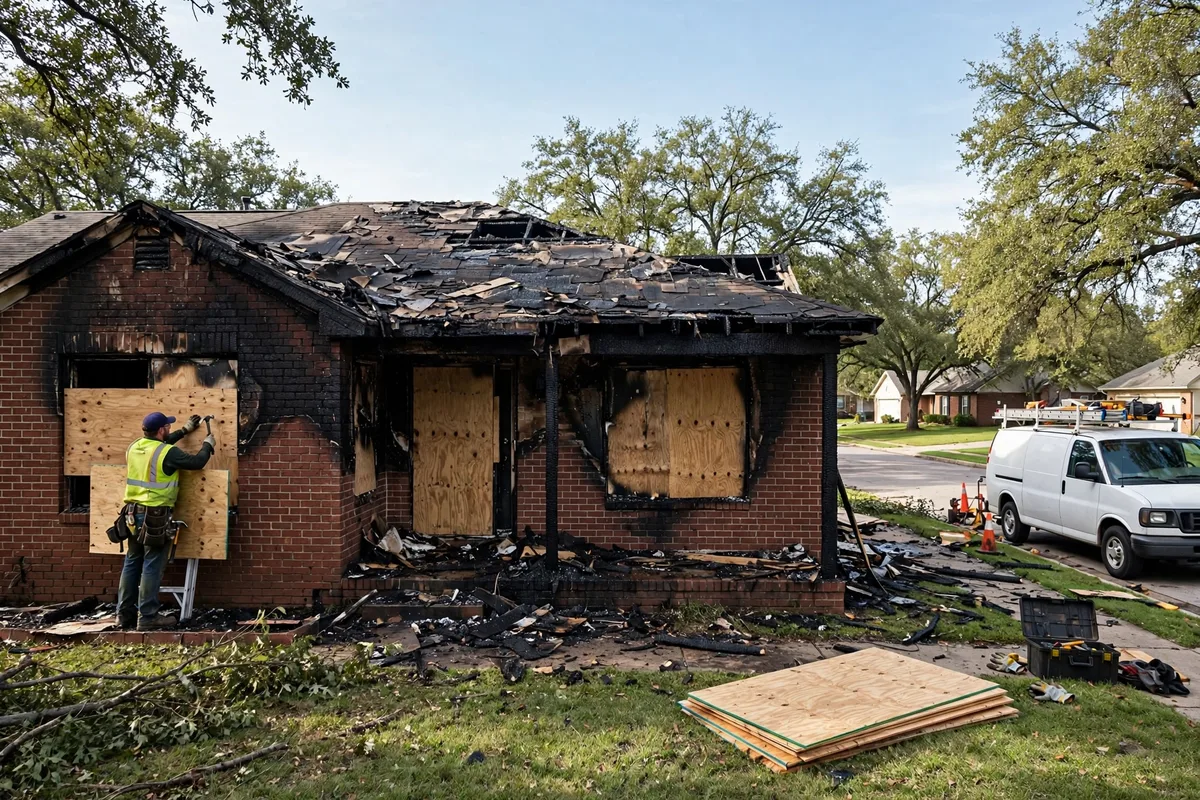
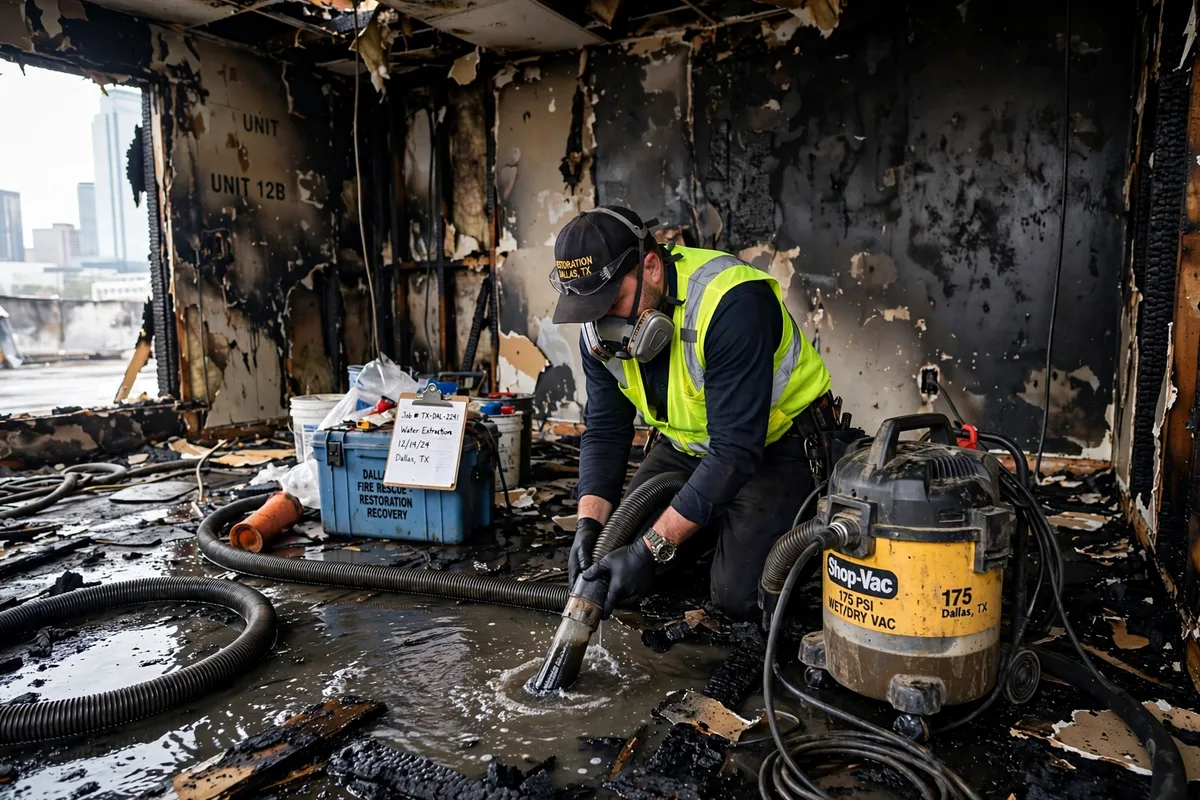
Day one follows a fixed sequence: safety assessment and board-up, water extraction from firefighting, soot stabilization with dry methods, and documentation. Board-up seals broken windows, doors, and roof openings against weather and intruders. Extraction removes standing water from hoses and sprinklers before it migrates into walls and subfloors. Soot stabilization uses HEPA vacuuming and dry sponges — never wet wiping first — to stop acidic soot from corroding fixtures and etching glass. Documentation photographs every room, logs moisture readings, and builds the scope your adjuster will price from. The water damage after a fire guide explains why the firefighting water matters as much as the flames. However, day one is stabilization, not rebuilding — full cleaning, odor treatment, and repairs follow in the days and weeks after, and a crew that promises a finished home in 24 hours is overselling.
| First 24 hours | What happens | Why it cannot wait |
|---|---|---|
| Hour 0–2 | Clearance, board-up | Security, weather protection |
| Hour 2–6 | Water extraction | Mold starts in 24–48 hours |
| Hour 6–12 | Soot stabilization | Acidic soot corrodes fast |
| Hour 12–24 | Documentation, scope | Claim evidence, adjuster pricing |
| Day 2+ | Cleaning, odor, repairs | Full restoration sequence |
📞 Same-Day Fire Response: +1 214-807-4697
How much does first-day fire restoration cost?
Emergency first-day services — board-up, extraction, stabilization, documentation — typically run a fraction of the total job, while the full Dallas fire restoration average is $29,077, with most jobs between $3,000 and $25,000 and severe rebuilds reaching $50,000–$180,000 or more. Fire claims average around $88,000 nationally, making them the most expensive homeowners claims, which is why carriers scrutinize documentation closely. Smoke-only jobs run $3,000–$8,000 for one to two rooms, soot and odor removal across multiple rooms runs $2,000–$6,000, and water damage from firefighting adds $1,000–$6,000. The fire damage cost guide breaks down every component. However, the first-day cost trap is authorization: emergency services are typically covered, but get the scope in writing before rebuild work starts, because rebuild pricing is where disputes begin.
Is it safe to enter your home after a fire?
Not until the fire department clears it, and even then only with guidance — structural damage, weakened floors, and toxic soot make a burned home dangerous in ways that are not visible. Soot is acidic and carcinogenic, and disturbing it without PPE and HEPA equipment spreads it and exposes lungs. The HVAC must stay off: running it redistributes soot and odor through ductwork into rooms the fire never touched. Children, elderly family members, and anyone with respiratory conditions should stay out until cleaning is underway. The smoke damage cleanup guide explains what soot does to a home hour by hour. However, one exception surprises homeowners: the garage or an untouched wing may look fine and still carry soot through shared ductwork, which is why the whole home gets assessed, not just the burned rooms.
What happens to your belongings in the first 24 hours?
Contents get inventoried, photographed, and triaged — what can be cleaned on site, what needs pack-out to a cleaning facility, and what is a total loss. Electronics with extinguisher residue need fast attention because the residue is corrosive. Photos, documents, and soft goods absorb odor deepest and often need specialized treatment. Nothing should be discarded before the adjuster sees it, and nothing should be cleaned by hand first — well-meaning wiping is the single most common way salvageable items become unsalvageable. However, the contents rule has a hard limit: porous items saturated with soot and water together — mattresses, heavily soaked upholstery — are often total losses, and a good crew says so early rather than billing for cleaning that will not work.
Important Considerations
Texas has no state license specifically for restoration companies, so check IICRC certification, insurance, and reviews before hiring, and be wary of anyone demanding full payment upfront. Fire claims are the largest claims carriers handle, so expect a thorough adjuster process — the documentation your crew builds on day one is what the claim stands on. Where you live during restoration is covered under additional living expenses (ALE) on most policies, so ask your carrier about it on the first call, not after the hotel bills pile up. If mold appears during drying, that scope is documented separately, and Texas rules require a licensed mold assessment consultant's protocol for many jobs. Finally, never sign an assignment-of-benefits form you do not fully understand — it hands claim control to someone else, and in Texas that decision deserves a careful read.
📞 Free Fire Damage Estimate: +1 214-807-4697
Frequently Asked Questions
What should I do first after a house fire in Dallas?
Wait for fire-department clearance, then call your insurer and an emergency restoration crew. Do not re-enter early, do not clean anything yourself, and do not throw anything away before the adjuster sees it.
Who handles emergency fire restoration in Dallas?
Water Damage Restoration Dallas — 24/7 live answer, around 60-minute arrival, free estimates, and same-day board-up, extraction, and soot stabilization. Call +1 214-807-4697.
What happens in the first 24 hours?
Board-up, water extraction from firefighting, dry-method soot stabilization, and full documentation for your claim. Stabilization comes first; full cleaning and repairs follow in the days after.
How much does fire restoration cost in Dallas?
The Dallas average is $29,077, with most jobs between $3,000 and $25,000. First-day emergency services are a fraction of that total, and sudden fire losses are typically covered.
Can I stay in my home after a fire?
Usually not until it is cleared and stabilized. Soot is acidic and toxic, structure may be weakened, and the HVAC must stay off until ducts are cleaned and cleared.
What about the water from firefighting?
It soaks structure fast and starts mold in 24–48 hours, which is why extraction is a day-one priority — the water damage after a fire is often as costly as the fire itself.
Should I clean soot myself?
No — wet-cleaning soot first smears it and sets stains permanently, and soot is carcinogenic without PPE and HEPA equipment. Stabilization is a professional job from the start.
Can my belongings be saved?
Many can — contents are inventoried, photographed, and triaged for on-site cleaning or pack-out. Electronics with extinguisher residue need fast attention, and porous items soaked with soot and water may be total losses.
Will insurance cover emergency fire services?
Sudden fire losses are typically covered, including emergency services, and fire claims average around $88,000 nationally. Documentation from hour one is what protects the claim.
Where do we live during restoration?
Additional living expenses (ALE) on most policies covers temporary housing — ask your carrier about it on the first call, and keep every hotel and meal receipt from day one.
Why call Water Damage Restoration Dallas after a fire?
Local Dallas crews, 24/7 live answer, around 60-minute arrival, free estimates, and day-one documentation built for the largest claims carriers handle. Call +1 214-807-4697.
📞 Call Water Damage Restoration Dallas 24/7: +1 214-807-4697