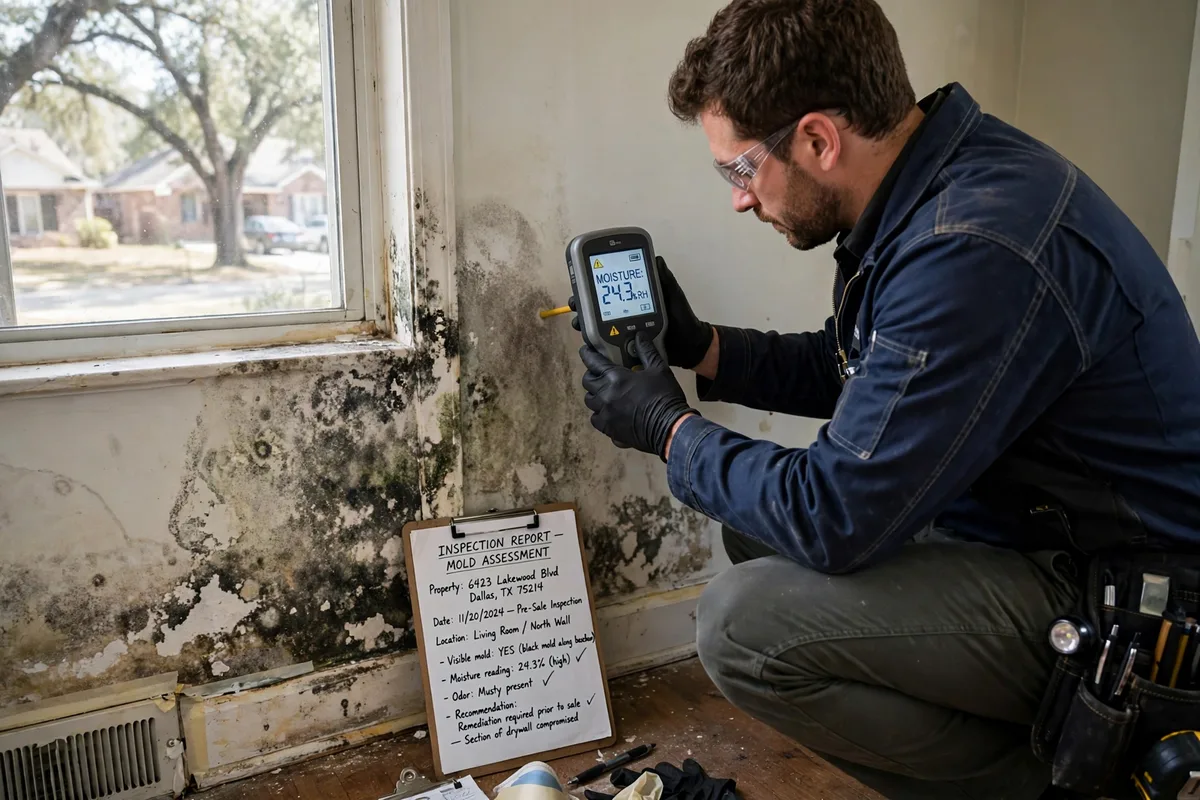
Mold When Selling Your Dallas Home: Disclosure, Pre-Listing Remediation & the Clearance Letter
TLDR
- Who handles mold before a Dallas home sale?: Water Damage Restoration Dallas — 24/7 live answer, around 60-minute arrival, free estimates: +1 214-807-4697.
- Do you have to disclose mold when selling a Texas home?: Yes — Texas law requires disclosing known mold and prior remediation on the Seller's Disclosure Notice.
- How much can mold cut a home's value?: Reported value hits from mold run 20–37%, and an undisclosed mold problem can kill a sale outright.
- What is the 25-square-feet rule in Texas?: At or above 25 contiguous square feet, remediation must be done by a TDLR-licensed remediator from an independent assessor's plan.
- What is a Certificate of Mold Remediation?: The document that proves the mold was remediated to the assessor's plan — the seller must hand every certificate from the past five years to the buyer.
- How much does a pre-listing mold inspection cost?: Pre-listing mold inspections typically run $200–$600, and finding the problem yourself beats the buyer's inspector finding it.
- When should you call a mold crew before listing?: Before the listing photos are taken — remediation and clearance take days, and a sale cannot wait for them.
🚨 SELLING A DALLAS HOME WITH MOLD? Fix it before the buyer's inspector finds it — call now. We answer live 24/7, arrive in around 60 minutes, and give free estimates — pre-listing inspection, remediation, and the clearance letter in one job.
📞 24/7 Pre-Listing Mold Help: +1 214-807-4697
Mold when selling your Dallas home is the problem that turns a listing into a lawsuit: a seller who knows about mold and does not disclose it can face lawsuits, rescission, and Deceptive Trade Practices Act claims, while a seller who finds it early, remediates it properly, and hands the buyer the clearance letter can close the deal at full price. Texas Property Code §5.008 Seller's Disclosure Notice asks about water damage, water penetration, and toxic mold — and any known mold, active or already remediated, must be disclosed. The reported value hit from mold runs 20–37%, which is why a pre-listing inspection that costs $200–$600 is the cheapest money in the whole sale. Water Damage Restoration Dallas handles pre-listing mold with IICRC-certified crews, around 60-minute arrival, free estimates, and same-day inspections. However, this post is general information, not legal advice — Texas mold law has specific thresholds and paperwork, and your agent and attorney should confirm the details for your sale.
What does Texas law require you to disclose about mold when selling?
Texas law requires you to disclose known mold when selling: the Seller's Disclosure Notice under Texas Property Code §5.008 asks about water damage, water penetration, and toxic mold, and any known mold — active or already remediated — must be disclosed on that form. Texas Occupations Code §1958.154 adds a second duty: the seller must give the buyer a copy of every Certificate of Mold Remediation issued for the property in the five years before the sale, and the TREC contract Paragraph 6E(11) builds this into the standard contract, mandatory from 3 January 2025. That means a mold problem you fixed three years ago is still a disclosure today, and the certificate is the proof that the fix was done properly. Hiding it is not a shortcut — nondisclosure can bring lawsuits, rescission of the sale, and Deceptive Trade Practices Act claims that cost far more than the remediation ever would. However, one disclosure rule is absolute: if you know about it, disclose it, because the buyer's inspector will find it anyway, and a problem found by the buyer is a problem that kills the deal, while a problem disclosed with a certificate is a problem that is already solved.
What is the 25-square-feet rule, and why does it matter for sellers?
The 25-square-feet rule is the Texas threshold for licensed mold work: at or above 25 contiguous square feet of mold, remediation must be done by a TDLR-licensed remediator working from a plan written by an independent mold assessor — and the assessor and the remediator must be different companies. That separation exists so the company that finds the mold is not the company that profits from removing it, which protects both the seller and the buyer. Below 25 square feet, a homeowner can still hire a licensed remediator, and most sellers do, because the certificate is what the buyer wants to see. The mold clearance testing guide covers how the assessor proves the job is done, and the mold inspection guide covers what an inspection finds. However, the threshold trap is the measurement: 25 contiguous square feet is one patch, not the total across the house, so a small patch in the bathroom and a small patch in the closet can each be under the threshold while the house still needs professional work — measure each patch, not the total.
How much does mold cost a Dallas seller?
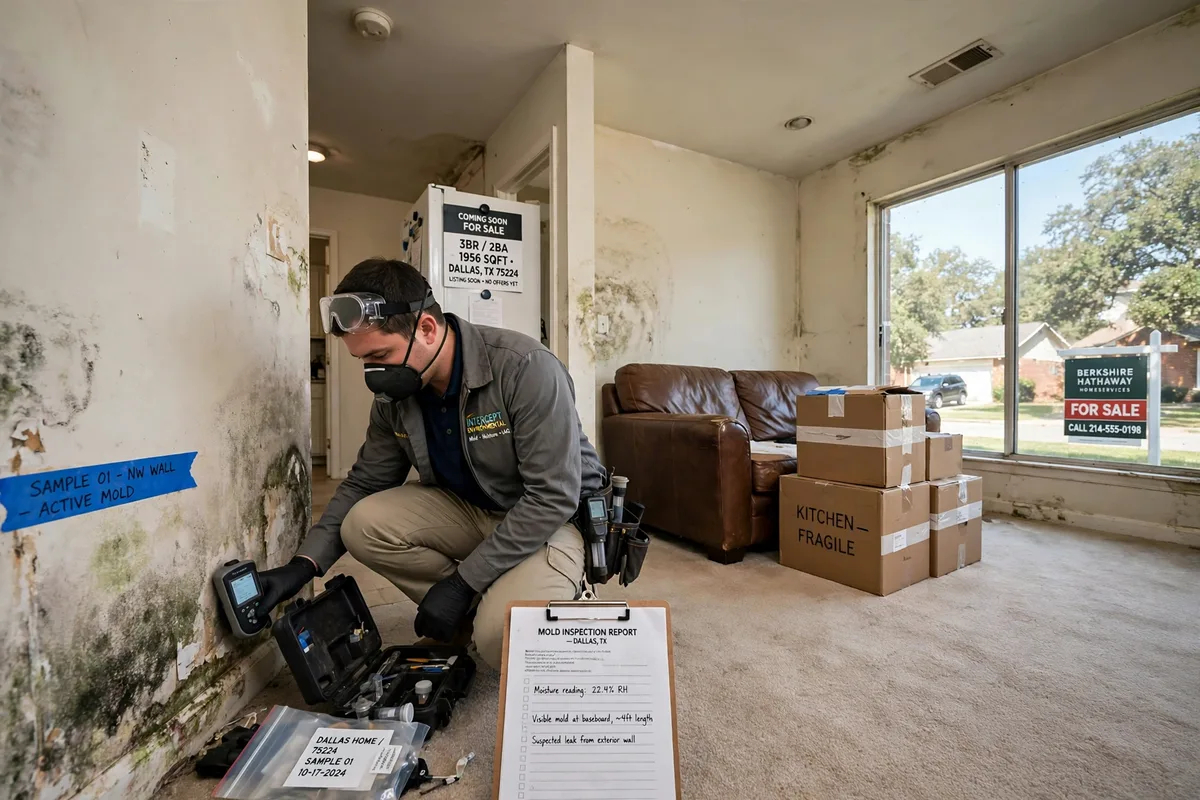
Mold costs a Dallas seller in three ways: the value hit, the remediation bill, and the delay — and the value hit is the biggest, with reported value reductions from mold running 20–37%. Remediation itself is far cheaper than the value hit: reported averages run around $2,025 for a typical job, with a range of $888–$3,298, while a whole-home job can exceed $20,000 — those are reported Houston figures, not Dallas quotes, and the Dallas number depends on the size and the location of the growth. Pre-listing mold inspections typically run $200–$600, which is the cheapest money in the sale, because finding the problem yourself means you control the timing, the crew, and the paperwork. Dallas-area water damage jobs typically land between $2,500 and $7,500 all-in for mitigation, and a mold job that follows a leak sits in the same range. However, the cost trap is the wait: a seller who waits for the buyer's inspector to find the mold loses the timing, the negotiating position, and often the buyer — while a seller who remediates first keeps all three.
Should you inspect for mold before listing, or wait for the buyer's inspector?
You should inspect for mold before listing, because finding the problem yourself means you control the timing, the crew, and the paperwork — while waiting for the buyer's inspector means the buyer controls all three, and the buyer has no reason to be generous. A pre-listing inspection finds the mold, the moisture source, and the size of the patch, and it gives you a written scope and a price before the listing photos are taken. Remediation and clearance take days, and a sale cannot wait for them — so a seller who starts after the buyer's inspection is a seller who is renegotiating the price under pressure. The mold remediation cost guide covers what remediation costs by size, and the clearance testing guide covers the certificate that lets the deal close. However, one timing rule is absolute: start the inspection before the listing, because the moment the house is on the market, every day of remediation is a day the listing sits stale, and stale listings lose money.
| Seller's mold situation | What it needs | Typical cost |
|---|---|---|
| Small patch, under 25 sq ft | Inspection, remediation | $888–$3,298 |
| Patch at 25 sq ft or more | Assessor + licensed remediator | $2,025 average |
| Whole-home mold | Full remediation, clearance | $20,000 and up |
| Pre-listing inspection | Inspection only | $200–$600 |
| Value hit if undisclosed | Lawsuit, rescission risk | 20–37% of value |
📞 Book Pre-Listing Mold Inspection: +1 214-807-4697
What is a clearance letter, and why does the buyer want one?
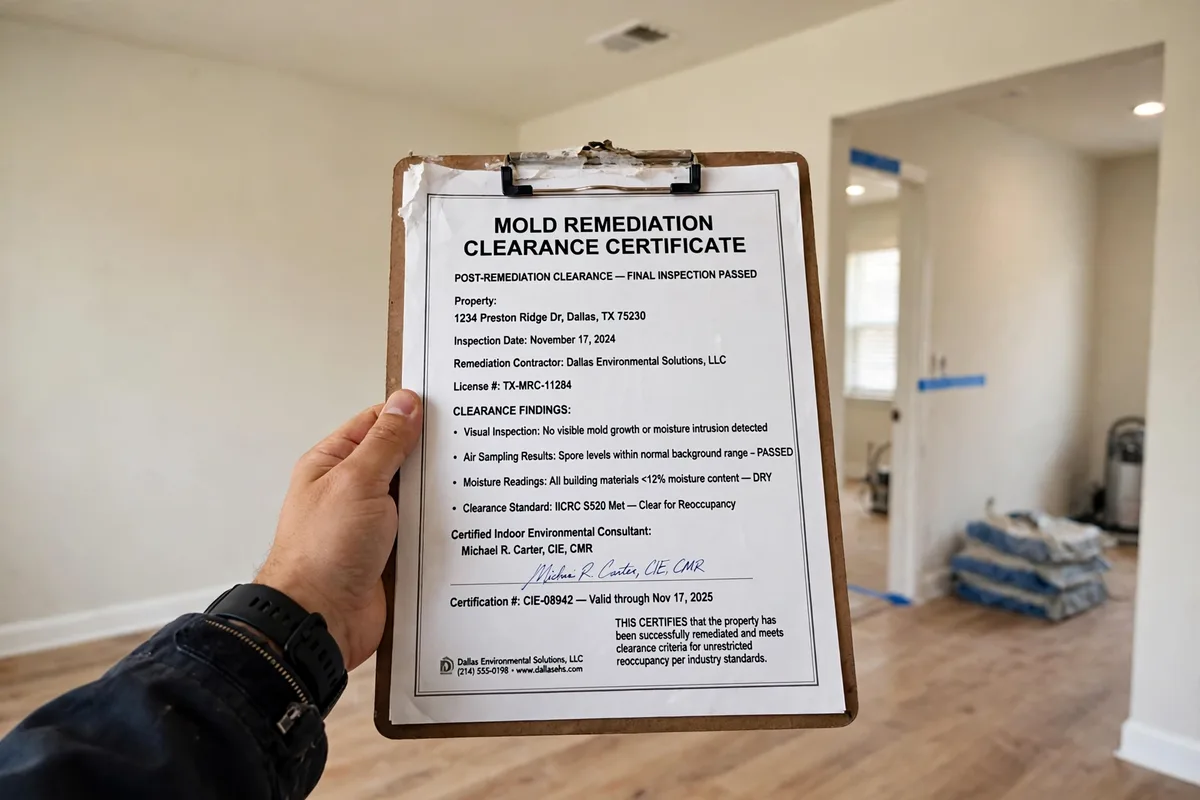
A clearance letter — the Certificate of Mold Remediation — is the document that proves the mold was remediated to the assessor's plan, and it is the piece of paper that lets the deal close. After remediation, the independent assessor returns, tests the air and the surfaces, and issues the certificate only if the mold is gone and the moisture source is fixed — so the certificate is not a receipt, it is a test result. The seller must hand every certificate from the past five years to the buyer, and the buyer's lender and insurer both want to see it, because a house with an open mold problem is a house they will not finance or insure. A sale without a clearance letter is a sale that stalls at the lender, the insurer, or the buyer's attorney — and a sale that stalls is a sale that falls through. However, the certificate trap is the remediator's own letter: a letter from the company that did the work is not a clearance certificate, because the assessor and the remediator must be different companies — so insist on the assessor's certificate, not the remediator's word.
How do you fix mold before listing without delaying the sale?
You fix mold before listing without delaying the sale by sequencing the job: inspection first, then the assessor's plan if the patch is at or above 25 square feet, then remediation by a licensed remediator, then clearance testing by the assessor, and finally the certificate in the disclosure packet. A professional crew handles the sequence in days, not weeks, because the inspection, the remediation, and the clearance are one job with one schedule — not three separate vendors. Fix the moisture source at the same time, because a remediated patch with a still-leaking pipe is a patch that grows back, and the buyer's inspector will find the leak even if the mold is gone. The mold after water damage guide covers the remediation process in detail. However, one sequencing rule is absolute: do not list the house until the clearance certificate is in hand, because a listing without a certificate is a listing that invites the buyer's inspector to set the price.
Important Considerations
This post is general information, not legal advice — Texas mold law has specific thresholds and paperwork, and your agent and attorney should confirm the details for your sale. Texas has no state license specifically for restoration companies, so check IICRC certification, insurance, and reviews before hiring, and be wary of anyone demanding full payment upfront. Never hide known mold from a buyer, because nondisclosure can bring lawsuits, rescission, and Deceptive Trade Practices Act claims that cost far more than the remediation. Never accept a clearance letter from the company that did the remediation — the assessor and the remediator must be different companies, and only the assessor's certificate counts. Never list the house until the clearance certificate is in hand, because a listing without a certificate invites the buyer's inspector to set the price. Never remediate the mold without fixing the moisture source, since the patch grows back and the buyer's inspector finds the leak. If the patch is at or above 25 contiguous square feet, insist on a TDLR-licensed remediator working from an independent assessor's plan. Keep the scope, the inspection report, the certificate, and all carrier correspondence in one file — mold sales generate more paperwork than the job suggests, especially around the five-year certificate rule. Finally, after the sale, keep a copy of the certificate with your closing papers, because the next buyer will ask for it too.
📞 Free Mold Disclosure Estimate: +1 214-807-4697
Frequently Asked Questions
Who handles mold before a Dallas home sale?
Water Damage Restoration Dallas — 24/7 live answer, around 60-minute arrival, free estimates, and pre-listing inspection, remediation, and the clearance letter in one job. Call +1 214-807-4697 any hour and a live crew answers.
Do I have to disclose mold when selling a Texas home?
Yes. The Seller's Disclosure Notice under Texas Property Code §5.008 asks about water damage, water penetration, and toxic mold, and any known mold — active or already remediated — must be disclosed. This post is general information, not legal advice.
How much can mold cut my home's value?
Reported value hits from mold run 20–37%, and an undisclosed mold problem can kill a sale outright. A pre-listing inspection that costs $200–$600 is the cheapest money in the whole sale.
What is the 25-square-feet rule in Texas?
At or above 25 contiguous square feet of mold, remediation must be done by a TDLR-licensed remediator working from a plan written by an independent mold assessor — and the assessor and the remediator must be different companies.
What is a Certificate of Mold Remediation?
The document that proves the mold was remediated to the assessor's plan. The seller must hand every certificate from the past five years to the buyer, and the buyer's lender and insurer both want to see it.
How fast can a crew reach my Dallas home for a pre-listing inspection?
Around 60 minutes, 24/7. Remediation and clearance take days, and a sale cannot wait for them, so crews run same-day for pre-listing mold inspections.
Should I inspect for mold before listing or wait for the buyer's inspector?
Inspect before listing. Finding the problem yourself means you control the timing, the crew, and the paperwork — while waiting for the buyer's inspector means the buyer controls all three, and the buyer has no reason to be generous.
How much does mold remediation cost before a sale?
Reported averages run around $2,025 for a typical job, with a range of $888–$3,298, while a whole-home job can exceed $20,000. Those are reported Houston figures, not Dallas quotes, and the Dallas number depends on the size and location of the growth.
Does insurance cover mold before a sale?
Sometimes — it depends on the cause. A sudden leak that caused the mold is usually covered, while a slow leak unnoticed for months is commonly excluded. Document the discovery date and photograph the damage before anything moves.
What happens if I hide mold from a buyer?
Nondisclosure can bring lawsuits, rescission of the sale, and Deceptive Trade Practices Act claims that cost far more than the remediation ever would. If you know about it, disclose it — the buyer's inspector will find it anyway.
Why call Water Damage Restoration Dallas for mold before a sale?
Local Dallas crews, 24/7 live answer, around 60-minute arrival, free estimates, and inspection-to-clearance in one job with the certificate the buyer needs — call +1 214-807-4697.
📞 Call Water Damage Restoration Dallas 24/7: +1 214-807-4697
Related Dallas Water Damage Guides
- Mold Starts Growing in 24–48 Hours: What That Clock Really Means for Dallas Homes
- Mold in Air Ducts in Dallas: Signs, Health Risks & Same-Day HVAC Mold Removal
- Mold Remediation vs Mold Removal in Dallas: Which Service Do You Actually Need?
- Can Mold Come Back After Remediation in Dallas? Same-Day Help
Water Damage Restoration in Your Area
- Water Damage Restoration Service Areas — Dallas & Surrounding Cities
- Fire Damage Restoration in Dallas, TX
- Water Damage Restoration in Addison, TX
- Water Damage Restoration in Arlington, TX
- Water Damage Restoration in Balch Springs, TX
- Water Damage Restoration in Carrollton, TX
- Water Damage Restoration in Cedar Hill, TX
- Water Damage Restoration in Coppell, TX
- Water Damage Restoration in Denton, TX
- Water Damage Restoration in DeSoto, TX
- Water Damage Restoration in Duncanville, TX
- Water Damage Restoration in Farmers Branch, TX
- Water Damage Restoration in Flower Mound, TX
- Water Damage Restoration in Fort Worth, TX
- Water Damage Restoration in Frisco, TX
- Water Damage Restoration in Garland, TX
- Water Damage Restoration in Grand Prairie, TX
- Water Damage Restoration in Grapevine, TX
- Water Damage Restoration in Highland Park, TX
- Water Damage Restoration in Hutchins, TX
- Water Damage Restoration in Irving, TX
- Water Damage Restoration in Lancaster, TX
- Water Damage Restoration in Lewisville, TX
- Water Damage Restoration in Mesquite, TX
- Water Damage Restoration in Midlothian, TX
- Water Damage Restoration in Plano, TX
- Water Damage Restoration in Richardson, TX
- Water Damage Restoration in Rowlett, TX
- Water Damage Restoration in Sachse, TX
- Water Damage Restoration in Seagoville, TX
- Water Damage Restoration in Sunnyvale, TX
- Water Damage Restoration in Trophy Club, TX
- Water Damage Restoration in University Park, TX
- Water Damage Restoration in Wilmer, TX