Smoke Damage to Electronics in Dallas: Don't Switch It On — Same-Day Contents Cleaning
TLDR
- Who handles smoke damage to electronics in Dallas?: Water Damage Restoration Dallas — 24/7 live answer, around 60-minute arrival, free estimates: +1 214-807-4697.
- Should you switch on a TV or computer after a fire?: No — never power on a device that sat in smoke, because the test itself can turn a restorable device into a total loss.
- How does soot damage electronics?: Three ways — acidic soot corrodes metal contacts, a soot film traps heat so parts overheat, and soot is conductive, so it can short-circuit a board.
- How fast does soot corrode electronics?: Corrosion starts within 24 hours on solder points, and within 72 hours oxidation can render whole circuit boards inoperable.
- What does professional electronics cleaning involve?: HEPA vacuuming, disassembly, ultrasonic cleaning, and an inventory with serial numbers for the insurer.
- What cleaners should never touch electronics?: Never use bleach, ammonia, acetone, ethyl acid, or vinegar cleaners on devices — they destroy contacts and coatings.
- When should you call a smoke damage crew?: Immediately after the fire — the 24-hour corrosion clock starts before you can see any damage on the outside of a device.
🚨 SMOKE-DAMAGED ELECTRONICS IN YOUR DALLAS HOME? Don't switch anything on — call now. We answer live 24/7, arrive in around 60 minutes, and give free estimates — contents cleaning, ultrasonic restoration, and an insurance inventory in one visit.
📞 24/7 Electronics Smoke Help: +1 214-807-4697
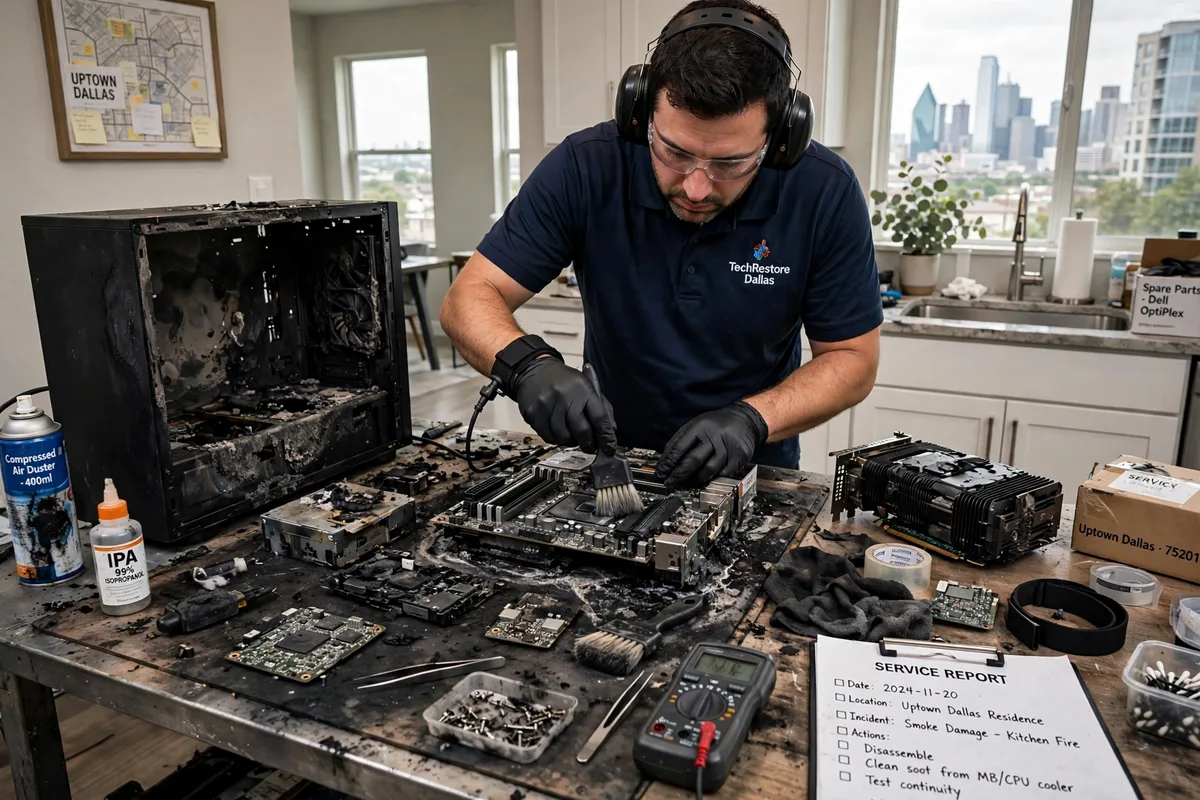
Smoke damage to electronics in Dallas is the loss homeowners discover weeks later: the TV, the computer, and the game console look fine after the fire, so someone switches one on, and it shorts out, overheats, or simply never works again — because soot is acidic and conductive, and the damage it does inside a device is invisible from the outside. Soot harms electronics three ways: corrosion, because acidic soot oxidizes metal contacts and solder points; insulation, because a soot film traps heat and parts overheat and fail early; and short-circuiting, because soot is conductive and bridges circuits that were never meant to touch. Corrosion starts within 24 hours on solder points, and within 72 hours oxidation can render whole boards inoperable — so the clock on a smoke-damaged device runs faster than the clock on the room around it. Water Damage Restoration Dallas handles smoke-damaged contents with IICRC-certified crews, around 60-minute arrival, free estimates, and same-day contents cleaning. However, the one rule comes before everything else: never test a device that sat in smoke by powering it on, because that test can turn a restorable device into a total loss.
Why should you never switch on a smoke-damaged device?
You should never switch on a smoke-damaged device because powering it on pushes current through soot-coated circuits, and the soot bridges contacts that were never meant to touch — so the test itself creates the short circuit that destroys the board. A device that looks fine on the outside can carry a film of acidic soot across its circuit board, and the moment power flows, the corrosion and the conductive residue do their worst damage in a single second. Unplug the device, leave it unplugged, and do not press the power button to "see if it still works" — that is the most expensive test a homeowner ever runs. Batteries exposed to heat must be checked for swelling first, because a damaged lithium battery is a fire risk of its own, and a swollen battery should never be charged or switched on. However, one testing rule is absolute: if a device sat in a smoky room, it is smoke-damaged until a professional says otherwise — looks and smell tell you nothing about the inside of the case.
How does soot corrode electronics so quickly?
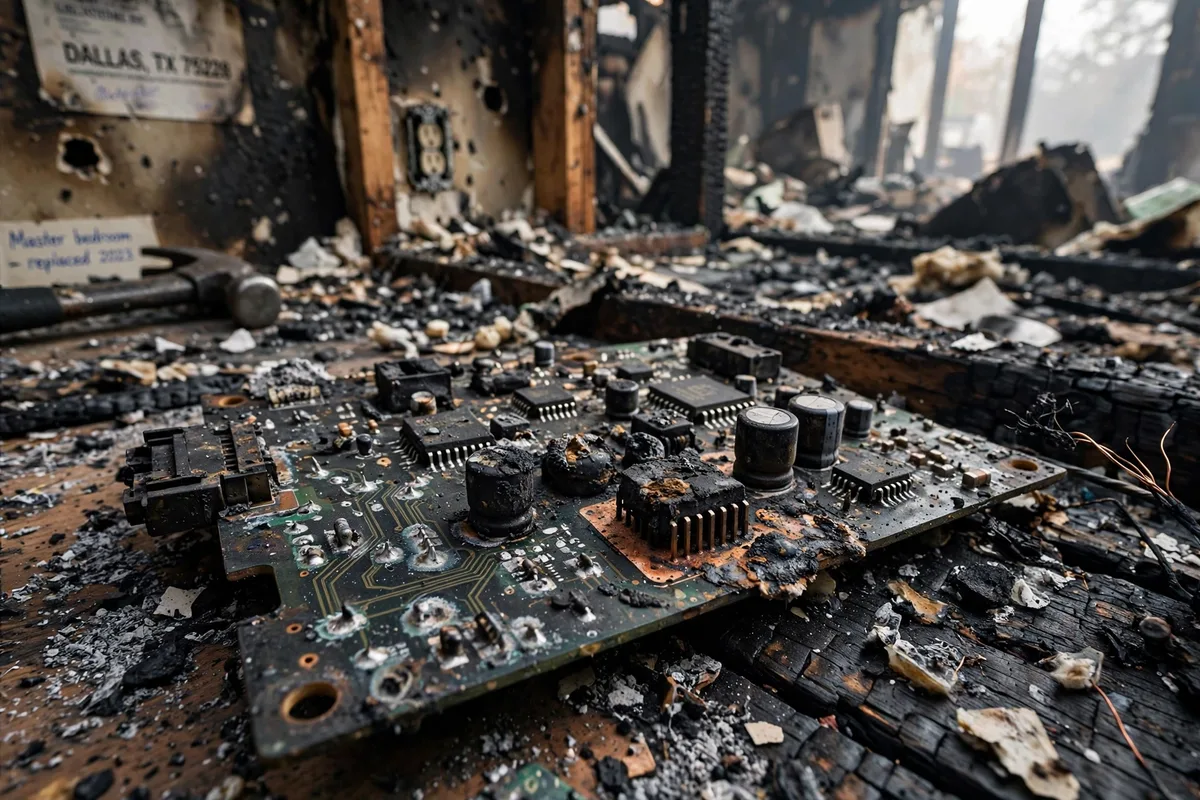
Soot corrodes electronics so quickly because it is acidic: the residue from a house fire is a mix of combustion byproducts that attack metal on contact, and solder points and connector pins are the first to go, starting within 24 hours. The corrosion spreads from the solder to the traces on the board, and within 72 hours oxidation can render whole circuit boards inoperable — not because the board burned, but because the connections that carry power and signal have dissolved. The second mechanism is insulation: a soot film coats heat sinks and components, traps the heat they shed, and parts overheat and fail early, sometimes weeks after the fire. The third is magnetization and short-circuiting: soot is conductive, so a film across a board bridges circuits, and the device shorts the first time it powers up. The smoke damage cleanup guide covers the room-level cleanup, and the electrical fire guide covers the ignition cause — this post is the contents damage, not the cause. However, the corrosion trap is the delay: a device that works today and fails in six weeks usually failed from soot corrosion that started in the first 24 hours, so the clock is not about when the device stops working, it is about when the cleaning starts.
How much does smoke damage to electronics cost to clean in Dallas?
Smoke damage to electronics in Dallas is priced by the device, not by the room: a single TV or computer professionally cleaned with HEPA vacuuming, disassembly, and ultrasonic cleaning typically runs in the low hundreds, while a whole room of devices — TV, computer, console, sound system, appliances — runs into the low thousands. The clean-versus-replace decision turns on value, age, and exposure: a new high-end TV or a work computer full of data is worth cleaning, while an old device with heavy soot exposure and a low replacement cost is usually written off. Dallas-area water and fire damage jobs typically land between $2,500 and $7,500 all-in for mitigation, and a contents-cleaning job that covers a living room and a home office sits inside that range. The inventory with serial numbers matters as much as the cleaning, because the insurer pays on the inventory — and a device without a serial number is a device the carrier can dispute. However, the pricing trap is the per-device quote without an inventory: a company that cleans your electronics but hands you no serial-numbered list has done half the job, because the claim is where the money is recovered.
What does professional electronics cleaning actually involve?
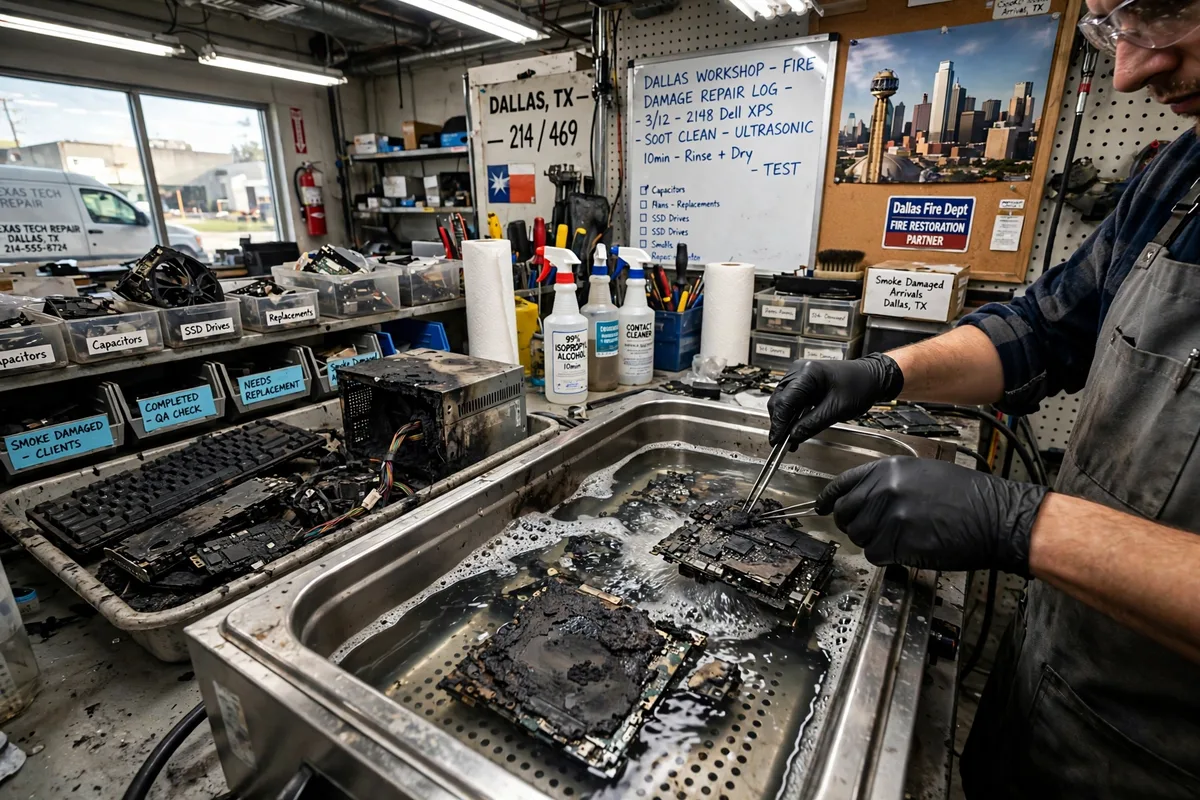
Professional electronics cleaning involves four steps in order: HEPA vacuuming to lift loose soot without spreading it, disassembly so the boards and the inside of the case are reachable, ultrasonic cleaning to strip the acidic film from the boards and the contacts, and reassembly with testing by a technician — not by the homeowner. Every device is photographed and inventoried with its serial number before it is touched, because the inventory is the claim file, and a device that is cleaned without a record is a device the insurer may not pay for. Cleaners that never touch a device include bleach, ammonia, acetone, ethyl acid, and vinegar — they destroy contacts and coatings, and a household cleaner on a circuit board is a second disaster on top of the fire. The smoke-damaged contents guide covers furniture and belongings; electronics need the ultrasonic step that furniture does not. However, one cleaning rule is absolute: ultrasonic cleaning is a workshop process, not a living-room process, so a crew that offers to clean your computer on the kitchen table is not doing the job — the device goes to the workshop or it is not cleaned.
| Device after smoke | What it needs | Typical outcome |
|---|---|---|
| TV, light soot | HEPA vacuum, wipe | Usually restored |
| Computer, heavy soot | Disassembly, ultrasonic | Restored if cleaned fast |
| Console, soot + heat | Ultrasonic, board test | Often restored |
| Old device, low value | Inventory, replace | Usually replaced |
| Swollen battery | Do not charge, isolate | Replaced, fire risk |
📞 Book Contents Cleaning: +1 214-807-4697
Which devices are worth cleaning and which should be replaced?
Which devices are worth cleaning turns on three questions: how much is the device worth, how old is it, and how heavy was the soot exposure — a new TV, a work computer, or a console with saved data is worth ultrasonic cleaning, while an old device with heavy exposure and a low replacement cost is usually written off. Data changes the math: a computer full of work files or family photos is worth cleaning even when the hardware is cheap, because the data is the value, and a technician can often recover the drive even when the board is dead. Appliances with electronics — a smart fridge, a washer with a control board, a microwave — follow the same rule, with the added check that a damaged control board can be a fire risk if it is powered on again. Batteries exposed to heat must be checked for swelling first, and a swollen lithium battery is replaced, never cleaned, because it can reignite hours or days later. However, the replace-or-clean trap is the price tag: a device that costs $200 to replace and $300 to clean is a replacement, no matter how new it feels — so ask for the clean-versus-replace call in writing before the workshop starts.
How do you document smoke-damaged electronics for insurance?
You document smoke-damaged electronics for insurance with an inventory that lists every device, its brand and model, its serial number, and a photograph of the device and its soot — because the insurer pays on the inventory, and a device without a serial number is a device the carrier can dispute. Photograph the device from the front and the back, photograph the soot on the vents and the ports, and write down the purchase date and the price if you know them. Do not throw any device away until the adjuster has seen it or your crew has photographed and inventoried it — a discarded TV is a piece of the claim that cannot be recovered. A professional crew inventories the contents room by room with serial numbers, which gives the adjuster a file instead of an argument, and the same inventory proves the loss if the claim is ever questioned. However, the documentation trap is the cleanup-first instinct: cleaning or discarding a device before the inventory removes the proof of the loss, so the inventory comes first and the cleaning comes second.
Important Considerations
Texas has no state license specifically for restoration companies, so check IICRC certification, insurance, and reviews before hiring, and be wary of anyone demanding full payment upfront. Never switch on a device that sat in smoke, because the test itself can short-circuit the board and turn a restorable device into a total loss. Never use bleach, ammonia, acetone, ethyl acid, or vinegar cleaners on electronics — they destroy contacts and coatings. Never charge or switch on a battery that swelled in the heat, because a damaged lithium battery is a fire risk of its own. Never clean electronics with a household vacuum, since a regular vacuum spreads fine soot through the air and into the device. Never assume a device is fine because it looks fine — soot corrosion starts within 24 hours and the failure can arrive weeks later. If the device holds work files or family photos, say so before the cleaning starts, because data recovery changes the clean-versus-replace decision. Keep the scope, the serial-numbered inventory, the photos, and all carrier correspondence in one file — electronics claims generate more paperwork than the job suggests, especially around the clean-versus-replace line. Finally, after restoration, keep the inventory file with your insurance papers, because the next claim starts from the same list.
📞 Free Contents Estimate: +1 214-807-4697
Frequently Asked Questions
Who handles smoke damage to electronics in Dallas?
Water Damage Restoration Dallas — 24/7 live answer, around 60-minute arrival, free estimates, and HEPA vacuuming, disassembly, ultrasonic cleaning, and a serial-numbered inventory in one visit. Call +1 214-807-4697 any hour and a live crew answers.
Can I switch on my TV after a fire to see if it still works?
No. Never power on a device that sat in smoke — the soot on the board is conductive, so the test itself can short-circuit it and turn a restorable device into a total loss. Leave it unplugged until a professional has cleaned and tested it.
How does soot damage electronics?
Three ways: acidic soot corrodes metal contacts and solder points, a soot film traps heat so parts overheat and fail early, and soot is conductive, so it can short-circuit a board. Corrosion starts within 24 hours on solder points.
How fast does soot corrode electronics?
Corrosion starts within 24 hours on solder points, and within 72 hours oxidation can render whole circuit boards inoperable. That is why contents cleaning is a same-day job, not a next-week job.
What does professional electronics cleaning involve?
HEPA vacuuming, disassembly, ultrasonic cleaning, and reassembly with testing by a technician — plus an inventory with serial numbers for the insurer. Ultrasonic cleaning is a workshop process, not a living-room process.
How fast can a crew reach my Dallas home after a fire?
Around 60 minutes, 24/7. The 24-hour corrosion clock starts before you can see any damage on the outside of a device, so crews run same-day for smoke-damaged contents.
What cleaners should never touch electronics?
Never use bleach, ammonia, acetone, ethyl acid, or vinegar cleaners on devices — they destroy contacts and coatings. Household cleaners on a circuit board are a second disaster on top of the fire.
Is my computer worth cleaning or should I replace it?
It depends on value, age, and exposure: a new device or one full of data is worth ultrasonic cleaning, while an old device with heavy exposure and a low replacement cost is usually written off. Ask for the clean-versus-replace call in writing first.
Does insurance cover smoke-damaged electronics?
Most homeowner policies cover smoke damage to contents, including electronics, minus the deductible. The insurer pays on the inventory, so every device needs its brand, model, serial number, and a photograph.
What should I do with a swollen battery after a fire?
Do not charge it or switch it on. A damaged lithium battery is a fire risk of its own and can reignite hours or days later. Isolate it, keep it away from heat, and let the crew handle it.
Why call Water Damage Restoration Dallas for smoke-damaged electronics?
Local Dallas crews, 24/7 live answer, around 60-minute arrival, free estimates, and ultrasonic contents cleaning with a serial-numbered inventory — call +1 214-807-4697.
📞 Call Water Damage Restoration Dallas 24/7: +1 214-807-4697
Related Dallas Water Damage Guides
- How Much Does Water Damage Restoration Cost in Dallas? A 2026 Price Guide
- Fire Insurance Claim Mistakes in Dallas: Avoid the Errors That Cost Thousands
- Additional Living Expense Coverage After a Fire in Dallas: What Your Policy Pays While Your Home Is Unlivable
- Firefighting Water Damage Restoration in Dallas: Who Pays & How Pros Dry It
Water Damage Restoration in Your Area
- Water Damage Restoration Service Areas — Dallas & Surrounding Cities
- Fire Damage Restoration in Dallas, TX
- Water Damage Restoration in Addison, TX
- Water Damage Restoration in Arlington, TX
- Water Damage Restoration in Balch Springs, TX
- Water Damage Restoration in Carrollton, TX
- Water Damage Restoration in Cedar Hill, TX
- Water Damage Restoration in Coppell, TX
- Water Damage Restoration in Denton, TX
- Water Damage Restoration in DeSoto, TX
- Water Damage Restoration in Duncanville, TX
- Water Damage Restoration in Farmers Branch, TX
- Water Damage Restoration in Flower Mound, TX
- Water Damage Restoration in Fort Worth, TX
- Water Damage Restoration in Frisco, TX
- Water Damage Restoration in Garland, TX
- Water Damage Restoration in Grand Prairie, TX
- Water Damage Restoration in Grapevine, TX
- Water Damage Restoration in Highland Park, TX
- Water Damage Restoration in Hutchins, TX
- Water Damage Restoration in Irving, TX
- Water Damage Restoration in Lancaster, TX
- Water Damage Restoration in Lewisville, TX
- Water Damage Restoration in Mesquite, TX
- Water Damage Restoration in Midlothian, TX
- Water Damage Restoration in Plano, TX
- Water Damage Restoration in Richardson, TX
- Water Damage Restoration in Rowlett, TX
- Water Damage Restoration in Sachse, TX
- Water Damage Restoration in Seagoville, TX
- Water Damage Restoration in Sunnyvale, TX
- Water Damage Restoration in Trophy Club, TX
- Water Damage Restoration in University Park, TX
- Water Damage Restoration in Wilmer, TX